

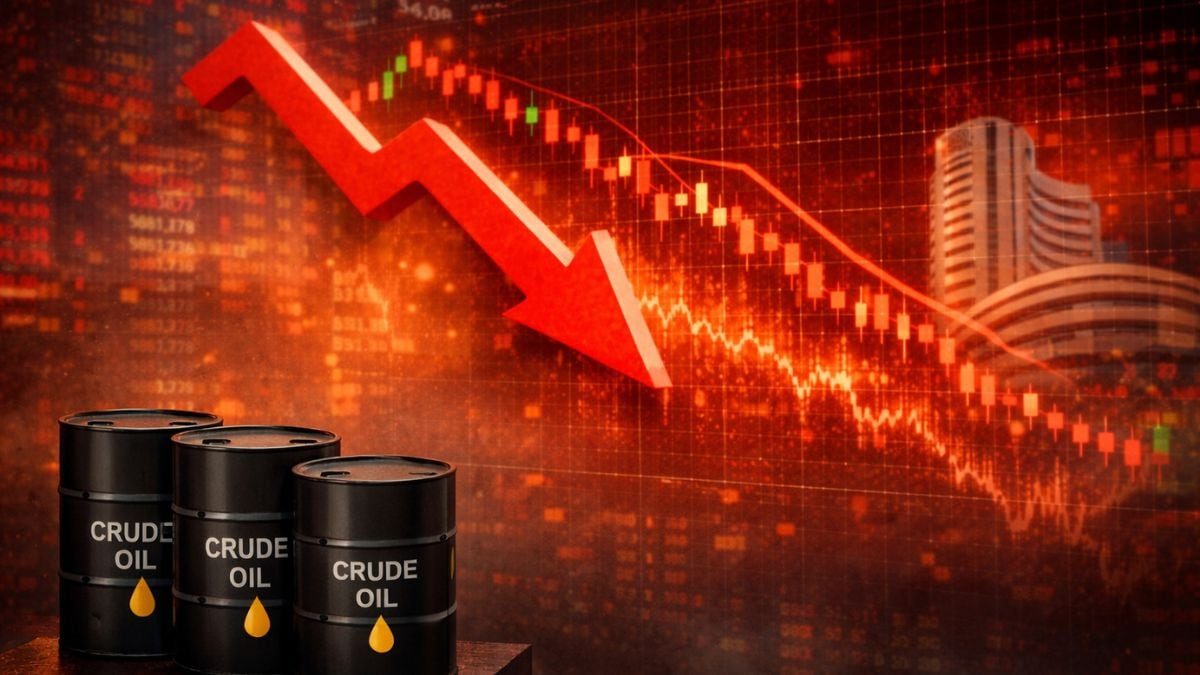
The Nifty 50 is facing a phase of pressure as global developments begin to weigh on investor sentiment. Over the past few weeks, the Indian stock market has witnessed persistent selling activity, largely driven by the spike in crude oil prices and rising geopolitical tensions between the United States and Iran.
Energy prices often act as a powerful trigger for emerging markets like India. Since the country relies heavily on imported oil, any sharp rise in crude prices can quickly translate into inflation worries, economic concerns, and market volatility.
With global crude prices moving closer to $100 per barrel, investors are now closely tracking whether this level holds — because it could significantly influence the near-term direction of the Nifty 50.
Market Performance
The recent market trend reflects growing caution among investors as global risks continue to build.
In the last few trading sessions, the benchmark index has seen steady declines as global uncertainty and energy price volatility triggered selling across sectors.
Recent movement in the benchmark index
- Nifty 50 has declined more than 4% in the past week
- The index has fallen around 8% over the last one month
- Market weakness has been influenced by continuous foreign institutional investor outflows
Such moves highlight how quickly global developments can spill into domestic markets. When international investors turn cautious, emerging markets often experience increased volatility.
 Rising Crude Oil Prices Add Pressure
The sharp movement in global crude oil prices has emerged as the primary trigger behind the recent weakness in equities.
Oil prices in international markets have surged again and are now approaching the $100 per barrel mark. The rise comes after tensions escalated in the Gulf region, disrupting supply routes and raising fears of prolonged supply shortages.
A major factor behind these concerns is the effective closure of the Strait of Hormuz, one of the most critical energy transport corridors in the world.
A large share of global oil shipments passes through this narrow waterway. Any disruption here can immediately tighten global supply and push prices higher.
For an oil-importing economy like India, such developments often create multiple economic pressures:
- Higher energy import costs
- Rising inflation risks
- Pressure on the trade balance
- Weaker sentiment in equity markets
Why Oil Prices Influence the Nifty 50?
The effect of crude oil prices on the stock market changes depending on whether oil is trading at relatively low or high levels.
When crude trades within a moderate range, rising oil prices often reflect stronger global demand. In such situations, equity markets may also perform well because higher demand signals economic growth.
However, the situation changes once crude prices climb beyond the $90–$100 range.
At that point, high oil prices begin to act as a burden rather than a growth signal. For India, this is particularly significant because higher crude prices directly increase the country’s import bill and add pressure to the economy.
As a result, equity markets tend to react negatively when oil prices stay elevated for long periods.
Possible Downside for the Nifty 50
Before the current geopolitical tensions intensified, the Nifty 50 had reached a level of 25,178.
If crude oil continues to remain above $100 per barrel for an extended period, the benchmark index could see a deeper correction.
A decline of roughly 10% from the pre-conflict level could bring the index closer to 22,660.
This makes the 22,700 region a closely watched level for market participants.
Sharp corrections during global crises are not unusual. Markets often adjust quickly when major economic factors such as energy prices change rapidly.
Impact on Market Valuations
Rising crude oil prices can also influence how investors value stocks across the market.
If crude prices stay elevated and global uncertainty persists, some market valuation indicators could shift.
Possible valuation changes include:
- Nifty 50 price-to-earnings ratio moving toward around 18x
- Earnings yield rising to nearly 5.6%
- The spread between bond yields and earnings yield narrowing to about 100 basis points
These changes reflect how markets recalibrate when macroeconomic risks increase.
Market Cap-to-GDP Ratio Could Adjust
Another important indicator that reflects overall market valuation is the market-capitalisation-to-GDP ratio.
During periods of volatility, this ratio tends to adjust as stock prices respond to economic conditions.
If the correction deepens, this metric could move closer to 110%, indicating a shift in overall market valuation relative to the size of the economy.
Mid and Small Caps May See Higher Volatility
Market corrections rarely impact all segments equally.
Historically, large-cap stocks tend to remain relatively stable during global uncertainty. In contrast, mid-cap and small-cap stocks often experience sharper price swings.
This happens because smaller companies are generally more sensitive to:
- Economic slowdowns
- Liquidity conditions
- Changes in investor risk appetite
During uncertain periods, investors often move capital toward larger and more established companies.
Sectoral Impact of Higher Crude Prices
Prolonged rises in crude oil prices can put pressure on multiple sectors throughout the economy.
Sectors that rely heavily on petroleum products or energy inputs usually face the most immediate impact.
Industries that could feel pressure include
- Automobiles
- Aviation
- Oil marketing companies (OMCs)
- City gas distribution companies (CGDs)
- Building materials
- Consumer-focused businesses
- Industrial companies
Apart from these, sectors that are sensitive to broader economic conditions could also see volatility.
These include:
- Financial services
- Real estate
- Discretionary consumption
- Industrial firms with export exposure to Gulf countries
Higher oil prices often raise operating costs for companies, which can eventually influence profitability expectations and stock performance.
A Similar Situation Occurred in 2022
Global markets have faced similar conditions in the past.
In 2022, crude oil prices climbed above $100 per barrel for several months following Russia's invasion of Ukraine.
That surge in energy prices created significant market volatility worldwide.
During that phase, the Nifty 50 declined by roughly 10% as rising oil prices fueled inflation concerns and economic uncertainty.
However, once the situation stabilised, markets gradually recovered and eventually moved into a strong rally in the following year.
Summary
The recent surge in crude oil prices toward $100 per barrel has once again placed global financial markets on edge.
The Nifty 50 has already declined over 4% in the past week and around 8% in the last month, reflecting cautious investor sentiment and continued foreign outflows.
If crude oil stays high for an extended period, the benchmark index may edge toward 22,660, making the 22,700 level a key point for investors to watch.
At the same time, industries that rely heavily on petroleum inputs may face cost pressures, while mid-cap and small-cap stocks could experience greater volatility compared with large-cap companies.
For now, the direction of global crude oil prices and developments surrounding the US-Iran conflict remain the key factors shaping the near-term outlook of the Indian stock market.
Source: Livemint




 Easy & quick
Leave A Comment?