

The US Dollar Index (DXY) has surged sharply in recent weeks, strengthening by nearly 2% since the onset of the US–Iran conflict on February 28. This move has triggered a broad-based decline in global currencies, reinforcing the dollar’s role as the world’s primary safe-haven asset.
Why Is the US Dollar Strengthening?
Global investors are currently operating in a classic risk-off environment, moving capital away from riskier assets and toward the safety of the US dollar. The key drivers behind this surge include:
- Escalating geopolitical tensions between the US and Iran
- Rising uncertainty in global energy markets
- Increased demand for safe-haven assets like the US dollar
In such times, the US dollar typically outperforms not only other currencies but also assets such as gold and US Treasuries.
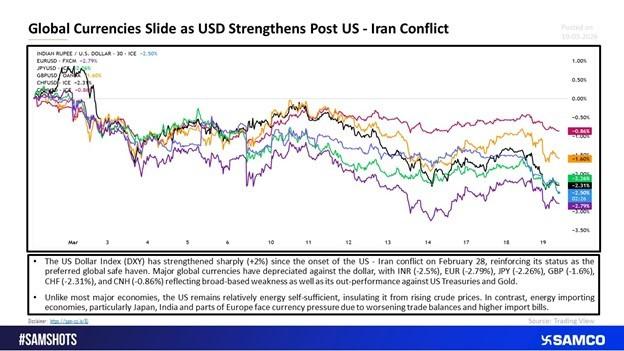
The rally in the US dollar is being driven by a classic risk-off environment, where global investors shift capital toward safer assets.
Key triggers include:
- Escalating geopolitical tensions between the US and Iran
- Rising uncertainty in global energy markets
- Increased demand for safe-haven assets like the US dollar
In such scenarios, the dollar typically outperforms other asset classes, including gold and US Treasuries.
Major Global Currencies Under Pressure
The strengthening dollar has led to a broad depreciation across major currencies:
- Indian Rupee (INR): -2.5%
- Euro (EUR): -2.79%
- Japanese Yen (JPY): -2.26%
- British Pound (GBP): -1.6%
- Swiss Franc (CHF): -2.31%
- Chinese Yuan (CNH): -0.86%
This widespread weakness highlights the global nature of the currency sell-off.
Energy Dynamics: Why the US Has an Advantage?
One of the key reasons behind the dollar’s strength is the relative energy independence of the United States.
- The US is largely self-sufficient in energy
- Rising crude oil prices have limited impact on its trade balance
In contrast, energy-importing economies such as:
- India
- Japan
- European nations
face:
- Higher import bills
- Worsening trade deficits
- Increased currency pressure
Impact of Rising Crude Oil Prices
The ongoing geopolitical tensions have pushed up Crude Oil prices, creating additional stress for importing countries.
This leads to:
- Higher dollar demand for oil imports
- Weakening of local currencies
- Rising inflation and fiscal pressure
Broader Implications of a Strong Dollar
A stronger US dollar has far-reaching consequences for the global economy:
1. Tighter Global Financial Conditions
- Liquidity tightens as capital flows into the US
- Borrowing costs increase globally
2. Pressure on Emerging Markets
- Countries with dollar-denominated debt face repayment challenges
- Capital outflows intensify
3. Impact on Global Trade
- Strong dollar makes exports from other countries less competitive
- Can slow down global economic growth
4. Effect on US Corporates
- A stronger dollar can hurt US export revenues
- Multinational earnings may face pressure
What Lies Ahead?
The direction of global currencies will depend on:
- Evolution of the US–Iran conflict
- Movement in crude oil prices
- Strength of global risk sentiment
If geopolitical tensions persist, the US dollar is likely to remain strong, keeping pressure on global currencies.
Conclusion
The recent rally in the US dollar is a reflection of global uncertainty and shifting capital flows. As geopolitical tensions rise and crude prices remain elevated, energy-importing economies are facing the brunt of currency depreciation.
For investors and policymakers, this environment signals:
- Continued currency volatility
- Tightening global liquidity
- Increased focus on macro stability




 Easy & quick
Leave A Comment?