

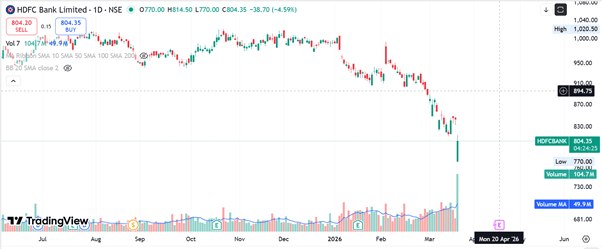
HDFC Bank shares came under sharp selling pressure on 19 March 2026, following a sudden governance-related development that unsettled investor sentiment. The stock plunged nearly 9% intraday to ₹770, marking a fresh 52-week low, before recovering partially to close around ₹798.
This unexpected move has sparked concerns around governance, even as the bank’s core fundamentals remain stable.
What Triggered the Sharp Fall in HDFC Bank Stock?
The key trigger was the abrupt resignation of Atanu Chakraborty, the bank’s Part-time Chairman and Independent Director, effective March 18, 2026.
Chakraborty, a former Secretary in the Department of Economic Affairs, was widely regarded as a strong governance figure and played a crucial role during the bank’s HDFC–HDFC Bank merger phase.
Why the Resignation Raised Red Flags?
The market reaction was amplified by the tone of his resignation letter, which stated:
“Certain happenings and practices within the bank… are not in congruence with my personal values and ethics.”
While the statement lacked specifics, it introduced ambiguity and governance concerns, which investors typically react to very quickly—especially in large, systemically important banks.
Management Clarifies: No Regulatory or Operational Issues
Key takeaways from management:
- No regulatory issues flagged
- No operational disruptions
- No specific concerns were formally communicated
- Business operations remain stable and unaffected
This helped the stock recover from its intraday lows, though sentiment remains cautious.
Technical View: Weak Sentiment in the Near Term
From a technical perspective:
- The stock witnessed a sharp breakdown with high volumes
- Such moves typically indicate strong selling pressure
- The formation suggests near-term weakness and volatility
Unless confidence returns quickly, the stock may continue to face resistance at higher levels.
Fundamental Outlook: Business Remains Strong
Despite the sharp correction, the fundamental story of HDFC Bank remains intact:
- Stable earnings trajectory
- Strong loan growth outlook
- Robust balance sheet
- Leadership continuity at the operational level
However, governance concerns can lead to valuation compression, even if earnings remain unaffected.
Why Governance Matters for Banking Stocks?
In the banking sector, trust and transparency are critical. Any uncertainty related to governance can:
- Impact investor confidence
- Lead to temporary de-rating of valuations
- Increase short-term volatility in stock price
This is why even a vague resignation comment can trigger a disproportionate market reaction.
Investor Takeaway: Short-Term Noise or Bigger Concern?
At this stage:
- The issue appears to be sentiment-driven rather than fundamental
- Management has denied any operational or regulatory risks
- However, the lack of clarity keeps uncertainty alive
Key things to watch:
- Any further disclosures from the bank
- Regulatory commentary (if any)
- Price action and institutional flows
Conclusion
The recent fall in **HDFC Bank stock highlights how sensitive markets are to governance signals. While the bank’s core fundamentals remain strong, the resignation of a key board member and the tone of his exit have introduced short-term uncertainty.
Until clarity emerges, the stock may remain volatile, with investors closely tracking any developments.





 Easy & quick
Leave A Comment?