

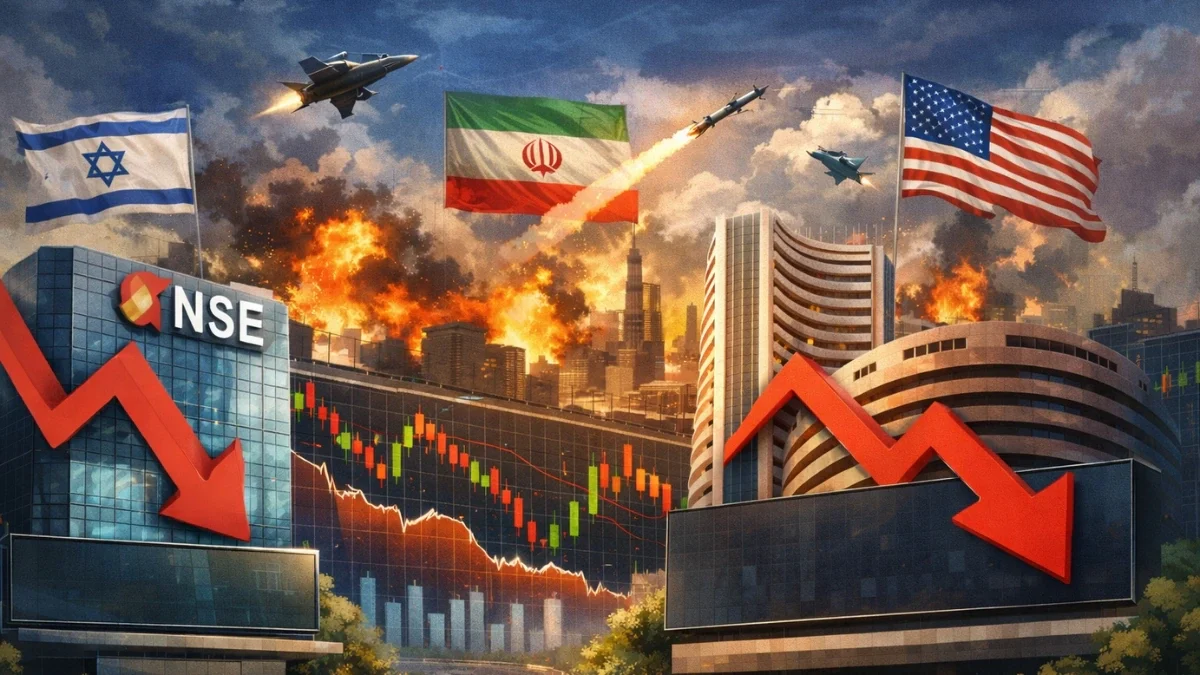
Rising geopolitical tensions have started to reflect clearly in the Indian stock market. Since the beginning of the US-Iran war, the benchmark Nifty 50 index has declined close to 5%, highlighting the nervous mood across global financial markets.
There have been occasional sessions where the market attempted to recover. But the overall trend has remained cautious as investors continue to track developments related to the conflict and its possible impact on global energy supplies.
The pressure was visible again during the latest trading session, where benchmark indices slipped sharply.
Market Performance: Sensex and Nifty Extend Losses
Indian equity markets traded lower during Wednesday’s session as concerns around the US-Iran war continued to influence investor sentiment.
Both benchmark indices recorded declines of more than 1% during the day.
Key Market Numbers
- Sensex dropped over 1,000 points, translating to a fall of roughly 1.3%
- The index touched an intraday low of 77,161
- Nifty 50 slipped 1.20%
- The index hit a day’s low of 23,971.60
Selling pressure was mainly visible in banking, financial services, and automobile stocks, which weighed heavily on the broader indices.
Since these sectors carry significant weight in benchmark indices, their decline pushed the overall market lower during the session.

Previous Session’s Recovery Failed to Hold
The latest fall came soon after a brief recovery in the market.
In the previous trading session, Indian equities had bounced back strongly. That recovery was supported by easing crude oil prices and hopes that geopolitical tensions might cool down.
However, the relief was short-lived. As uncertainty surrounding the US-Iran war persisted, market sentiment turned cautious again.
This shift shows how sensitive markets currently are to global developments.
Crude Oil Prices Remain a Key Market Trigger
Movements in crude oil prices have played a major role in driving market volatility this week.
At the start of the week, oil prices surged sharply and nearly touched $120 per barrel on Monday. Such a spike raised concerns across global financial markets.
Later, prices moved lower.
Recent Oil Price Movement
- Crude oil briefly approached $120 per barrel
- Prices later eased and remained below $90
Even though prices cooled down, the earlier surge created uncertainty among investors worldwide.
Oil price fluctuations often influence market sentiment because they can affect inflation, economic growth, and overall financial stability.
Concerns Over Energy Supply Continue
One of the major worries linked to the US-Iran conflict is the possibility of disruptions in global energy supply.
Markets are concerned that the ongoing war could interfere with the flow of oil and natural gas across international markets.
Such disruptions could affect energy availability and pricing worldwide.
Because of this risk, investors and financial markets are closely monitoring developments related to the conflict.
Global Efforts Help Ease Oil Supply Fears
Some steps taken by global institutions have helped reduce immediate pressure on oil prices.
The G-7 group of nations requested the International Energy Agency (IEA) to prepare contingency plans for a potential release of emergency oil reserves if needed.
This announcement helped calm some of the concerns related to oil supply shortages.
As a result, crude prices retreated from the sharp highs seen earlier in the week.
Geopolitical Events Driving Market Volatility
The recent decline in the Nifty 50 highlights how global events can quickly influence stock market movements.
Geopolitical tensions often create sudden uncertainty in financial markets. Investors tend to react quickly to developments that may affect global trade, energy supply, or economic stability.
During such periods, equity markets across the world can experience sharp fluctuations.
The ongoing US-Iran war has created exactly such an environment, where markets react rapidly to news and updates from the region.
Why Nifty 50 Movement Is Important?
The Nifty 50 serves as one of the primary indicators of the Indian stock market’s health.
The index tracks 50 major companies listed on the National Stock Exchange (NSE) and covers several key sectors of the economy.
Because of this broad representation, movements in the Nifty 50 often reflect the overall sentiment in Indian equities.
The recent 5% decline since the US-Iran war began therefore signals the cautious approach currently adopted by investors.
Markets React Quickly to Global News
Financial markets are highly sensitive to geopolitical developments.
During periods of global conflict, investors often respond quickly to:
- Changes in crude oil prices
- Concerns about energy supply disruptions
- Shifts in global economic outlook
Such factors can lead to rapid changes in market direction.
The current market behaviour reflects these dynamics, as investors continue to track every update related to the conflict.
Volatility Likely to Continue for Now
For the time being, global developments remain the main driver of market sentiment.
Investors are closely watching:
- Updates related to the US-Iran war
- Movements in crude oil prices
- Developments affecting global oil and gas supply
Any significant change in these factors could influence market direction in the coming sessions.
Until then, volatility is likely to remain a key theme across global and domestic markets.
Summary
The Indian stock market has turned cautious as geopolitical tensions intensify.
Since the start of the US-Iran war, the Nifty 50 has fallen nearly 5%, reflecting weak global sentiment. During the latest session, both Sensex and Nifty 50 declined more than 1%, with banking, financial services, and automobile stocks leading the losses.
Crude oil prices have been another major driver of market sentiment. Prices surged close to $120 per barrel earlier in the week before easing and staying below $90.
Meanwhile, concerns about potential disruptions in global oil and gas supplies continue to keep financial markets on edge.
As the situation evolves, global cues are expected to remain a key influence on the direction of the Indian stock market.
Source: Livemint




 Easy & quick
Leave A Comment?