


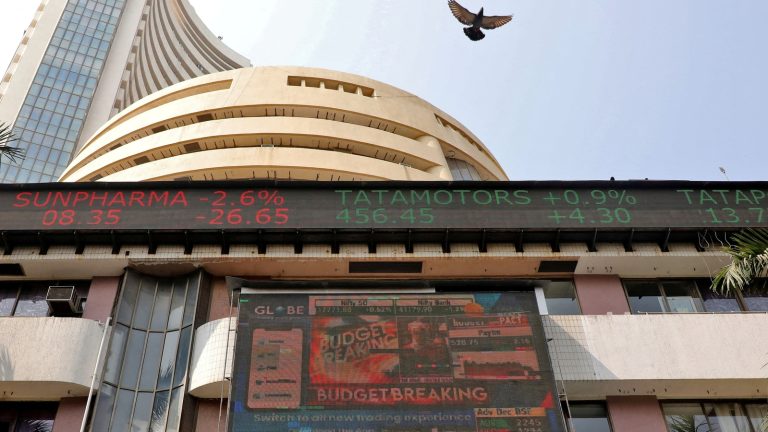
The Indian stock market opened on Tuesday on a weak footing, and the pressure only intensified as the session progressed. Selling was broad-based, sentiment was fragile, and risk appetite stayed low.
Both the Sensex today and the Nifty 50 today slipped sharply in early trade, reflecting rising nervousness around currency weakness, global cues, and sustained foreign investor selling.
Market Performance: Sensex, Nifty 50 Under Pressure
Morning trade saw heavy selling across large-cap, mid-cap, and small-cap stocks.
Key market levels during the session:
- Sensex today: Fell nearly 500 points, hitting an intraday low of 84,716
- Nifty 50 today: Slipped below the 26,000 mark, touching 25,879
- BSE Midcap index: Down over 0.5%
- BSE Smallcap index: Also declined more than 0.5%
The weakness was not limited to benchmarks. Broader markets moved in tandem, signalling a risk-off mood across the Indian stock market.
₹2 Lakh Crore Erodes as Market Capitalisation Shrinks
The early sell-off had an immediate impact on overall market wealth.
- Within the first 30 minutes of trade, investors saw nearly ₹2 lakh crore wiped out
- Total market capitalisation of BSE-listed companies fell to around ₹469 lakh crore by 9:45 am
- This compares with ₹471 lakh crore in the previous session
The sharp erosion underscored how fragile sentiment remains in the current environment.
Indian Stock Market Struggles in December
December has been a challenging month so far for equities.
- Both the Sensex and Nifty 50 are down about 1% in December
- This puts the indices on track to snap a three-month winning streak
Following months of sustained gains, the Indian stock market has entered a consolidation phase amid mounting global and domestic headwinds.
Why Is the Indian Stock Market Falling Today? Key Reasons Explained
The sell-off is being driven by a combination of interconnected triggers rather than a single event.
Rupee Weakness Weighs on Sentiment
The Indian rupee continues to trade near record lows against the US dollar.
- The rupee hovered close to 91 per dollar
- It opened at 90.79, compared to 90.73 in the previous session
- The currency has weakened by nearly 6% so far this year
A weak rupee adds pressure on market confidence, especially during periods of foreign fund outflows.
Weak Global Cues Add to Selling Pressure
Global markets provided little comfort.
- Major Asian indices declined sharply during the session
- Overnight weakness in US markets added to risk aversion
- Investors remained cautious ahead of key global economic data releases
The lack of positive cues from overseas markets kept traders defensive.
Sustained Foreign Investor Selling
Foreign institutional investors have remained consistent sellers.
- FIIs have sold over ₹21,000 crore worth of equities in December so far
- Since July, total equity selling by FIIs has crossed ₹1.70 lakh crore
Persistent outflows continue to cap upside and amplify volatility in the Indian stock market.
Liquidity Tightness in Secondary Markets
Another factor weighing on sentiment is reduced liquidity.
- A strong pipeline of IPOs has absorbed a large share of retail participation
- This has left limited liquidity in the secondary market
- As a result, markets are struggling to build momentum
Lower liquidity often leads to sharper reactions during periods of uncertainty.
Summary: Indian Stock Market Remains Under Pressure
Tuesday’s session highlighted the fragile state of market sentiment.
Key takeaways:
- Sensex dropped nearly 500 points, Nifty 50 slipped below 26,000
- Mid-cap and small-cap stocks also declined
- Nearly ₹2 lakh crore in market value was erased early in the session
- Rupee weakness, foreign outflows, global uncertainty, and liquidity concerns drove the fall
For now, the Indian stock market appears to be moving through a cautious phase, with investors closely watching currency trends, global developments, and fund flow data before taking fresh positions.