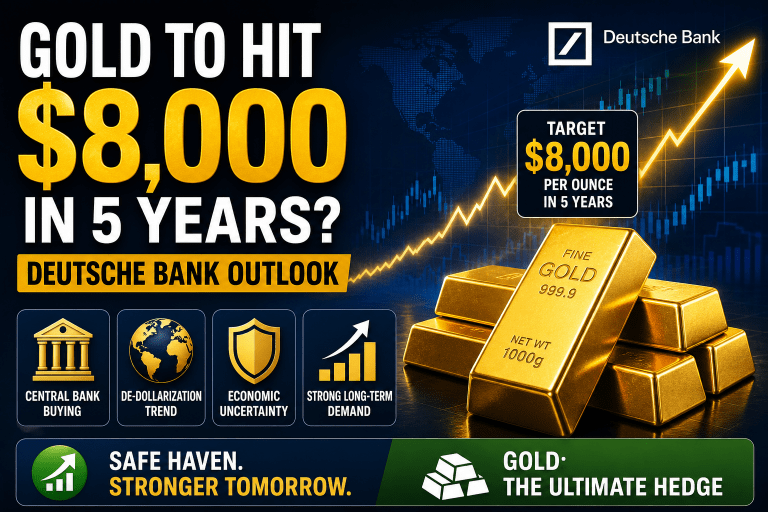
Gold is back in focus—and this time, the bullish case is bigger than ever.
According to Deutsche Bank, gold prices could potentially reach $8,000 per ounce in the next five years—but this isn’t a random prediction. It’s based on structural shifts in the global economy and financial system.
So what’s really driving this outlook—and how should investors think about it?
Quick Take
Gold could rise to $8,000/oz in 5 years if central banks increase gold reserves and reduce dependence on the US dollar, creating strong long-term demand.
Why Gold Could Surge: The Real Drivers
1. De-dollarization Trend (Biggest Trigger)
The biggest reason behind this forecast is the global shift away from the US dollar.
- Central banks are reducing dollar exposure
- Increasing allocation to gold as a reserve asset
- Gold share in reserves may rise from ~30% to 40%
Why this matters:
Gold demand from central banks is structural, not cyclical—which means long-term price support.
2. Massive Central Bank Buying
Since 2008:
- Central banks have added over 225 million ounces of gold
Emerging economies (India, China, UAE, etc.) are leading this shift.
Result:
- Supply remains limited
- Institutional demand keeps increasing
3. Geopolitical & Economic Uncertainty
Gold thrives in uncertain environments:
- Global conflicts
- Inflation concerns
- Currency volatility
Investors treat gold as a safe-haven asset
4. Supply vs Demand Imbalance
Gold supply grows slowly (mining constraints), while:
- Central bank demand rises
- ETF & investor demand remains strong
This imbalance creates long-term upward pressure on prices
Important: This Is NOT a Base Case Forecast
Deutsche Bank has clearly stated:
$8,000 is a scenario-based model, not a guaranteed forecast
- Official near-term estimates are much lower
- The $8K level depends on extreme structural shifts
What This Means for Stock Market & Economy
For Stock Market
- Gold rally = risk-off sentiment
- Investors shift from equities → safe assets
- Can indicate:
- Market volatility
- Weak global growth expectations
For Economy
A strong gold rally often signals:
- Currency instability
- Inflation concerns
- Lower trust in fiat systems
It reflects macro stress, not economic strength
Impact on Other Asset Classes
- Equities: May face pressure if gold rallies sharply
- Bonds: Compete with gold for safe-haven flows
- USD: Likely weakens in a gold bull scenario
Should Investors Invest in Gold Now?
Bull Case
- Hedge against inflation
- Protection during market volatility
- Long-term structural demand
Risks
- No fixed returns (unlike bonds)
- Price depends on global sentiment
- Can underperform during strong equity cycles
Final Takeaway
The $8,000 gold prediction is less about price—and more about a changing global financial system.
Key insight:
- If de-dollarization accelerates → gold rallies
- If global stability returns → upside may be limited
For investors, gold should be seen as:
Portfolio hedge, not primary growth asset
Frequently Asked Questions
Can gold really reach $8,000?
Yes, but only under specific scenarios like strong central bank buying and reduced reliance on the US dollar.
Why are central banks buying gold?
To diversify reserves and reduce dependence on the US dollar.
Is gold good for long-term investment?
It works best as a hedge against inflation and market volatility.
Disclaimer
This content is for informational purposes only and does not constitute investment advice. Please consult a SEBI-registered financial advisor before making investment decisions. Investments in securities markets are subject to market risks.