

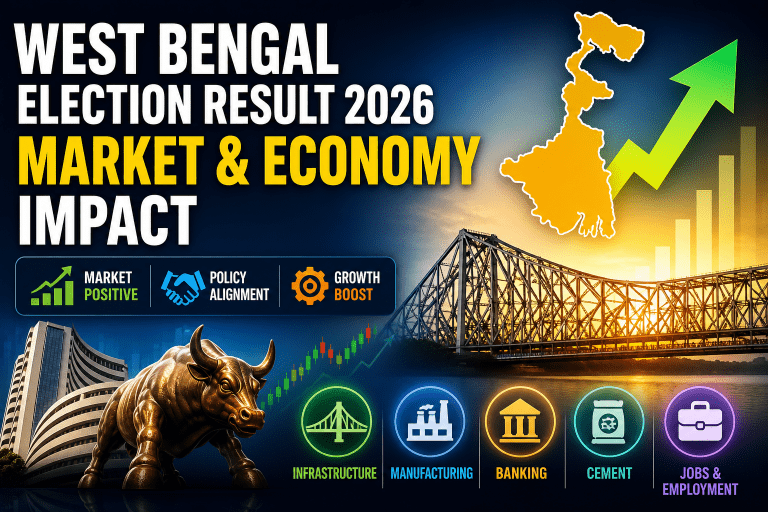
The outcome of the West Bengal elections has caught the attention of investors—not for political reasons, but for its potential impact on markets, economic growth, and sectoral opportunities.
A decisive mandate and expected policy alignment with the central government could influence capital flows, infrastructure spending, and investor sentiment.
Let’s break down what this means purely from a market and economy perspective.
Quick Take (For Investors)
A strong electoral mandate in West Bengal is market-positive in the short term, driven by:
- Improved policy stability
- Faster infrastructure execution
- Better centre-state coordination
How Stock Markets Typically React
Markets prefer certainty and execution visibility.
In such scenarios, investors expect:
- Faster project clearances
- Higher government spending (capex push)
- Improved ease of doing business
This often leads to:
- Short-term market rally (sentiment-driven)
- Sector-specific momentum
Sector-Wise Impact (Most Important for Investors)
Infrastructure & Capital Goods (Big Winners)
- Road, rail, ports, and urban infra projects may accelerate
- Higher order inflows for EPC companies
Stocks in infra & construction could see re-rating potential
Cement & Building Materials
- Increased construction activity boosts demand
- Pricing power improves in growth phases
Banking & NBFCs
- Benefit from higher credit demand (infra + MSME loans)
- Asset quality improves if economic activity picks up
Manufacturing & Industrial Stocks
- Policy alignment may attract new investments
- Boost to “Make in India” + state-level industrial policies
Regional Economy Sectors
- Agriculture-linked industries
- Tea, logistics, fisheries
Indirect beneficiaries via demand revival
Impact on Economy
From a macro perspective, the biggest trigger is capex + execution.
Positive Economic Signals:
- Higher state spending
- Faster project implementation
- Increased private investment interest
This can lead to:
- Higher state GDP growth
- Job creation
- Consumption boost
Employment & Consumption Link
More infrastructure and industrial activity =
👉 More jobs → Higher income → Stronger consumption
This is crucial because:
- Consumption drives ~55–60% of India’s GDP
Key Risks Investors Should Watch
Markets don’t move on elections alone.
Watch these factors:
- Execution delays (very common in state projects)
- Fiscal pressure due to aggressive spending
- Global risks (oil prices, inflation, interest rates)
Bottom line: Execution > Election result
Market Strategy: What Should Investors Do?
Short-Term
- Expect sectoral rallies (infra, cement, PSU banks)
- Momentum-based opportunities
Long-Term
- Focus on companies with:
- Strong order books
- Healthy balance sheets
- Government exposure
Final Takeaway
The West Bengal election outcome is a sentiment trigger for markets, not a guaranteed structural shift.
Real impact depends on:
- Policy execution
- Capex rollout
- Economic follow-through
For investors, this is a sectoral opportunity—not a blanket market signal.
Frequently Asked Questions
Is the election result positive for stock market?
Yes, it improves sentiment due to policy stability and infrastructure expectations.
Which sectors benefit the most?
Infrastructure, cement, banking, and capital goods.
Should investors act immediately?
Short-term traders may benefit, but long-term investors should focus on fundamentals and execution.
Disclaimer
This content is for informational purposes only and does not constitute investment advice. Please consult a SEBI-registered financial advisor before making investment decisions. Investments in securities markets are subject to market risks.