

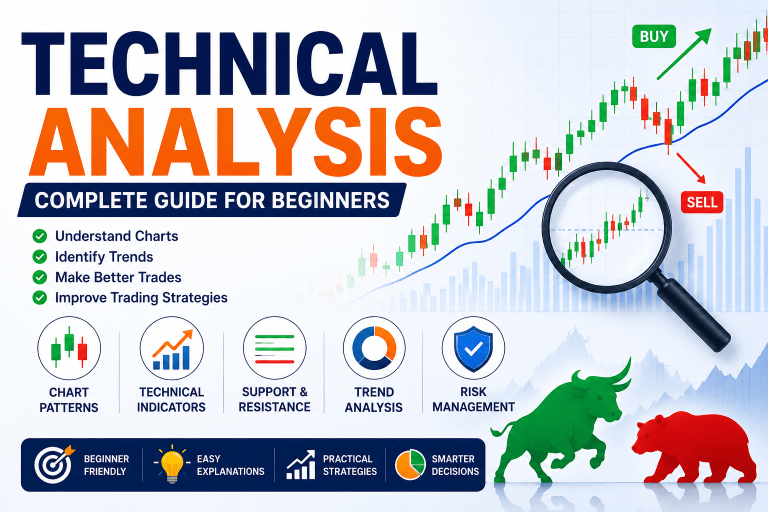
Technical analysis is one of the most widely used methods for analysing stocks, indices, commodities, and financial markets. Traders use technical analysis to study price movements, identify trends, and make trading decisions based on charts and indicators rather than company fundamentals.
In the Indian stock market, technical analysis has become extremely popular among intraday traders, swing traders, options traders, and even long-term investors looking for better entry and exit opportunities.
This guide explains technical analysis in simple language, including chart patterns, indicators, candlestick analysis, support and resistance, trading psychology, and risk management.
What is Technical Analysis?
Technical analysis is the study of historical price movements and trading volumes to predict future market trends.
Instead of analysing company financials like revenue or profit, technical analysts focus on:
- Stock price movement
- Trading volume
- Market trends
- Chart patterns
- Technical indicators
The basic belief behind technical analysis is:
“Price already reflects all available information.”
Traders use charts and indicators to identify potential buying and selling opportunities.
How Technical Analysis Works
Technical analysis works on three important assumptions:
1. Market Discounts Everything
All information such as news, earnings, interest rates, and investor sentiment is already reflected in stock prices.
2. Prices Move in Trends
Stock prices generally move in trends rather than random directions.
Main types of trends:
- Uptrend
- Downtrend
- Sideways trend
3. History Repeats Itself
Human emotions like fear and greed create repetitive market patterns that appear regularly on stock charts.
Why Technical Analysis is Important
Technical analysis helps traders and investors:
- Identify market trends
- Find entry and exit points
- Manage trading risk
- Improve timing decisions
- Understand market psychology
- Analyse momentum and volatility
Technical analysis is widely used in:
- Intraday trading
- Swing trading
- Options trading
- Commodity trading
- Forex trading
- Cryptocurrency trading
Types of Charts Used in Technical Analysis
Line Chart
The simplest chart type that connects closing prices.
Best for:
- Long-term trend analysis
- Beginners
Bar Chart
Displays:
- Open price
- High price
- Low price
- Close price
Provides more market information than line charts.
Candlestick Chart
The most popular chart type among traders.
Candlestick charts visually show:
- Buying pressure
- Selling pressure
- Market sentiment
- Reversal patterns
Candlestick analysis forms the foundation of modern technical trading.
Candlestick Patterns Explained
Candlestick patterns help traders understand market psychology.
Bullish Candlestick Patterns
Hammer
Signals possible trend reversal after a decline.
Bullish Engulfing
Strong buying pattern where a bullish candle fully engulfs the previous bearish candle.
Morning Star
Three-candle bullish reversal pattern.
Bearish Candlestick Patterns
Shooting Star
Indicates possible reversal after an uptrend.
Bearish Engulfing
Strong selling pattern.
Evening Star
Bearish reversal pattern after a rally.
Support and Resistance
Support and resistance are among the most important concepts in technical analysis.
What is Support?
A price level where buying demand is strong enough to prevent further decline.
What is Resistance?
A level where selling pressure prevents prices from rising further.
Traders use these levels for:
- Entry points
- Stop-loss placement
- Profit booking
- Breakout identification
Trend Analysis in Technical Trading
Uptrend
Higher highs and higher lows.
Indicates bullish momentum.
Downtrend
Lower highs and lower lows.
Indicates bearish momentum.
Sideways Market
Price moves within a range without clear direction.
Moving Averages Explained
Moving averages smooth price data and help identify trends.
Simple Moving Average (SMA)
Average closing price over a fixed period.
Exponential Moving Average (EMA)
Gives more weight to recent prices.
Popular moving averages:
- 20 EMA
- 50 EMA
- 100 EMA
- 200 EMA
Important Technical Indicators
RSI (Relative Strength Index)
Measures momentum and identifies overbought or oversold conditions.
RSI=100−1001+RSRSI = 100 – \frac{100}{1 + RS}RSI=100−1+RS100
RSI Levels
- Above 70 → Overbought
- Below 30 → Oversold
MACD Indicator
MACD helps traders identify trend direction and momentum.
MACD=EMA12−EMA26MACD = EMA_{12} – EMA_{26}MACD=EMA12−EMA26
MACD consists of:
- MACD line
- Signal line
- Histogram
Bollinger Bands
Used to measure volatility.
Bollinger Bands=SMA±2σBollinger\ Bands = SMA \pm 2\sigmaBollinger Bands=SMA±2σ
Helps traders identify:
- Volatility expansion
- Breakouts
- Mean reversion
Volume Analysis
Volume indicates the strength behind a price movement.
High Volume + Price Rise
Strong bullish signal.
High Volume + Price Fall
Strong bearish signal.
Volume confirmation is extremely important during breakouts.
Chart Patterns Every Trader Should Know
Head and Shoulders
Bearish reversal pattern.
Double Top
Signals possible downside reversal.
Double Bottom
Bullish reversal structure.
Triangle Pattern
Indicates consolidation before breakout.
Flag and Pennant
Continuation patterns during strong trends.
Breakout Trading Explained
Breakout trading involves entering trades when price moves above resistance or below support.
Bullish Breakout
Price breaks above resistance with strong volume.
Bearish Breakdown
Price falls below support.
Breakouts often lead to sharp price movement.
Intraday Trading Using Technical Analysis
Technical analysis is extremely popular among intraday traders.
Commonly used tools:
- VWAP
- RSI
- EMA crossover
- Support and resistance
- Volume breakout
Intraday traders focus heavily on:
- Momentum
- Liquidity
- Risk management
Swing Trading Using Technical Analysis
Swing traders hold positions for days or weeks.
Swing trading strategies include:
- Breakout trading
- Pullback trading
- Trend-following strategies
- Moving average setups
Risk Management in Technical Trading
Risk management is more important than prediction accuracy.
Important Risk Management Rules
Use Stop-Loss
Always define maximum risk before entering a trade.
Position Sizing
Avoid risking large capital on a single trade.
Risk-Reward Ratio
Most professional traders prefer:
- 1:2
- 1:3
risk-reward setups.
Trading Psychology in Technical Analysis
Market psychology drives price movement.
Main emotions affecting traders:
- Fear
- Greed
- Hope
- Panic
Successful traders focus on:
- Discipline
- Consistency
- Emotional control
- Process-based trading
Advantages of Technical Analysis
Quick Decision-Making
Useful for short-term trading.
Applicable Across Markets
Works in:
- Stocks
- Commodities
- Forex
- Crypto
Improves Entry and Exit Timing
Helps identify better trade opportunities.
Visual and Data-Driven
Charts simplify market analysis.
Limitations of Technical Analysis
No Guaranteed Accuracy
Markets remain unpredictable.
False Signals
Indicators may fail during volatile conditions.
Emotional Trading Risks
Improper discipline can lead to losses.
News Events Can Override Charts
Major global events can invalidate setups instantly.
Technical Analysis vs Fundamental Analysis
| Technical Analysis | Fundamental Analysis |
|---|---|
| Studies price charts | Studies company financials |
| Focuses on timing | Focuses on business value |
| Popular for trading | Popular for investing |
| Short-term orientation | Long-term orientation |
Many investors combine both approaches for better decision-making.
Best Timeframes for Technical Analysis
| Trading Style | Timeframe |
|---|---|
| Intraday Trading | 5 min – 15 min |
| Swing Trading | Daily chart |
| Positional Trading | Weekly chart |
| Long-Term Investing | Monthly chart |
Common Mistakes Beginners Make
Overtrading
Taking too many trades.
Ignoring Stop-Loss
One of the biggest reasons traders lose money.
Using Too Many Indicators
Leads to confusion.
Emotional Trading
Fear and greed destroy consistency.
Blindly Following Tips
Always do your own analysis.
Best Technical Analysis Tools for Indian Traders
Popular charting platforms include:
- TradingView
- Chartink
- Samco Trading Platform
- NSE India charts
- Investing.com
How to Learn Technical Analysis
Best ways to learn:
- Study charts daily
- Practice on paper trading
- Learn price action
- Maintain trading journal
- Focus on risk management
- Start with simple setups
Consistency matters more than complexity.
Future of Technical Analysis
Technical analysis continues evolving with:
- AI-based trading systems
- Algorithmic trading
- Quantitative strategies
- Automated chart recognition
However, market psychology and price action remain core components of trading.
Conclusion
Technical analysis is a powerful method used by traders and investors to analyse market trends, identify opportunities, and improve decision-making.
From candlestick patterns and indicators to support-resistance and chart analysis, technical trading helps market participants understand price behaviour and market psychology.
While technical analysis can improve probability and timing, successful trading ultimately depends on discipline, risk management, emotional control, and continuous learning.
Frequently Asked Questions
Is technical analysis useful for beginners?
Yes, beginners can use technical analysis to understand market trends and improve trading decisions.
Which is the best indicator for technical analysis?
There is no single best indicator. RSI, MACD, moving averages, and volume analysis are widely used.
Can technical analysis predict stock prices accurately?
Technical analysis improves probability but cannot guarantee accuracy.
Is technical analysis better than fundamental analysis?
Both approaches serve different purposes. Technical analysis is mainly used for trading, while fundamental analysis is preferred for long-term investing.
Which chart is best for trading?
Candlestick charts are the most popular among traders because they clearly show market sentiment and price action.
Disclaimer
This article is intended only for educational and informational purposes and should not be considered investment advice or trading recommendation. Stock market investments and trading involve risk. Investors should conduct their own research and consult a SEBI-registered financial advisor before making investment decisions.