



Jupiter Wagons witnessed a sharp 19% single-day rally, putting the stock firmly in the spotlight. Such strong one-day moves often raise an essential question for investors: Does a sharp rally signal further upside, or does it mark a near-term top?
To answer this, we analysed historical price action over the past decade, focusing on instances where Jupiter Wagons gained more than 15% in a single trading session. The findings offer valuable insights into short-term volatility and medium- to long-term return potential.
Jupiter Wagons: Historical Performance After 15%+ Single-Day Rallies
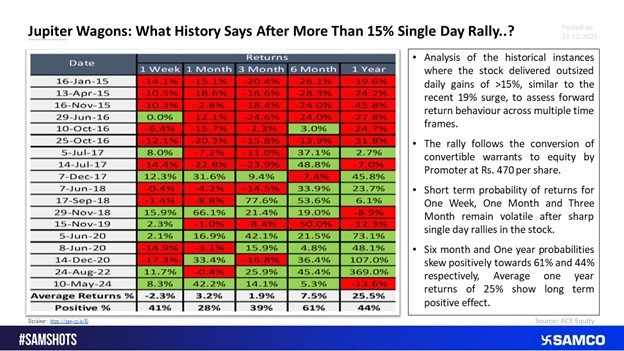
Over the last ten years, Jupiter Wagons has recorded 18 occasions where the stock surged more than 15% in a single day. These events were studied to evaluate forward returns across multiple time frames, 1 week, 1 month, 3 months, 6 months, and 1 year.
Key Observations from Historical Data
- Short-term returns (1 week and 1 month) have been volatile and inconsistent.
- Medium-term trends (6 months and 1 year) have been more constructive.
- Sharp rallies have not consistently marked the stock's immediate tops.
This indicates that while traders may experience near-term volatility, longer-term investors have often seen reasonable follow-through after such rallies.
Jupiter Wagons Forward Returns: What the Numbers Say?
Based on historical analysis:
Time Frame | Average Forward Return | Positive Outcome Ratio |
1 Week | Mixed | Inconsistent |
1 Month | Mixed | Inconsistent |
6 Months | 7.5% | 61% |
1 Year | 25.5% | 44% |
What This Means for Investors?
- Six-month forward returns have been positive in nearly two-thirds of instances, suggesting improving risk-reward beyond short-term noise.
- One-year returns, while more selective, still show a meaningful average upside, especially during structurally supportive phases.
What Triggered the Recent Jupiter Wagons Rally?
The latest rally was driven by the promoter group's conversion of convertible warrants into equity.
Key Details of the Warrant Conversion
- Warrants were allotted in June 2024
- Issue price: ₹470 per share
- 25% paid upfront at the time of allotment
- The remaining 75% infused at conversion
Such transactions are typically viewed as fundamentally positive, as they involve fresh capital infusion rather than speculative market buying.
Why Promoter Warrant Conversion Matters?
Markets generally interpret promoter warrant conversions as a sign of confidence for several reasons:
- Demonstrates long-term commitment by promoters
- Improves balance sheet strength
- Reduces funding uncertainty
- Aligns promoter interests with public shareholders
In many historical cases, stocks witnessing promoter-led equity infusion have shown improved medium-term performance, provided business fundamentals remain intact.
Technical vs Fundamental Perspective on Jupiter Wagons
From a technical standpoint, sharp rallies are often followed by consolidation phases. However, history shows that when such moves are supported by structural developments, they tend to form higher bases rather than reversing sharply.
From a fundamental angle, promoter capital infusion strengthens the investment narrative and reduces downside risks associated with liquidity or leverage.
Should Investors Worry About a Short-Term Top?
Based on historical data:
- Immediate tops after 15%+ rallies are not statistically common
- Short-term corrections or sideways movement may occur
- Medium-term returns have often rewarded patient investors
This suggests that while timing becomes important for traders, long-term investors may not need to rush exits solely due to a single-day surge.
Conclusion: What History Suggests for Jupiter Wagons?
Jupiter Wagons’ 19% single-day rally fits a historical pattern where:
- Near-term volatility is normal
- Medium-term outcomes have been largely constructive
- Promoter actions reinforce confidence
Investors should continue to monitor earnings performance, order inflows, and execution, while using volatility as an opportunity to reassess positioning rather than reacting emotionally.




 Easy & quick
Leave A Comment?