


Silver has officially crossed a historic milestone in 2025, touching ₹2,50,000 per kilogram, marking one of the most powerful re-ratings the metal has witnessed in decades. What was once viewed primarily as a precious metal and secondary safe-haven has now emerged as a strategic industrial asset, driven by deep structural changes in global supply chains, geopolitics, and energy transition trends.
The rally is not speculative in nature. Instead, it reflects a fundamental shift in how silver is valued across industrial, investment, and geopolitical frameworks.
Silver’s 2025 Milestone Journey
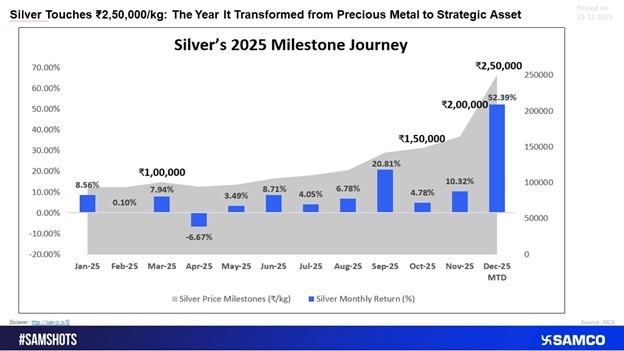
The price journey of silver throughout 2025 highlights consistent momentum rather than a one-off spike. Monthly returns stayed largely positive, with sharp acceleration in the second half of the year as prices surged from ₹1,50,000 levels to ₹2,50,000/kg.
Why Silver Was Sharply Re-Rated in 2025?
1. China’s Export Controls Turned Silver Strategic
China’s indication of export controls starting 2026 fundamentally altered the silver supply outlook. As one of the world’s largest processors and exporters of critical metals, China’s policy shift triggered front-loaded stocking by industries and investors globally.
Silver instantly moved from being a freely available commodity to a strategic material, forcing:
- Governments to reassess supply security
- Corporations to build inventory buffers
- Investors to price in future scarcity
This policy shift played a major role in accelerating silver’s re-rating.
2. Fifth Consecutive Year of Structural Supply Deficit
Silver is now facing its fifth straight year of structural supply deficit, a rare and critical condition for any globally traded metal.
Key supply challenges include:
- Mine production stagnation, despite higher prices
- Recycling supply plateauing, unable to offset demand growth
- Limited new projects due to long gestation cycles
With supply unable to respond quickly, every incremental demand shock translated directly into higher prices.
3. Silver’s Role in the Energy Transition Exploded
Silver has become a core input metal for the global energy transition, not just an ancillary component.
Demand growth is being driven by:
- Solar photovoltaic installations, where silver is irreplaceable
- Electric vehicles (EVs) and charging infrastructure
- 5G networks, AI hardware, and advanced electronics
As green energy adoption accelerates worldwide, silver demand has become structural and non-cyclical, fundamentally altering its demand profile.
4. Macro Tailwinds Boosted Precious Metal Allocation
The macroeconomic backdrop in 2025 has been strongly supportive of precious metals.
Major tailwinds include:
- Expectations of global rate cuts, lowering opportunity cost
- A softer US dollar, improving commodity pricing power
- Heightened geopolitical uncertainty, increasing safe-haven demand
Unlike earlier cycles, silver benefited simultaneously from industrial demand growth and investment flows, creating a powerful dual-engine rally.
Silver: From Precious Metal to Strategic Asset
The 2025 rally marks a clear regime shift. Silver is no longer just a hedge against inflation or currency depreciation. It is now:
- A strategic industrial metal
- A critical energy transition input
- A geopolitical asset linked to supply security
This transformation explains why silver’s price action has been faster, steeper, and more sustained than traditional precious-metal cycles.
Outlook: What Lies Ahead for Silver?
With supply constraints unlikely to ease quickly and industrial demand continuing to expand, silver’s long-term outlook remains structurally strong.
Key factors to watch:
- Implementation timeline of China’s export controls
- Expansion pace of global solar and EV infrastructure
- Central bank policy shifts and real interest rate trends
While short-term volatility is inevitable after such a sharp rally, the broader setup suggests that silver has entered a new valuation zone, not a temporary spike.
Conclusion
Silver touching ₹2,50,000/kg is not just a price milestone, it represents a redefinition of the metal’s global role. Structural deficits, geopolitical shifts, and energy transition demand have collectively transformed silver from a traditional precious metal into a strategic asset class.
For investors, policymakers, and industries alike, silver is no longer optional, it is essential.



 Easy & quick
Leave A Comment?