Price action trading has stood the test of time. Even as markets become faster, more algorithm-driven, and increasingly crowded with indicators, many successful traders continue to rely on price itself as their primary source of information. The reason is simple: price reflects real-time market psychology, capturing the collective decisions of buyers and sellers.
This article explains a three-step price action trading strategy in a practical, repeatable manner. It is designed to help beginners understand the core logic of price action while adding sufficient depth for active traders dealing in stocks, futures, options, and ETFs in Indian markets.
Why Price Action Trading Still Works
Markets may evolve, but human behaviour remains constant. Fear, greed, hesitation, and urgency continue to drive price movement. Price action trading works because it focuses directly on these behaviours rather than relying on derived indicators.
While indicators summarise past data, price action shows what is happening now. When used with discipline, it helps traders:
- Avoid over-analysis
- Improve timing
- Adapt across timeframes and instruments
The three-step price action trading strategy brings structure to what is often seen as a discretionary approach.
What Is Price Action Trading?
Price action trading is the practice of analysing raw price movement on a chart to make trading decisions. It relies on:
- Candlestick chart patterns
- Support and resistance zones
- Market structure such as trends, ranges, and breakouts
Unlike indicator-heavy strategies, price action trading focuses on how price behaves at important levels, rather than reacting to signals generated by calculations.
In simple terms:
- Indicators interpret price
- Price action reads price directly
This makes price action highly adaptable across intraday, swing, and positional trading.
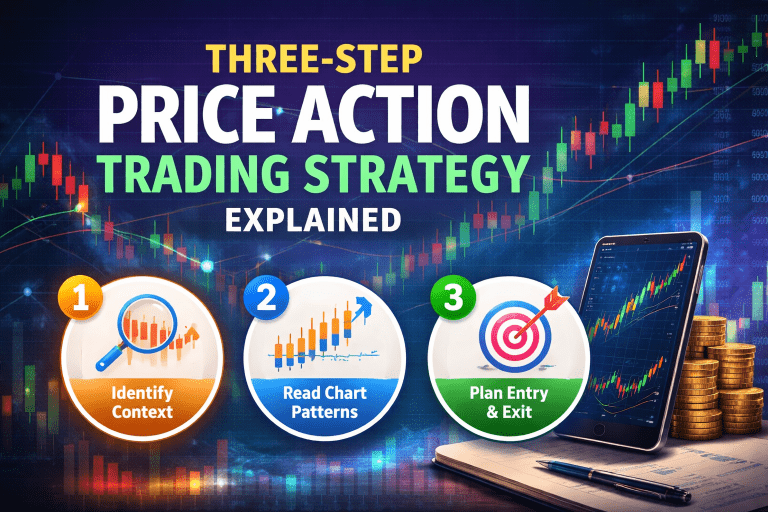
The Three-Step Price Action Trading Strategy
Step 1: Identify the Market Context
Every price action trade begins with understanding where the market is currently positioned. This step is critical and often ignored by beginners.
Markets typically operate in three states:
- Trending: Higher highs and higher lows, or lower highs and lower lows
- Ranging: Price oscillates between defined support and resistance
- Breakout phase: Price moves decisively beyond a range or key level
Trading a candlestick pattern without understanding the broader context leads to low-probability trades. A bullish pattern in a strong downtrend or near major resistance often fails.
Higher timeframe analysis helps establish context. For example:
- A daily trend defines bias
- A 15-minute or hourly chart helps execution
This approach works well for trend-following strategies, including ETF-based tactical bets, where alignment with the broader trend improves consistency.
Step 2: Read Candlestick Chart Patterns
Once context is clear, traders move to candlestick chart patterns for execution signals. Candlesticks represent the battle between buyers and sellers within a specific timeframe.
Common and effective patterns include:
- Pin bars: Indicate rejection of higher or lower prices
- Engulfing patterns: Signal strong momentum shift
- Inside bars: Represent consolidation and potential breakout
However, patterns are not signals by themselves. Their effectiveness depends on where they appear.
Patterns work best when:
- They form near support or resistance
- They align with the prevailing trend
- They appear after a pullback, not after extended moves
False signals usually occur when traders:
- Trade every pattern they see
- Ignore trend direction
- Enter without confirmation or patience
For short-term traders, price action setups often align well with stocks to trade for 5 days, where controlled momentum and defined levels matter more than indicators.
Step 3: Plan Entry, Stop-Loss, and Exit
This is where price action becomes a trading strategy, not just chart reading.
Every trade must answer three questions clearly:
- Where to enter
- Where to exit if wrong
- Where to book profits if right
Entry:
Entries are usually placed after confirmation, such as a candle close or minor breakout in the direction of the setup.
Stop-Loss:
Stop-loss placement should be logical, not arbitrary. It is typically placed:
- Beyond the pattern structure
- Outside key support or resistance
Exit and Risk-Reward:
A favourable risk-to-reward ratio ensures that even if some trades fail, overall performance remains positive. Price action traders often focus on fewer, higher-quality trades rather than frequency.
This structured approach works effectively for futures trading, where disciplined risk management is essential, and for options strategies, where defined-risk setups help control downside.
Applying Price Action Across Trading Instruments
One of the strengths of price action trading is its versatility.
Stocks
Price action works exceptionally well in stocks, especially for beginners. Clear trends, visible support and resistance, and manageable volatility make it easier to apply across swing and positional trades.
Index Options
Index charts often respect key levels more consistently than individual stocks. Price action helps:
- Identify directional bias
- Time option entries using candlestick confirmation
- Avoid overtrading during choppy phases
This approach aligns well with structured setups such as index options to buy for 5 days.
Stock Options
For stock options, price action helps traders stay selective. Instead of trading every move, traders wait for:
- Clear breakouts
- Pullbacks within trends
- Strong candlestick confirmation
This reduces unnecessary trades and improves discipline, particularly in short-term option buying strategies.
For traders looking at short-duration opportunities, price action analysis works effectively when combined with curated ideas like [Stock Options to Buy for 5 Days], where confirmation and discipline matter more than frequency.
This structured approach aligns well with short-term setups such as [Index Options to Buy for 5 Days], where price action around key levels helps improve entry timing and reduce overtrading.
Risk Management Rules for Price Action Traders
Risk management is often missing from price action discussions, yet it determines long-term survival.
Core rules include:
- Never risk more than a fixed percentage of capital per trade
- Avoid trading every visible pattern
- Accept that not all setups will work
- Focus on process, not outcomes
Price action trading rewards patience more than activity.
How the Samco Trading App Enhances Price Action Trading
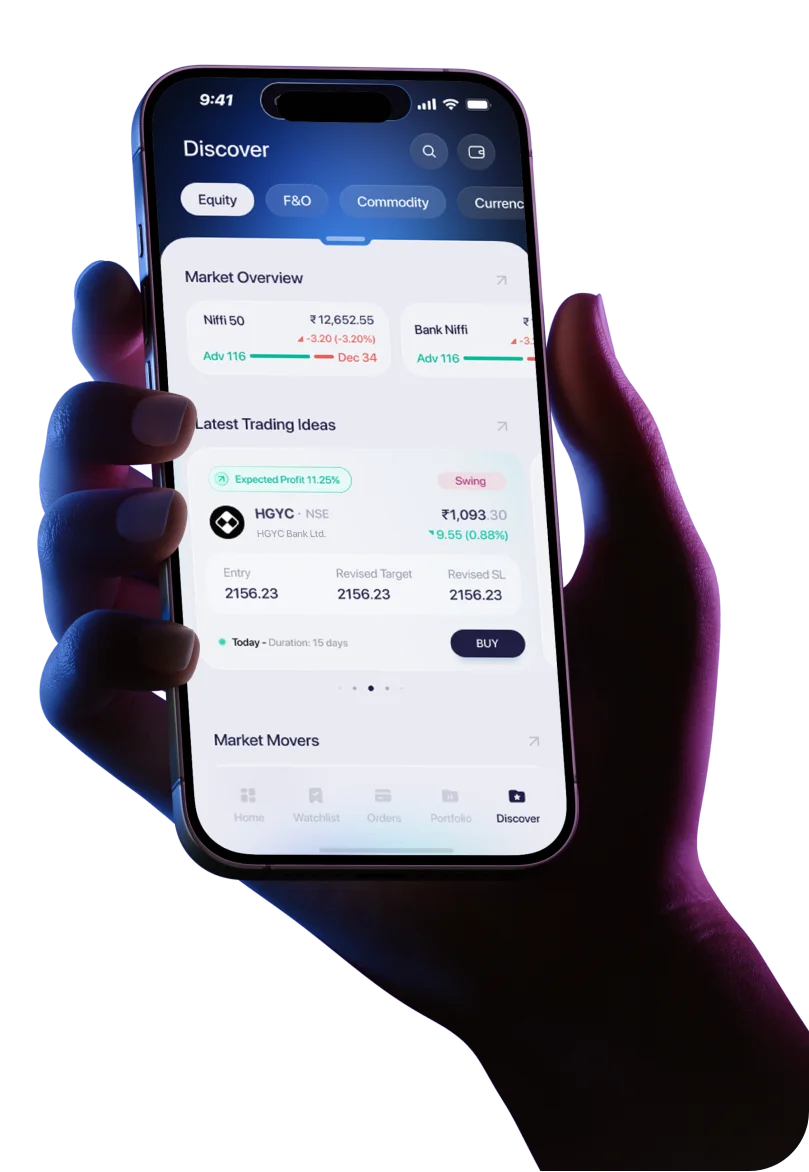
A clean trading environment is essential for price action traders. The Samco Trading App supports this approach by offering:
- Clear, clutter-free charts
- Quick order execution
- Smooth navigation across stocks, futures, options, and ETFs
This allows traders to focus on decision-making rather than platform complexity, making it suitable for active traders who rely on precision and timing.
Common Mistakes in Price Action Trading
Even simple strategies fail when misapplied. Common errors include:
- Trading patterns without market context
- Ignoring higher timeframe bias
- Becoming overconfident after short-term success
- Failing to maintain a trade journal
Consistency comes from reflection and process improvement, not constant strategy changes.
Conclusion: Making Price Action a Repeatable Trading System
Price action trading is not a shortcut to quick profits. It is a skill developed through observation, discipline, and repetition. The three-step price action trading strategy provides a structured framework that helps traders move from random decisions to consistent execution.
By focusing on context, confirmation, and risk management, traders can apply price action effectively across stocks, futures, options, and ETFs. With the right tools and disciplined execution, price action becomes not just a method of analysis, but a repeatable trading system.