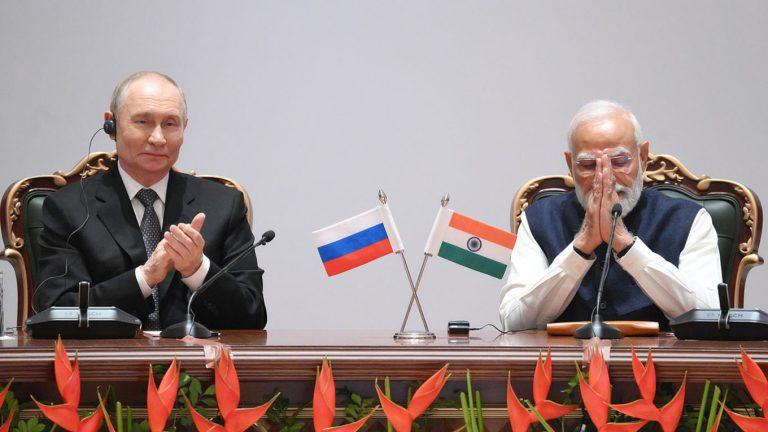
India’s transition from a traditional buyer–seller defence relationship with Russia to a deeper model involving joint research, co-development, and co-production marks a major step toward long-term strategic autonomy. This shift significantly benefits India’s defence public-sector undertakings (DPSUs) and private manufacturers, expanding their order pipelines and strengthening localisation across critical platforms.
Below is a detailed analysis of how major Indian companies could stand to gain across missiles, aircraft, tanks, naval assets, air defence systems, and small arms.
1. BrahMos Missile System – Major Boost for Indian Defence Manufacturers
The BrahMos cruise missile programme, one of India’s most successful Indo-Russian joint ventures, will be among the biggest beneficiaries of the enhanced co-development framework.
Key Beneficiaries
Bharat Dynamics Ltd. (BDL)
- Principal manufacturer of BrahMos missiles
- Larger order visibility across land, sea, and air versions
- Future demand for BrahMos-NG and extended-range variants boosts long-term revenue
Hindustan Aeronautics Ltd. (HAL)
- Integration of BrahMos on Su-30MKI requires heavy airframe modification
- Future integration of the lighter BrahMos-NG across additional fighter platforms
Bharat Electronics Ltd. (BEL)
- Supplies guidance modules, radar components, and fire-control systems
- Higher indigenisation raises margins
L&T Defence
- Manufactures launchers, canisters, and naval integration systems
Strategic Outcome
Next-generation BrahMos variants, deeper localisation, and export potential create a multi-decade growth opportunity for Indian companies.
2. Sukhoi Su-30MKI Upgrade Programme – A Multi-Year Revenue Driver
The Su-30MKI, the backbone of the Indian Air Force (IAF), is now set for a major upgrade cycle under the enhanced India–Russia collaboration.
Key Beneficiaries
HAL (Prime Beneficiary)
- Licensed producer of Su-30MKI
- Will co-develop avionics, mission computers, upgraded sensors, and EW suites
- Increased MRO, overhauls, and structural upgrades
BEL
- Indigenous radars, EW systems, and communication suites
- Replacement of outdated Russian electronics
BDL
- Benefits from the integration of Astra missiles, BrahMos-NG, and other indigenous weapons
Private Sector: Data Patterns, Astra Microwave, Paras Defence
- Supply radar modules, RF systems, and avionics components
Strategic Outcome
The Su-30 modernisation programme is a long-term initiative that promotes localisation, technology transfer, and multi-year earnings visibility.
3. T-90 Bhishma Tanks – Strong Upside for Land Systems Ecosystem
The T-90 Bhishma, currently license-produced in India, will see deeper indigenous involvement as upgrade and modernisation cycles accelerate.
Key Beneficiaries
Heavy Vehicles Factory (HVF)
- Continues as platform integrator for T-90
Bharat Forge
- Armoured components, artillery barrels, mobility systems
- Potential participation in gun system upgrades and next-gen tank variants
BEL
- Fire-control systems, thermal sights, communication systems, battlefield management systems
L&T
- Armoured hull components, structural assemblies
- Possible role in next-generation armoured platforms
Solar Industries
- Benefits from increased ammunition requirements
Strategic Outcome
The T-90 programme transforms into a multi-decade domestic manufacturing and upgrade ecosystem with higher India-specific customisation.
4. S-400 Triumf Air Defence System – Indirect but Significant Benefits
Although India imports the S-400 directly, deeper India–Russia cooperation enhances the domestic ecosystem supporting integration and maintenance.
Key Beneficiaries
BEL
- Command-and-control integration
- Networking with the Integrated Air Command and Control System (IACCS)
- Indigenous communication modules
Data Patterns, Astra Microwave
- Auxiliary radar components
- Signal processing modules
- Communication sub-systems
L&T
- Radar station infrastructure
- Civil works, shelters, and launch site engineering
Strategic Outcome
While manufacturing is limited, long-term sustainment and interface modernisation create recurring revenue for Indian companies.
5. INS Vikramaditya & Russian-Origin Submarines – Boost for Indian Shipyards
The new cooperation framework prioritises domestic overhauls of major Russian-origin naval assets.
Key Beneficiaries
Cochin Shipyard Ltd. (CSL)
- Increasing role in refits, repairs, and ship overhauls
L&T Shipbuilding
- Structural modifications
- Hull work
- Integration of indigenous sensors and weapons
BEL
- Combat management systems
- Sonar electronics
- Naval communication systems
Mazagon Dock Shipbuilders (MDL)
- Submarine refit activities shifting to Indian yards
Strategic Outcome
A major boost to naval autonomy and multi-year work pipelines for shipyards and naval equipment manufacturers.
6. AK-203 Assault Rifle – A Model for Future Co-Production
The AK-203 rifle programme under Indo-Russian Rifles Private Limited (IRRPL) showcases the government’s preferred model going forward.
Key Beneficiaries
BEL
- Optical sights
- Imaging devices
- Electronic accessories
Solar Industries
- Ammunition manufacturing
MSMEs
- Barrels, forgings, machining, polymer components
Adani Defence (PLR Systems)
- Although a competitor, it benefits from an expanding domestic small-arms ecosystem
Strategic Outcome
India builds a robust small-arms industry with scalable capacity and reduced dependence on imports.
Conclusion: A Structural Shift Toward Defence Self-Reliance
The shift from a transactional buyer–seller model to joint R&D and co-production fundamentally transforms India’s defence landscape. Across missiles, fighters, tanks, naval platforms, small arms, and air defence systems, Indian companies—both PSU and private—stand to gain through:
- Higher localisation
- Technology transfer
- Larger order visibility
- Stronger export prospects
- Domestic capability building
- Multi-year upgrade and sustainment cycles
This evolution strengthens India’s long-term defence autonomy and creates sustained growth opportunities across the domestic defence industrial ecosystem.