


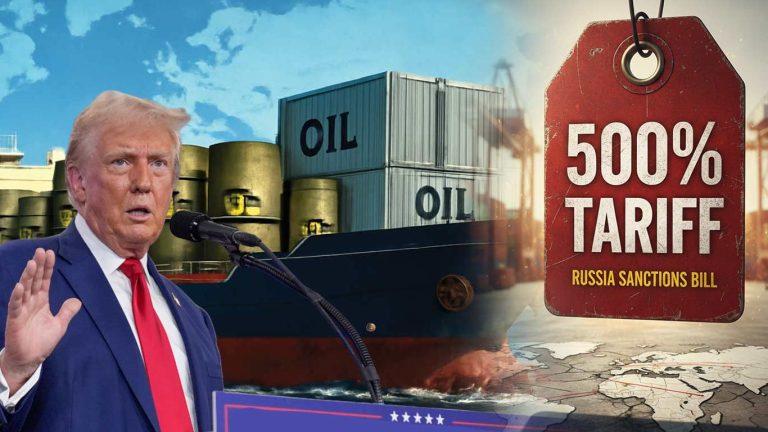
In global markets, risks rarely arrive with warning sirens. More often, they emerge quietly, through policy drafts, political signalling, and a single line buried inside a proposed bill. Early January 2026 delivered one such moment, as the United States gave a political green signal to a sanctions proposal that could impose tariffs of up to 500% on countries continuing to trade in Russian energy.
Formally titled the “Sanctioning Russia Act of 2025,” the bill is a bipartisan proposal in the U.S. Senate. While it is not yet law, its intent is unmistakable: to economically isolate Russia by extending penalties beyond Moscow to nations that purchase Russian oil. For India, this is not a theoretical development, it represents a potential inflection point in trade, energy strategy, and geopolitics.
Why This Bill Exists?
The motivation behind the bill is strategic rather than commercial. The U.S. views continued purchases of Russian energy as indirect financial support for Russia’s war effort in Ukraine. By threatening punitive tariffs on imports from countries such as India, China, and Brazil, the bill seeks to make Russian oil economically unattractive.
The logic is straightforward:
- Apply pressure on major buyers of Russian energy
- Weaken Russia’s energy revenues
- Increase diplomatic leverage in peace negotiations
Rather than targeting Russia alone, the bill weaponises trade access to enforce geopolitical outcomes.
Why India Is in the Spotlight?
India has emerged as one of the largest importers of Russian crude since Western sanctions reshaped global energy flows. Discounted pricing made Russian oil commercially attractive, particularly at a time of global energy inflation.
Some key realities define India’s position:
- India imports around 88% of its crude oil requirements
- Russian crude became a key source due to pricing advantages
- Imports from Russia have already moderated, declining from 2.1 million barrels per day (bpd) in June to about 1.2 million bpd in December, signalling gradual diversification
India’s approach has remained transactional rather than political—prioritising energy security and affordability. However, the proposed U.S. bill directly challenges this model by attaching trade consequences to energy sourcing decisions.
What Does a “500% Tariff” Actually Mean?
If enacted, the bill would empower the U.S. to impose extraordinarily high import duties—up to 500%—on goods from countries that continue buying or reselling Russian energy.
Key technical aspects include:
- Tariffs would apply to goods entering the U.S. market
- There is no statutory framework to impose tariffs on services
- The provision also targets secondary purchases and resale of Russian oil, not just direct imports
The pressure, therefore, would not be exerted at the oil transaction level but through restricted access to the U.S. export market.
The Trade Risk for India
According to estimates cited by the Global Trade Research Initiative (GTRI), the implications could be significant:
- A 500% tariff could disrupt or effectively halt up to USD 120 billion of India–U.S. goods trade
- India’s total exports of goods and services to the U.S. exceed USD 120 billion annually
- The U.S. is among India’s most critical export destinations
Such tariffs would not be symbolic. At these levels, Indian exports would become commercially unviable, impacting manufacturing, engineering goods, and commodity-linked sectors.
What This Means for India?
1. Energy Strategy Under Scrutiny
India’s declining Russian oil imports already suggest a gradual pivot back toward Middle Eastern and alternative suppliers. The bill could accelerate this transition, albeit at higher energy costs, forcing policymakers to weigh affordability against trade stability.
2. Export Risk Concentration
With over USD 120 billion in exports tied to the U.S., India faces concentrated exposure. Any disruption would ripple across industrial production, employment, and corporate earnings in export-heavy sectors.
3. A Strategic Balancing Act
India is not violating international law by purchasing Russian oil. However, the bill introduces economic consequences for geopolitical positioning, compelling India to balance:
- Energy affordability
- Export competitiveness
- Diplomatic autonomy
The Larger Picture: Trade as a Geopolitical Weapon
This bill is about more than oil. It signals how trade policy is increasingly being weaponised as a foreign policy tool. The proposed 500% tariff is less an economic instrument and more a geopolitical message: global commerce is no longer neutral.
For India, the most likely path forward is pragmatic rather than ideological:
- Continue reducing dependency on Russian crude without abrupt disruption
- Safeguard strategic export relationships, particularly with the U.S.
- Preserve diplomatic independence while adapting to a shifting global order
Conclusion
The Sanctioning Russia Act of 2025 may not yet be law, but its message is already influencing markets and risk assessments. It places India at a rare intersection of energy security, trade dependence, and geopolitical pressure.
If enacted, a 500% tariff would not merely raise costs, it would fundamentally alter the economics of global alliances. For Indian policymakers, businesses, and investors, this is no longer just a political headline. It represents a developing structural risk that demands careful, unemotional analysis.
In today’s markets, the most powerful forces are not always demand cycles or earnings—but legislation drafted thousands of miles away.