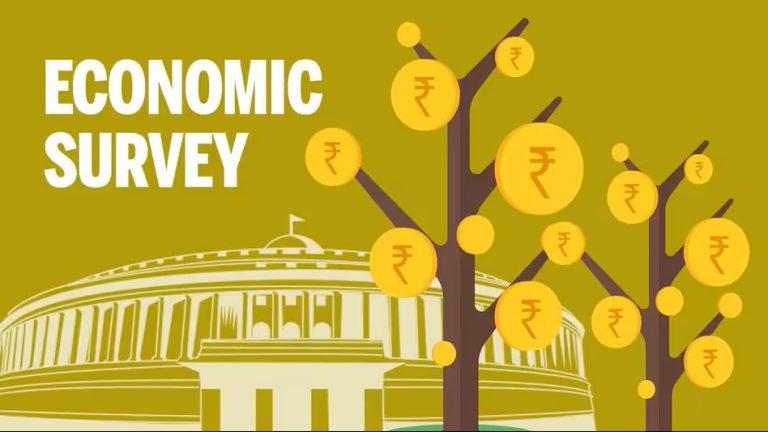
The Economic Survey 2026 was tabled in Parliament on January 29 by Union Finance Minister Nirmala Sitharaman. At a moment when the global economy is still on shaky ground, the Survey presents India’s outlook as calm, balanced, and built to withstand external shocks.
Prepared by the Economic Division of the Department of Economic Affairs under the leadership of the Chief Economic Adviser, the Economic Survey 2026 reviews how the economy performed and where it stands heading into the next financial year.
The headline message is clear: India’s growth story remains intact, even as global risks continue to hover.
Market Performance: Growth Holds Firm Despite Global Headwinds
The Economic Survey 2026 projects real GDP growth of 6.8% to 7.2% in FY27. This projection is rooted in strong domestic drivers rather than external demand.
Global growth remains weak. Trade disruptions, volatile capital flows, and slower expansion in key economies continue to create uncertainty. But for India, these factors are seen more as external risks, not immediate threats.
The Survey notes that policy reforms over recent years have helped lift India’s medium-term growth potential closer to 7%, keeping the economy on a stable footing.
Short version:
- Global risks exist
- Domestic strength dominates
- Growth outlook remains steady, not pessimistic
Main News: Key Takeaways from Economic Survey 2026
1. Domestic Economy Remains Stable
The Survey states that despite a weak global outlook, India’s internal fundamentals are strong.
External risks include:
- Slower growth in trading partners
- Trade disruptions due to tariffs
- Capital flow volatility
However, the impact is seen as intermittent, not structural. Ongoing trade discussions with the US are expected to reduce uncertainty on the external front.
2. Economic Growth Projection for FY27
Taking all factors into account, the Economic Survey 2026 projects:
- FY27 real GDP growth: 6.8% to 7.2%
The Survey highlights:
- Domestic demand remains the main growth engine
- Macroeconomic stability is well anchored
- Risks around growth remain broadly balanced
The message is one of steady progress amid uncertainty.
3. Inflation Likely to Rise but Stay Managed
Inflation is expected to be slightly higher in FY27 compared to FY26, but within comfort levels.
Key inflation data highlighted in the Survey:
- IMF inflation estimate:
- FY26: 2.8%
- FY27: 4%
- Target range: 4% ± 2%
Supporting factors:
- Below-normal temperatures
- Above-normal monsoon
- Improved fertiliser supply
- Soft global commodity prices
The Survey also flags the weak rupee as a possible source of imported inflation, though the impact is expected to remain limited.
4. Fiscal Consolidation Remains on Track
Fiscal discipline continues to be a core theme in the Economic Survey 2026.
Key fiscal data:
- Fiscal deficit as of November 2025: 62.3% of Budget Estimates
- FY25 fiscal deficit: 4.8% of GDP
- FY26 target: 4.4% of GDP
The government remains focused on gradually reducing the deficit without disrupting growth momentum.
5. Coordinated Fiscal Discipline Is Critical
The Survey stresses that State-level fiscal discipline matters just as much as central discipline.
Why this matters:
- Markets view government debt on a consolidated basis
- State-level revenue deficits can influence sovereign bond yields
- Higher borrowing costs affect the overall economy
The recommendations of the Sixteenth Finance Commission are expected to play a key role in shaping Centre–State fiscal relations going forward.
6. Finance Seen as a Catalyst for Economic Transformation
The Economic Survey 2026 takes a broader view of finance — not just as a system, but as an enabler of growth.
Key themes highlighted:
- Finance builds trust
- Finance fosters competition
- Finance enables innovation
The Survey calls for:
- A simpler, service-oriented tax system
- Predictable and stable regulation
- Deepening long-term financing
- A balanced financial ecosystem
The message is that finance must actively support India’s development ambitions.
7. Services Sector Continues to Anchor Exports
Services remain a major strength for India, especially in exports. However, the Survey is clear that services alone are not a full substitute for goods-based exports.
Key insights:
- Services drive foreign exchange earnings
- Services support firm-level excellence
- But they don’t trigger broad industrial upgrading
Sustaining leadership in services will depend on:
- Productivity gains
- Innovation
- Skills aligned with new technologies
- Regulatory simplification
8. FDI Inflows Strengthen in FY26
Foreign Direct Investment showed strong momentum in the first eight months of FY26.
FDI data highlighted in the Economic Survey 2026:
- Gross FDI (Apr–Nov 2025): $64.7 billion
- Gross FDI (Apr–Nov 2024): $55.8 billion
- Net FDI (Apr–Nov 2025): $5.6 billion
- Net FDI (Apr–Nov 2024): $0.8 billion
Investments were spread across:
- Digital services
- Data centres
- IT infrastructure
The inflows underline sustained investor confidence despite global uncertainty.
9. Focus Shifts to Strategic Resilience
The Survey highlights a shift in India’s industrial strategy.
The next phase will focus on:
- Scale and competitiveness
- Innovation
- Integration into global value chains (GVCs)
Rather than aiming for complete self-reliance in every area, the emphasis is on diversification and capability-building.
10. Role of MSMEs in Industrial Growth
MSMEs are seen as critical to India’s long-term growth strategy.
The Survey notes that MSMEs need to:
- Move beyond micro-scale operations
- Integrate into formal supply chains
- Participate in export-linked production
Private sector investment in:
- R&D
- Technology adoption
- Skills development
- Quality systems
will be essential to support this transition.
Company Details: About the Economic Survey 2026
- Prepared by: Department of Economic Affairs
- Led by: Chief Economic Adviser
- Nature: Annual review of India’s economy
- Purpose: Assess economic performance and outline outlook
The Economic Survey acts as the foundation for policy discussions ahead of the Union Budget.
Summary: What Economic Survey 2026 Signals?
The Economic Survey 2026 sends a balanced signal.
- Growth around 7% remains achievable
- Inflation is expected to stay within target range
- Fiscal consolidation continues steadily
- Investor confidence remains resilient
- Structural reforms support long-term growth
In a world filled with uncertainty, the Survey’s tone is cautious, but confident. India’s economy is not insulated from global risks—but it is well-positioned to navigate them.
Economic Survey 2026 ultimately reinforces one message: steady progress, grounded in domestic strength, remains the central story of India’s economy.
Source: Livemint