


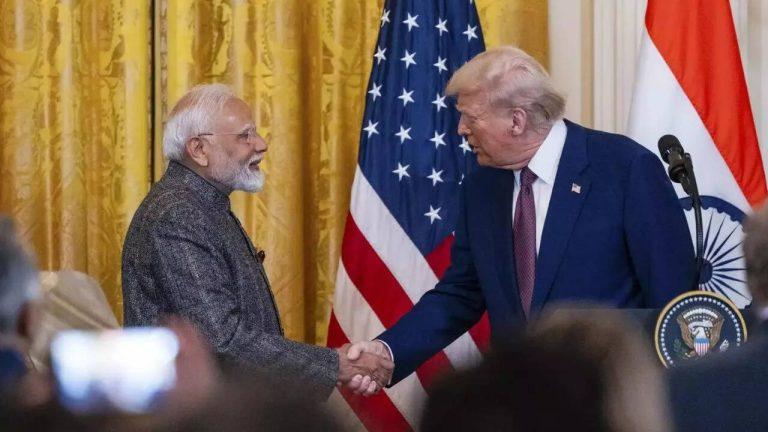
The India-US trade deal is back in focus as global markets digest a key policy signal that could shape trade flows in the near term. Indian stock markets are expected to open on a firmer note, tracking strong cues from the US after both countries released a joint statement outlining the framework for an Interim Trade Agreement (ITA).
This announcement didn’t arrive out of the blue. It builds on last week’s headlines but, this time, adds structure, rules, and clarity. For markets, that shift—from headline noise to written policy—often changes sentiment.
Market Performance: Why Markets Are Watching Closely?
US markets rallied on Friday. That momentum spilled into Asian cues.
The reason is simple. The India-US trade deal reduces uncertainty. And markets dislike uncertainty more than bad news.
The ITA is positioned as a first step toward a wider Bilateral Trade Agreement (BTA). While it is not a full trade pact, it provides near-term clarity on tariffs and trade rules. That clarity improves earnings visibility, which markets usually reward.
Export-linked sectors and manufacturing themes have moved into focus as a result.
Main News: What the Interim Trade Agreement Actually Says?
At the heart of the India-US trade deal is a tariff framework that balances reciprocal duties with selective liberalisation.
Here’s what stands out:
- The US will impose an 18% reciprocal tariff on select Indian goods
- Products impacted include:
- Textiles and apparel
- Leather and footwear
- Plastics and rubber
- Organic chemicals
- Home décor and artisanal goods
- Certain machinery
At the same time, the framework outlines removal of reciprocal tariffs across a wider product base. This improves price competitiveness for Indian exporters over time.
The shift is important. Trade headlines are moving from uncertainty-driven announcements to a rules-based framework, which markets typically see as more stable.
What Changed After the Trump–Modi Announcements?
Earlier announcements created excitement but lacked policy detail.
The joint statement fills that gap.
Key changes include:
- Legal and policy clarity replacing informal announcements
- Preferential tariff rate quotas for automotive parts
- Tariff removal on specific aircraft components
- Withdrawal of the additional 25% ad valorem duty under Executive Order 14329, effective February 7, 2026
These points materially change how businesses assess risk.
One more detail matters here. The US has kept the right to monitor compliance and re-impose duties if commitments are not met. That keeps discipline embedded in the agreement.
Energy, Oil, and Strategic Commitments
The India-US trade deal also touches sensitive geopolitical areas.
According to the framework:
- India has committed to stopping direct and indirect imports of Russian oil
- India will expand purchases of US energy products
- The US retains monitoring rights over these commitments
These elements underline that the agreement is not just about trade—it also reflects broader strategic alignment.
India’s Clarification on Tariffs
India has clarified an important point that shapes expectations.
This agreement involves selective liberalisation, not blanket zero tariffs.
That means:
- No across-the-board duty elimination
- Sector-specific tariff adjustments
- Focus on targeted areas rather than universal access
Another key part of the India-US trade deal is addressing non-tariff barriers, especially in:
- Medical devices
- ICT goods
These have long been friction points in bilateral trade.
Sector-Level Impact: Where Visibility Improves?
While the agreement does not promise sweeping changes, it improves visibility across multiple sectors.
Key takeaways:
- Electronics exports remain largely unchanged, having benefited from earlier exemptions
- Segments seeing improved clarity include:
- Textiles
- Diamonds and jewellery
- Machinery
- Chemicals
- Automobiles
In these sectors, tariff adjustments directly affect cost structures and pricing power.
Meanwhile:
- Pharmaceuticals continue to enjoy near-zero duty access
- Aircraft components retain strong linkage with the US market
This continuity matters as much as change.
Why This Matters for Market Sentiment?
The biggest shift from the India-US trade deal is psychological.
Markets now have:
- Defined tariff levels
- Clear policy language
- Reduced headline risk
That combination often supports steadier valuations rather than sharp speculative moves.
It also reinforces India’s positioning in global trade conversations at a time when supply chains remain cautious and regionally aligned.
Company Details (Trade Exposure Snapshot)
The agreement does not mention individual companies. However, trade-linked themes emerge clearly:
- Export-oriented manufacturing
- US-facing supply chains
- Sectors already compliant with global regulations
No revenue, EBITDA, margin, or profit estimates are disclosed in the framework. The agreement focuses on policy direction, not company-level financial projections.
Summary: What the India-US Trade Deal Signals?
To sum it up, the India-US trade deal is not about instant gains. It is about clarity replacing ambiguity.
Key points to remember:
- Interim Trade Agreement is a stepping stone toward a broader deal
- 18% reciprocal tariffs apply to select goods
- Wider tariff removals are under consideration
- Additional 25% duty withdrawn from February 7, 2026
- Selective liberalisation, not blanket tariff cuts
- Stronger rule-based trade framework
For markets, this kind of structure often sets the base. Not for hype-driven rallies—but for measured, sentiment-backed moves driven by visibility and policy stability.
And in today’s market environment, that stability itself is a signal worth watching.
Source: Livemint