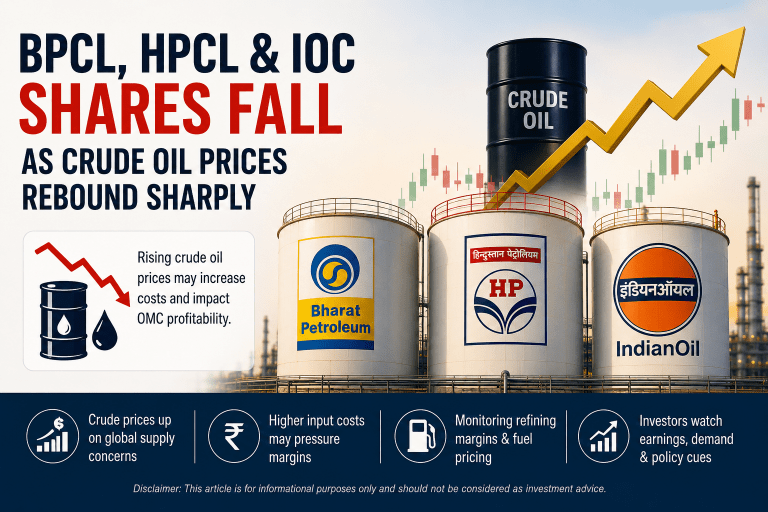



The stock market today opened on a cautious note, and the pressure was clearly visible on select frontline stocks. Shares of Eternal, IndiGo, and BPCL slipped sharply—falling up to 4%—as rising crude oil prices triggered fresh concerns across sectors.
This wasn’t just a routine dip. The fall had a clear trigger—geopolitical tensions in the Middle East that pushed oil prices higher, creating a ripple effect across global markets.
Market Performance: Pressure Builds as Oil Prices Spike
The broader mood in the stock market today was shaped by a sudden spike in crude oil prices.
- Brent crude surged by $4.66 (4.3%) to $112.04 per barrel
- It had earlier jumped over $5, touching $112.86 per barrel
- US West Texas Intermediate (WTI) rose $0.96 (1%) to $97.28 per barrel
- Earlier in the session, WTI had gained more than $3
This sharp rise in crude prices created immediate pressure on sectors sensitive to fuel costs.
 Main News: Eternal, IndiGo, BPCL Shares Under Pressure

As oil prices climbed, investors quickly reacted by pulling back from stocks that are directly or indirectly impacted by fuel costs.
Key Stock Movements
- Eternal share price declined by 4.4%
- Swiggy shares slipped 3.4%
- IndiGo share price dropped 3.1%, trading at ₹4,223
- BPCL share price fell around 3%
- HPCL shares declined nearly 4%
The selling was broad-based but clearly concentrated in sectors where rising crude oil translates into higher costs.
Why These Stocks Fell?
The link is simple—and the market reacted quickly.
- Rising crude oil increases operational costs
- Companies dependent on fuel see higher overheads
- Margins come under pressure as expenses rise
For businesses like airlines and oil marketing companies, this impact is almost immediate. Even platform-based companies like Eternal saw pressure due to expectations of increased delivery and logistics costs.
What Triggered the Crude Oil Surge?
The spike in oil prices came after a major escalation in geopolitical tensions.
- Iran attacked energy facilities across the Middle East
- The move followed a strike on the South Pars gas field
- This marked a sharp escalation in tensions involving the United States and Israel
The situation intensified further with multiple developments:
- QatarEnergy reported extensive damage at Ras Laffan LNG hub due to missile attacks
- Saudi Arabia intercepted four ballistic missiles targeting Riyadh
- A drone attack on a gas facility was also prevented
- Iran issued evacuation warnings before targeting oil facilities in Saudi Arabia, UAE, and Qatar
South Pars: A Critical Energy Hub
The South Pars gas field plays a crucial role in global energy supply.
- It is the world’s largest natural gas deposit
- Shared between Iran and Qatar
- Any disruption here directly impacts global energy markets
The recent attack on this facility added to concerns of supply disruption, which pushed crude prices sharply higher.
Global Response and Escalation Signals
The situation remains tense with multiple global reactions:
- Israel carried out the strike on South Pars
- The United States and Qatar were not involved in the attack
- The US warned it would respond if Iran targeted Doha
- Israel indicated no further strikes unless provoked again
These developments have kept markets on edge, especially energy-linked sectors.
Company Impact: Direct and Indirect Pressure
Fuel-Heavy Businesses
- Airlines like IndiGo face rising aviation turbine fuel costs
- Oil companies like BPCL and HPCL deal with pricing pressure
Platform & Logistics Companies
- Companies like Eternal are impacted through delivery and logistics expenses
- Rising fuel costs increase last-mile delivery overheads
Summary: What This Means for Stock Market Today?
The fall in Eternal, IndiGo, and BPCL share price reflects how quickly global events can impact the stock market today.
- Crude oil surged above $112 per barrel
- Middle East tensions escalated sharply
- Energy infrastructure attacks triggered supply concerns
- Fuel-sensitive stocks reacted immediately with declines up to 4%
Right now, the market is watching two things closely—oil prices and geopolitical developments. Any further escalation could continue to influence stock movements in the near term.
Source: Moneycontrol