

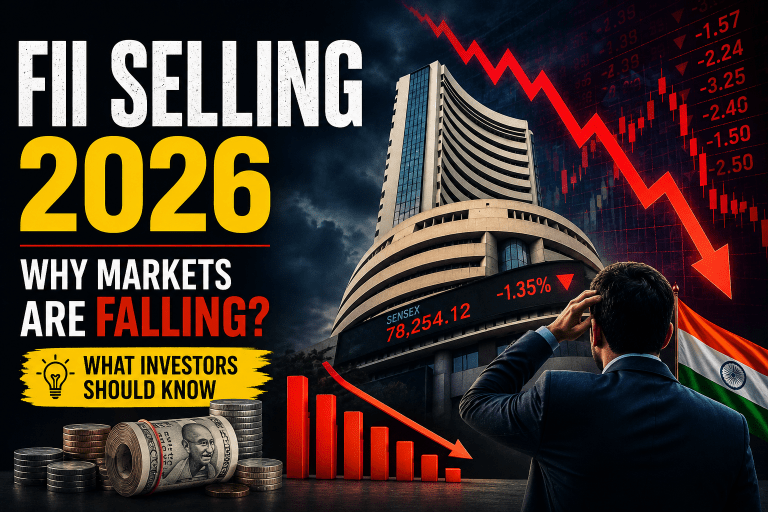
The Indian stock market in 2026 has been navigating an interesting phase. While the broader long-term outlook for the economy remains optimistic, one factor continues to dominate market conversations—persistent selling by Foreign Institutional Investors (FIIs).
For many investors, especially retail participants, this raises an important question: Is this a sign of deeper trouble, or just another phase in the market cycle?
To answer that, it’s important to understand not just what FII selling is, but why it happens and how it fits into the bigger picture.
Understanding FII Selling in the Current Context
Foreign Institutional Investors are among the largest participants in Indian equities. These include global mutual funds, pension funds, and large asset managers that allocate capital across countries based on risk, return, and macroeconomic conditions.
When FIIs begin to sell, the impact is often immediate. Markets tend to react sharply because these institutions control significant liquidity. In 2026, such selling has contributed to bouts of volatility, particularly around key index levels like the Nifty’s 24,000 range.
However, FII selling in itself is not unusual. It has occurred multiple times in the past, often triggered by global rather than domestic factors.
Why Are FIIs Pulling Money Out of India?
The current wave of outflows is largely being shaped by global dynamics rather than any structural weakness in the Indian economy.
One of the biggest drivers is the interest rate environment in developed markets. With central banks like the US Federal Reserve maintaining relatively high interest rates, global investors are finding safer and more predictable returns in government bonds. When risk-free returns become attractive, capital often shifts away from emerging markets like India.
Another important factor is crude oil prices. India remains heavily dependent on oil imports, and any sustained increase in oil prices tends to put pressure on inflation and the fiscal balance. This, in turn, affects investor sentiment and equity valuations.
Valuations themselves are also playing a role. Indian markets have been trading at a premium compared to many other emerging economies. While this reflects confidence in India’s growth story, it also creates opportunities for global investors to book profits and rebalance their portfolios.
Overlaying all of this is a broader layer of global uncertainty—geopolitical tensions, currency movements, and concerns about global growth. In such environments, investors tend to reduce exposure to riskier assets and move toward safer alternatives.
The Changing Nature of Market Support
What makes this phase different from earlier cycles is the growing role of domestic investors.
A few years ago, heavy FII selling would almost inevitably lead to sharp and prolonged market declines. Today, the situation is more balanced. Domestic Institutional Investors (DIIs), along with consistent inflows from retail investors through systematic investment plans (SIPs), are playing a much larger role in stabilizing markets.
This shift is important. It suggests that while FIIs continue to influence short-term movements, they no longer have complete control over market direction. The Indian market is gradually becoming more internally driven, supported by domestic savings and long-term capital.
How Markets Typically Behave During FII Outflows
Historically, phases of FII selling tend to follow a pattern.
Markets often react sharply at the beginning, as liquidity tightens and sentiment weakens. This is usually followed by a period of consolidation, where indices move within a range as domestic investors absorb the selling pressure. Eventually, once global conditions stabilize or earnings growth improves, markets begin to recover.
The current environment in 2026 appears to be in that middle phase—a period of consolidation with intermittent volatility.
What Does This Mean for Investors?
For investors trying to make sense of the situation, it helps to separate short-term noise from long-term fundamentals.
FII flows are, by nature, tactical. They respond quickly to changes in global conditions and can reverse just as quickly when those conditions change. The long-term direction of markets, however, tends to be driven more by earnings growth, economic expansion, and domestic liquidity.
This is why periods of FII selling are often viewed through different lenses by different participants. Some see them as signals of caution, while others interpret them as phases of adjustment within a broader growth trend.
Rather than reacting solely to FII activity, many market participants focus on underlying business performance, sectoral trends, and macroeconomic indicators.
Looking Ahead: What Could Change the Trend?
The direction of FII flows in the coming months will likely depend on a few key variables.
A shift in global interest rate expectations could alter capital flows significantly. If rates begin to ease, emerging markets may once again become attractive destinations for global capital. Stability in crude oil prices and currency movements could also improve sentiment.
At the same time, strong corporate earnings and continued economic momentum within India could reinforce confidence among both domestic and foreign investors.
The Bigger Picture
While FII selling tends to dominate headlines, it represents only one part of a much larger story.
India’s equity markets today are supported by a broader base of investors than ever before. Domestic participation has increased, financialization of savings is accelerating, and the economy continues to expand.
These structural factors suggest that while external shocks can influence short-term movements, the long-term trajectory of the market is shaped by deeper fundamentals.
Final Thoughts
FII selling in 2026 reflects a phase of global adjustment rather than a fundamental shift in India’s growth story.
It is a reminder that markets are interconnected and that capital flows respond quickly to changing conditions. At the same time, it also highlights how the Indian market is evolving—becoming more resilient, more balanced, and less dependent on external flows alone.
For investors, the key lies in understanding this context rather than reacting to isolated events. Market cycles come and go, but the broader trajectory is built over time.
Disclaimer
This article is for educational purposes only and should not be considered as investment advice. Investors are advised to consult their financial advisor before making any investment decisions.