

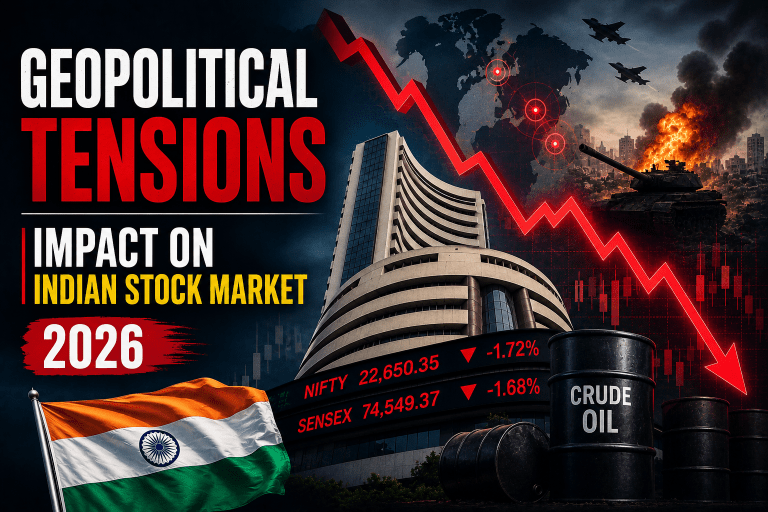
The Indian stock market in 2026 is not just reacting to domestic developments—it is increasingly being shaped by events unfolding thousands of miles away. From rising tensions in the Middle East to shifts in global power dynamics, geopolitical uncertainty has become one of the most influential forces driving market sentiment.
For investors, this raises a pressing question: Why do events in distant regions have such a strong impact on Indian equities? The answer lies in how deeply interconnected today’s financial systems have become.
The Invisible Thread Between Global Events and Indian Markets
At first glance, it may seem surprising that geopolitical developments outside India can influence local stock prices. However, modern markets are tightly linked through trade, capital flows, currency movements, and commodity prices.
When global uncertainty rises, investors across the world reassess risk. This often leads to a shift in capital—from equities and emerging markets to safer assets like gold, US bonds, or the dollar. India, being one of the largest emerging markets, naturally becomes part of this global rebalancing.
This is why even when domestic fundamentals remain stable, Indian markets can experience sudden bouts of volatility.
Why Geopolitical Tensions Trigger Market Reactions
One of the most immediate channels through which global tensions affect India is crude oil.
India imports a significant portion of its energy requirements. When geopolitical conflicts disrupt oil supply or create uncertainty around it, prices tend to rise. Higher oil prices increase inflationary pressure, widen the current account deficit, and affect corporate margins. All of this eventually reflects in stock market performance.
Currency movements add another layer of complexity. During periods of global stress, investors often move toward the US dollar, causing emerging market currencies like the rupee to weaken. A weaker rupee can make imports more expensive and reduce returns for foreign investors, which can further amplify capital outflows.
There is also a psychological dimension. Markets are driven not just by data, but by perception. Headlines about conflict, instability, or economic disruption tend to increase fear, leading to risk-averse behavior among investors.
The Role of Foreign Investors in Amplifying Volatility
Foreign Institutional Investors (FIIs) play a significant role in transmitting global shocks to Indian markets. When geopolitical risks rise, FIIs often reduce exposure to equities in emerging markets as part of broader portfolio adjustments.
This selling can intensify market declines, especially in large-cap stocks where foreign ownership is higher. At the same time, it can create ripple effects across sectors, increasing overall volatility.
However, it’s important to note that this behavior is not necessarily a reflection of India-specific concerns. In many cases, it is part of a global shift in asset allocation.
Sector-Wise Impact: Not All Stocks React the Same Way
Geopolitical tensions do not affect all sectors equally. Some industries are more sensitive to global developments than others.
Sectors like aviation, paints, and logistics tend to feel the pressure of rising fuel costs more directly. Similarly, companies with high import dependence may face margin challenges when currency volatility increases.
On the other hand, certain sectors can show relative resilience. Defensive segments such as FMCG and pharmaceuticals often attract investor interest during uncertain times due to their stable demand patterns.
Export-oriented industries may experience mixed effects, depending on currency movements and global demand conditions.
Market Behavior During Global Uncertainty
Historically, markets tend to go through distinct phases during geopolitical stress.
Initially, there is often a sharp reaction driven by uncertainty and rapid capital movement. This is followed by a period of adjustment, where investors begin to assess the actual economic impact rather than reacting purely to headlines. Over time, markets usually stabilize as clarity emerges and fundamentals reassert themselves.
The current phase in 2026 appears to reflect this pattern. While volatility remains elevated, there are also signs of resilience, supported by domestic participation and underlying economic strength.
How Investors Interpret Such Phases
Different investors respond to geopolitical uncertainty in different ways. Some prefer to reduce exposure and wait for clarity, while others view volatility as part of normal market cycles.
From an educational perspective, it is often observed that long-term investors focus more on structural trends—such as economic growth, corporate earnings, and policy direction—rather than short-term disruptions.
At the same time, periods of uncertainty tend to highlight the importance of diversification and risk management within portfolios.
What Could Ease Market Pressure?
The trajectory of the market in the coming months will depend on how geopolitical developments evolve.
Stability in oil prices would be a key positive factor. Similarly, any signs of easing tensions or diplomatic resolutions could improve global sentiment. Central bank policies, especially in developed economies, will also play an important role in shaping capital flows.
Domestically, continued economic momentum and earnings growth can provide a counterbalance to external risks.
The Bigger Picture: Short-Term Noise vs Long-Term Trends
While geopolitical tensions can dominate headlines and influence short-term market movements, they rarely alter the long-term trajectory of a growing economy.
India’s structural story—driven by consumption, infrastructure development, and digital transformation—remains intact. This is why markets often recover from externally driven shocks once uncertainty subsides.
Understanding this distinction between short-term triggers and long-term drivers is crucial for interpreting market behavior.
Final Thoughts
Geopolitical tensions are an unavoidable part of the global landscape, and their impact on financial markets is likely to persist. For Indian equities, these events act as external shocks that can influence sentiment, liquidity, and short-term price movements.
However, they are only one piece of a much larger puzzle. The long-term direction of the market continues to depend on economic fundamentals, corporate performance, and domestic participation.
For investors and observers alike, the key lies in viewing such developments in context—recognizing their impact without losing sight of the broader picture.
Frequently Asked Questions
Why do geopolitical tensions affect the Indian stock market?
They impact oil prices, currency movements, and global investor sentiment, all of which influence market performance.
Does war or global conflict always lead to market crashes?
Not always. Markets may react in the short term, but long-term trends depend on economic fundamentals.
Which sectors are most affected by global tensions?
Oil-sensitive and import-dependent sectors tend to be more impacted, while defensive sectors may remain relatively stable.
Disclaimer
This article is for educational purposes only and should not be considered as investment advice. Investors should consult their financial advisor before making any investment decisions.