

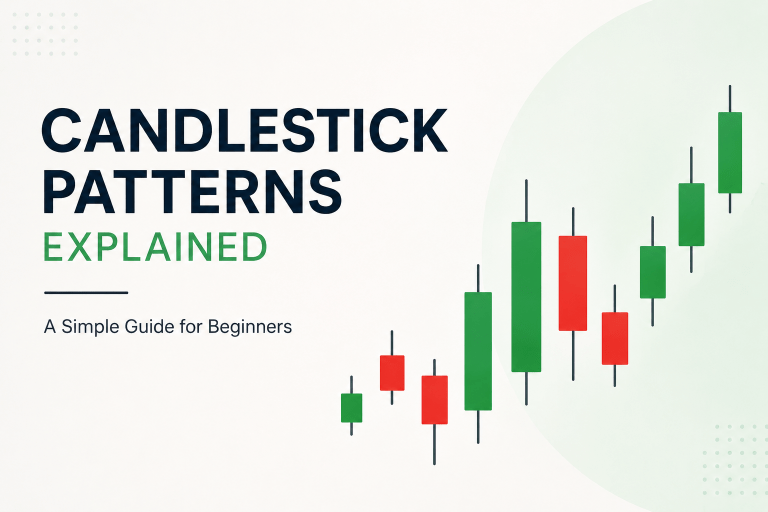
Candlestick patterns are one of the most important concepts in technical analysis and are widely used by traders to analyse market sentiment, identify trend reversals, and improve trading decisions.
Candlestick charts visually represent price movement and help traders understand the psychology of buyers and sellers in the stock market.
Whether you are learning technical analysis for beginners, intraday trading, or swing trading, candlestick patterns form the foundation of price action trading.
What are Candlestick Patterns?
Candlestick patterns are graphical representations of price movement during a specific time period.
Each candlestick shows:
- Opening price
- Closing price
- Highest price
- Lowest price
Candlestick patterns help traders identify:
- Bullish trends
- Bearish trends
- Reversal signals
- Continuation patterns
- Market momentum
Candlestick analysis is one of the most powerful tools used in technical analysis in stock market.
Components of a Candlestick
Candle Body
Represents the difference between opening and closing price.
Green Candle
Shows bullish price movement.
Red Candle
Shows bearish price movement.
Upper Shadow
Shows the highest price reached during the session.
Lower Shadow
Shows the lowest price during the session.
Why Candlestick Patterns are Important
Candlestick patterns help traders:
- Understand market psychology
- Identify trend reversals
- Spot breakout opportunities
- Improve entry and exit timing
- Analyse price action
Professional traders often combine candlestick analysis with:
- support and resistance
- RSI indicator
- moving averages
- volume analysis
- MACD indicator
for better trade confirmation.
Types of Candlestick Patterns
Candlestick patterns are mainly divided into:
Bullish Candlestick Patterns
Signals possible upward movement.
Bearish Candlestick Patterns
Signals possible downside movement.
Neutral Candlestick Patterns
Indicates market indecision.
Bullish Candlestick Patterns
Hammer Candlestick Pattern
The Hammer pattern appears after a decline and signals a potential bullish reversal.
Features
- Small candle body
- Long lower shadow
- Appears near support zone
Hammer patterns are widely used in swing trading strategies.
Bullish Engulfing Pattern
A strong bullish reversal pattern where:
- Green candle fully engulfs previous red candle
Indicates strong buying momentum.
Morning Star Pattern
Three-candle bullish reversal pattern.
Usually appears after strong selling pressure.
Signals possible trend reversal.
Piercing Line Pattern
Bullish reversal pattern where buyers regain control after bearish momentum.
Bearish Candlestick Patterns
Shooting Star Pattern
Appears after an uptrend and signals possible bearish reversal.
Features
- Small body
- Long upper shadow
- Weakening bullish momentum
Bearish Engulfing Pattern
A bearish candle completely engulfs previous bullish candle.
Signals strong selling pressure.
Evening Star Pattern
Three-candle bearish reversal structure.
Indicates weakening bullish trend.
Dark Cloud Cover Pattern
Bearish reversal signal after strong uptrend.
Neutral Candlestick Patterns
Doji Candlestick Pattern
Doji indicates indecision between buyers and sellers.
Appears when:
- Opening price ≈ Closing price
Doji patterns are important in price action trading.
Spinning Top Pattern
Shows market indecision and weak momentum.
Often appears during consolidation.
Marubozu Candlestick Pattern
Strong momentum candle with little or no shadows.
Bullish Marubozu
Strong buying pressure.
Bearish Marubozu
Strong selling pressure.
Candlestick Patterns with Support and Resistance
Candlestick patterns become more powerful near:
- Support levels
- Resistance zones
- Breakout areas
Example:
- Hammer near support → Strong bullish signal
- Shooting star near resistance → Bearish signal
This is why traders combine candlestick analysis with support and resistance in technical analysis.
Candlestick Patterns in Intraday Trading
Candlestick patterns are heavily used in intraday trading strategies.
Popular intraday patterns:
- Opening range breakout candles
- Bullish engulfing
- Marubozu candles
- Doji reversal
Intraday traders often use:
- Volume confirmation
- VWAP
- RSI
- Moving averages
along with candlestick analysis.
Candlestick Patterns in Swing Trading
Swing traders use candlestick patterns to:
- Identify reversals
- Confirm trend continuation
- Enter breakout trades
Best patterns for swing trading:
- Hammer
- Engulfing pattern
- Morning star
- Shooting star
How to Read Candlestick Patterns Correctly
Focus on Trend
Always analyse pattern within overall trend.
Check Volume
High volume improves reliability.
Use Confirmation
Avoid trading based on single candle alone.
Combine with Indicators
Use:
- RSI indicator
- MACD indicator
- moving averages
- volume analysis
for stronger confirmation.
Common Mistakes Beginners Make
Trading Every Pattern
Not every candlestick setup works.
Ignoring Market Trend
Trend direction matters more than isolated candles.
Ignoring Volume
Low-volume candles are less reliable.
No Risk Management
Always use stop-loss.
Proper risk management in trading is essential.
Advantages of Candlestick Patterns
Easy to Understand
Highly visual and beginner-friendly.
Works Across Markets
Used in:
- Stocks
- Forex
- Commodities
- Crypto
Useful for All Trading Styles
Works in:
- Intraday trading
- Swing trading
- Positional trading
Limitations of Candlestick Patterns
False Signals
Candlestick patterns may fail during volatile markets.
Needs Confirmation
Patterns work best with:
- Indicators
- Trend analysis
- Volume analysis
Emotional Trading Risk
Improper execution can lead to losses.
Best Candlestick Patterns for Beginners
If you are learning technical analysis for beginners, start with:
- Hammer
- Bullish engulfing
- Bearish engulfing
- Doji
- Shooting star
Mastering a few patterns is better than memorising too many setups.
Candlestick Patterns vs Chart Patterns
| Candlestick Patterns | Chart Patterns |
|---|---|
| Short-term signals | Larger market structures |
| Individual candles | Multiple price swings |
| Faster signals | Slower confirmation |
| Used in intraday trading | Used in swing trading |
Both are important parts of technical analysis.
Best Timeframes for Candlestick Analysis
| Trading Style | Best Timeframe |
|---|---|
| Intraday Trading | 5 min – 15 min |
| Swing Trading | Daily chart |
| Positional Trading | Weekly chart |
Higher timeframes usually provide stronger signals.
How to Practice Candlestick Analysis
Best ways to improve:
- Study historical charts
- Mark reversal zones
- Analyse live market candles
- Practice paper trading
- Maintain trading journal
Consistency is important while learning technical analysis.
Conclusion
Candlestick patterns are among the most powerful tools in technical analysis and help traders understand market psychology, price action, and momentum.
From bullish engulfing and hammer patterns to doji and shooting star candles, candlestick analysis helps traders improve timing and identify potential reversals.
However, successful trading requires combining candlestick patterns with:
- support and resistance
- RSI indicator
- moving averages
- volume analysis
- proper risk management
for better probability setups.
Frequently Asked Questions
What are candlestick patterns?
Candlestick patterns are chart formations used in technical analysis to identify market sentiment and price movement.
Which candlestick pattern is most reliable?
No single pattern is always reliable. Hammer, engulfing, and doji patterns are widely used.
Are candlestick patterns useful for intraday trading?
Yes, candlestick analysis is extremely popular in intraday trading.
Can beginners learn candlestick patterns easily?
Yes, candlestick patterns are visual and beginner-friendly.
Do candlestick patterns work alone?
No, they work best when combined with indicators and support-resistance analysis.