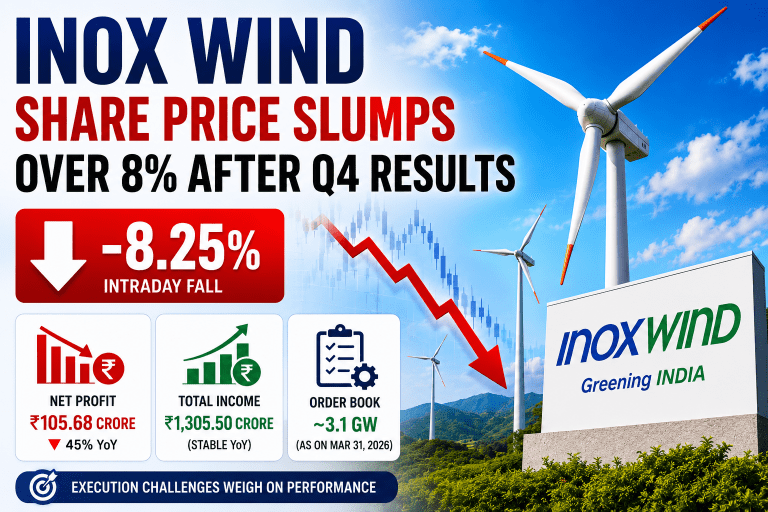
Shares of Inox Wind came under sharp selling pressure after the company announced its Q4 FY26 results. The stock declined more than 8% during trading as investors reacted to weaker profitability and concerns around execution challenges despite a healthy order book.
The decline has once again brought the renewable energy stock into focus, with market participants evaluating whether the correction presents a long-term opportunity or signals near-term caution.
Why Did Inox Wind Share Price Fall?
The primary reason behind the stock’s decline was a significant drop in quarterly profit.
For the March 2026 quarter, Inox Wind reported a consolidated net profit of ₹105.68 crore, down nearly 45% compared to ₹190.34 crore in the same quarter last year. Higher operating expenses and execution-related challenges weighed on profitability during the quarter.
The company’s total income remained largely stable at around ₹1,305 crore, but rising costs impacted margins and earnings growth. Investors were particularly concerned about weaker-than-expected operational performance.
Key Highlights From Inox Wind Q4 FY26 Results
Profit Declined Sharply
-
Net Profit: ₹105.68 crore
-
YoY decline: Around 45%
Revenue Remained Stable
-
Total Income: ₹1,305.50 crore
-
Marginal decline compared to last year
Higher Expenses Impacted Margins
The company witnessed rising operating and execution-related costs, which affected profitability despite steady revenue generation.
Strong Order Book Continues
One positive takeaway from the results was the company’s order backlog.
Inox Wind reported an order book of approximately 3.1 GW as of March 31, 2026, which provides revenue visibility for more than two years.
What Is Impacting Inox Wind’s Business?
According to the company, several operational challenges affected performance during the quarter:
-
Delays in project execution
-
Supply chain disruptions
-
Equipment availability issues
-
Logistics-related challenges
-
Delayed customer payments
-
Higher working capital requirements
Management indicated that these factors impacted execution timelines and profitability during the reporting period.
Renewable Energy Sector Remains in Focus
Despite short-term earnings pressure, the renewable energy sector continues to attract investor attention.
India’s push toward clean energy, increasing renewable energy capacity, and government initiatives supporting green power generation continue to create long-term growth opportunities for wind and solar energy companies.
As one of India’s major wind energy solutions providers, Inox Wind remains closely linked to the country’s renewable energy expansion plans.
What Are Analysts Saying?
Brokerages highlighted that Q4 performance was weaker than expectations due to lower execution and higher project-related costs.
However, analysts continue to monitor:
-
Execution improvement
-
Margin recovery
-
Order inflow growth
-
Project commissioning pace
-
Renewable energy demand trends
While earnings estimates have been revised lower by some brokerages, the company’s large order book remains a key factor being tracked by investors.
Key Factors Investors Should Watch
Going forward, investors may focus on:
-
Order execution progress
-
Revenue growth visibility
-
Margin improvement
-
Wind energy sector demand
-
Government renewable energy policies
-
Working capital management
-
Future quarterly earnings performance
These factors are likely to influence the stock’s performance in the coming quarters.
Conclusion
Inox Wind’s share price correction followed weaker-than-expected Q4 FY26 earnings and a sharp decline in net profit. While operational challenges affected short-term profitability, the company continues to maintain a strong order backlog that provides long-term revenue visibility.
Investors are expected to closely track execution improvements, margin recovery, and renewable energy sector growth before assessing the company’s future growth trajectory.
Disclaimer
This article is for informational and educational purposes only. It should not be considered investment advice, stock recommendations, or a solicitation to buy or sell securities. Investors should conduct their own research and consult a qualified financial advisor before making investment decisions.