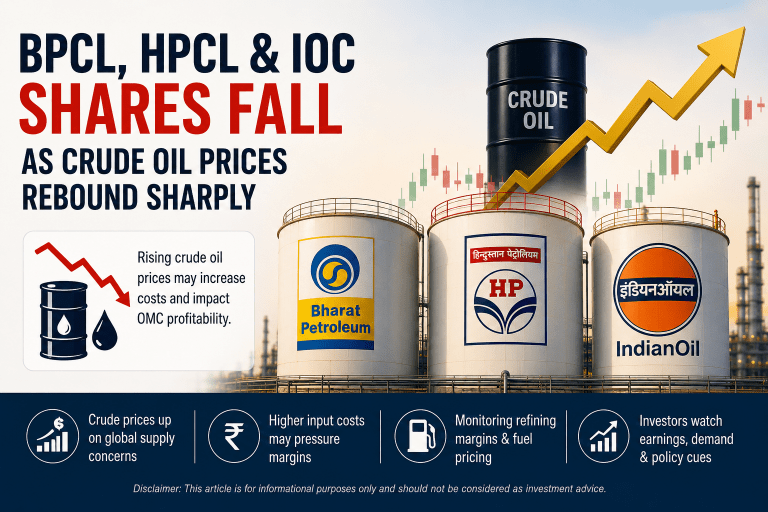
State-owned oil marketing companies (OMCs) witnessed selling pressure after global crude oil prices rebounded sharply, leading to a decline in the share prices of Bharat Petroleum Corporation Ltd. (BPCL), Hindustan Petroleum Corporation Ltd. (HPCL), and Indian Oil Corporation (IOC).
The decline reflects investor concerns that rising crude oil prices could increase input costs and impact the profitability of downstream oil marketing companies.
Why Did OMC Stocks Fall?
Crude oil prices moved higher following renewed geopolitical concerns and expectations of tighter global supply. Since India imports a significant portion of its crude oil requirements, any sharp increase in international oil prices can influence the earnings outlook for fuel retailers.
Higher crude prices may result in:
- Increased raw material costs for refiners
- Pressure on fuel marketing margins
- Higher working capital requirements
- Concerns over near-term profitability
These factors often lead to cautious investor sentiment toward oil marketing companies.
Impact on BPCL, HPCL and IOC
Following the rise in crude oil prices, shares of major public sector OMCs witnessed a broad-based decline during the trading session.
While short-term price movements may be influenced by changes in crude oil prices, investors also closely monitor:
- Refining margins
- Government fuel pricing policies
- Demand for petroleum products
- Inventory gains or losses
- Quarterly financial performance
These factors collectively determine the long-term earnings outlook for oil marketing companies.
Why Crude Oil Matters for OMC Stocks
Oil marketing companies purchase crude oil, refine it into petroleum products, and sell fuels such as petrol, diesel, LPG, and aviation fuel.
When crude oil prices rise rapidly, companies may experience margin pressure if retail fuel prices do not adjust proportionately. Conversely, stable or lower crude prices generally support profitability by reducing input costs.
What Should Investors Watch?
Investors may continue tracking the following factors:
- Global crude oil price trends
- Geopolitical developments affecting oil supply
- Domestic fuel pricing decisions
- Quarterly earnings and management commentary
- Refining margin performance
These indicators can influence market sentiment toward the oil & gas sector.
Key Takeaway
The recent decline in BPCL, HPCL, and IOC shares highlights the sensitivity of oil marketing companies to fluctuations in global crude oil prices. While short-term volatility may continue, long-term performance will depend on multiple operational and macroeconomic factors, including crude price trends, refining margins, government policies, and overall demand for petroleum products.
Disclaimer: This article is for informational and educational purposes only and should not be construed as investment advice or a recommendation to buy, sell, or hold any security. Investors should conduct their own research or consult a qualified financial advisor before making investment decisions.