

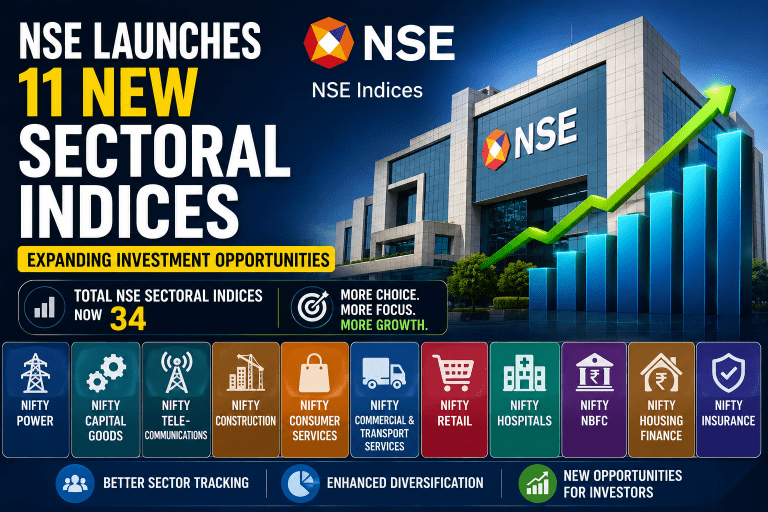
The National Stock Exchange (NSE), through its index subsidiary NSE Indices, has launched 11 new sectoral indices, significantly expanding its sector-based offerings amid growing demand for passive investment products, ETFs, and index funds. The move increases the total number of NSE sectoral indices to 34 and provides investors with more focused ways to track specific segments of the Indian economy.
The launch reflects the rising popularity of thematic and sector-specific investing, where investors seek targeted exposure to industries that are expected to benefit from long-term economic trends such as infrastructure development, financial inclusion, healthcare expansion, digital transformation, and rising consumer spending.
List of the 11 New NSE Sectoral Indices
The newly introduced sectoral indices include:
- Nifty Power
- Nifty Capital Goods
- Nifty Telecommunications
- Nifty Construction
- Nifty Consumer Services
- Nifty Commercial & Transport Services
- Nifty Retail
- Nifty Hospitals
- Nifty NBFC
- Nifty Housing Finance
- Nifty Insurance
These additions broaden the range of sectors available for benchmarking, portfolio construction, and passive investment products.
Why Has NSE Introduced New Sectoral Indices?
The launch comes at a time when passive investing is witnessing rapid growth in India.
Over the last few years, investors have increasingly allocated money to:
- Exchange Traded Funds (ETFs)
- Index Funds
- Smart Beta Products
- Sectoral Investment Strategies
- Thematic Funds
Sector-specific indices allow fund houses and asset managers to create products focused on individual industries rather than broader market indices such as Nifty 50 or Nifty 500.
What Is a Sectoral Index?
A sectoral index tracks companies operating within a specific industry.
For example:
- Nifty Bank tracks banking stocks.
- Nifty Pharma tracks pharmaceutical companies.
- Nifty IT tracks information technology companies.
Similarly, the newly launched indices will track companies within their respective sectors, allowing investors to monitor industry performance more effectively.
Key Indices That Could Attract Investor Attention
Nifty Power
India’s power sector is undergoing significant transformation through renewable energy investments, transmission expansion, and increasing electricity demand.
The Nifty Power Index is expected to provide investors with a benchmark for tracking companies involved in power generation, transmission, and distribution.
Nifty Hospitals
Healthcare remains one of India’s fastest-growing sectors.
The Nifty Hospitals Index will offer focused exposure to listed hospital operators and healthcare service providers, helping investors track growth in healthcare infrastructure and rising demand for medical services.
Nifty Retail
India’s retail sector continues to benefit from urbanization, rising incomes, digital commerce adoption, and growing consumer spending.
The Nifty Retail Index could become an important benchmark for investors seeking exposure to consumption-driven growth.
Nifty Insurance
Insurance penetration in India remains relatively low compared to developed markets.
The Nifty Insurance Index provides a dedicated benchmark for tracking listed insurance companies that may benefit from increasing financial awareness and protection needs.
Nifty NBFC
Non-Banking Financial Companies play a crucial role in India’s credit ecosystem.
The new index enables investors to monitor lending-focused financial institutions separately from traditional banks.
How Do New Indices Benefit Investors?
Better Sector Tracking
Investors can monitor specific industries without relying solely on broader market benchmarks.
Improved Portfolio Diversification
Sectoral indices allow investors to gain exposure to targeted themes and industries.
Support for ETFs and Index Funds
The launch creates opportunities for fund houses to introduce new passive investment products linked to these sectors.
Enhanced Market Transparency
Dedicated indices provide clearer visibility into sector-specific performance trends.
Impact on the Indian Investment Landscape
India’s passive investing industry has expanded significantly in recent years, with increasing investor participation in ETFs and index-based products.
The addition of these sectoral indices could further accelerate:
- ETF launches
- Sectoral index funds
- Institutional participation
- Thematic investing strategies
As investors increasingly seek targeted exposure rather than broad-market investments, sectoral indices are becoming an important part of portfolio construction.
What Should Investors Watch Next?
Market participants will be watching:
- ETF launches linked to the new indices
- Index fund offerings
- Sector-wise constituent companies
- Trading volumes and adoption rates
- Institutional investor participation
The success of these indices will largely depend on how quickly asset managers incorporate them into new investment products.
Frequently Asked Questions
How many new sectoral indices has NSE launched?
NSE Indices has launched 11 new sectoral indices, taking the total number of sectoral indices under the Nifty umbrella to 34.
Which are the major new indices?
Key additions include Nifty Power, Nifty Retail, Nifty Hospitals, Nifty NBFC, Nifty Insurance, and Nifty Housing Finance.
Why are sectoral indices important?
Sectoral indices help investors track industry-specific performance and serve as benchmarks for ETFs, index funds, and thematic investment products.
Will new ETFs be launched based on these indices?
While no specific products have been announced yet, sectoral indices are commonly used as benchmarks for future ETF and index fund launches.
Conclusion
The launch of 11 new NSE sectoral indices marks another step in the evolution of India’s passive investment ecosystem. By introducing benchmarks for sectors such as power, hospitals, retail, insurance, telecommunications, and housing finance, NSE is providing investors with more precise tools to track and participate in India’s growth story.
As demand for thematic and sector-specific investing continues to rise, these indices could become important benchmarks for future ETFs, index funds, and institutional investment strategies.
Disclaimer: This article is for informational and educational purposes only and should not be construed as investment advice, stock recommendations, or a solicitation to buy or sell securities. Investors should conduct their own research and consult a SEBI-registered investment adviser before making investment decisions.