

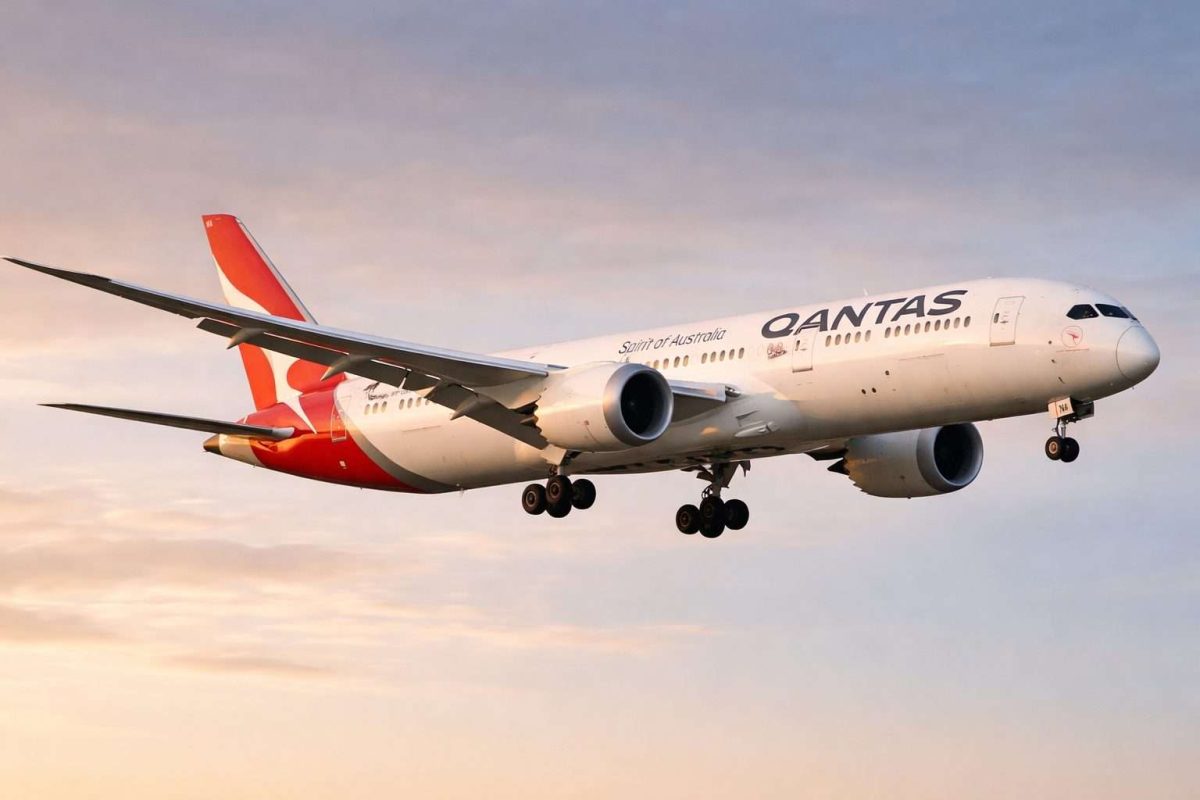
The Qantas Airways share price turned sharply lower in the stock market today. Investors woke up to a heavy sell-off after escalating tensions in the Middle East disrupted global aviation and pushed oil prices higher.
In early trade, the reaction was immediate. The market did not wait.
The sharp fall in the Qantas Airways share price reflects how sensitive airline stocks are to geopolitical shocks, rising crude oil prices, and sudden airspace closures.
Let’s break it down clearly.
Market Performance: Qantas Airways Share Price Hits 10-Month Low
Shares of Qantas Airways dropped as much as 10.4% at the open of the Australian market.
- Stock touched A$8.92 per share
- Lowest level since May 2, 2025
- Later pared losses but still down 5.8% by 2345 GMT
This marks a significant move in the Qantas Airways share price, making it one of the most watched stocks in the stock market today.
The broader market also reflected caution.
The benchmark S&P/ASX 200 slipped 0.5% to 9,156.20 by 2332 GMT, as risk-off sentiment dominated trading after large-scale strikes involving the US and Israel targeting Iran.
For context, the index had gained 0.3% on Friday before the weekend escalation.
 What Triggered the Fall in Qantas Airways Share Price?
The immediate trigger was the US-Israel-Iran conflict over the weekend.
Strikes and retaliatory attacks disrupted major air corridors. Oil prices surged. Airlines faced operational uncertainty. Investors reacted swiftly.
Here’s what intensified the pressure:
- Escalating conflict involving US, Israel, and Iran
- Attacks impacting key Middle East airports
- Rising crude oil prices
- Thousands of flights delayed or cancelled
- Key regional airspaces shut down
For airline stocks like Qantas, higher oil prices directly increase operating costs. At the same time, airport closures hit revenue streams. It is a double blow.
That explains the sharp move in the Qantas Airways share price in the stock market today.
Global Aviation in Turmoil: Flights Cancelled Across Regions
This is being described as the biggest disruption to global air travel since the Covid-19 pandemic.
Airspace closures spread across multiple countries:
- Iran
- Iraq
- Israel
- Syria
- Kuwait
- Qatar
- United Arab Emirates
Iran closed its airspace “until further notice.”
Israel shut its skies to civilian flights.
Qatar temporarily closed its airspace.
Iraq suspended operations.
The UAE partially and temporarily closed airspace.
The ripple effect was global.
Flight tracking platform FlightAware reported:
- 6,700+ flights delayed
- 1,900 flights cancelled globally as of 1000 GMT Sunday
- Thousands more affected the day before
Dubai and Doha — two critical global aviation hubs — remained shut for a second day.
Tens of thousands of passengers were stranded.
When aviation hubs close, airline stocks react. That pressure was visible in the Qantas Airways share price immediately.
Oil Prices and Airline Stocks: The Core Link
Airlines operate on tight margins. Fuel cost is one of the largest expenses.
When geopolitical conflict breaks out, oil prices typically rise on supply risk concerns.
That’s exactly what happened after large-scale strikes targeted Iran and retaliation followed.
Higher oil prices mean:
- Increased operating costs
- Margin pressure
- Reduced earnings visibility
- Lower investor confidence
In the stock market today, airline shares across the Asia-Pacific region reflected this stress.
Competitor Moves: Airline Stocks Under Pressure
Qantas was not alone.
Shares of Australia’s second-largest airline, Virgin Australia, also fell sharply.
- Slipped as much as 3.5%
- Hit A$3.03 per share
- Lowest level in nearly a month
- Later gained back around 1.9%
Meanwhile, Air New Zealand shares:
- Fell up to 0.5%
- Touched NZ$0.553
- Lowest since April 7, 2025
- Later traded flat
The weakness across airline stocks shows the broader impact on aviation sentiment.
Sector Impact in Stock Market Today
The war-driven volatility did not stop with airlines.
As trading progressed:
- Banking stocks declined
- Technology stocks slipped
- Airline stocks remained under pressure
However, not all sectors fell.
Gold, energy, and defence stocks moved higher amid war concerns. Investors shifted capital to perceived safe-haven and defence-linked sectors.
Risk-off mood clearly dominated the stock market today.
Major Airlines Suspending Services
Several international carriers cancelled services amid airspace uncertainty, including:
- Emirates
- Etihad
- Air France
- British Airways
- Air India
- Turkish Airlines
- Lufthansa
The cascading cancellations intensified fears of extended disruption.
For Qantas, even indirect exposure to major international hubs adds uncertainty to global operations and route planning.
Company Snapshot: Qantas Airways
Qantas Airways is Australia’s flagship airline and a key player in international travel.
It operates domestic and international routes and remains heavily linked to global aviation flows, fuel pricing, and geopolitical stability.
The latest decline in the Qantas Airways share price marks its lowest trading level in 10 months, underscoring how external shocks can quickly reshape investor sentiment in aviation stocks.
Summary: Why Qantas Airways Share Price Fell Today?
Here’s a quick recap:
- Qantas Airways share price dropped 10.4% to A$8.92
- Lowest level since May 2, 2025
- Later down 5.8%
- S&P/ASX 200 fell 0.5% to 9,156.20
- 6,700+ flight delays and 1,900 cancellations reported globally
- Multiple Middle Eastern airspaces closed
- Oil prices surged on geopolitical tensions
In the stock market today, the Qantas Airways share price reflected pure risk sentiment.
Airline stocks move fast when fuel costs rise and airspace shuts down. Markets price uncertainty instantly.
For now, global aviation remains sensitive to geopolitical developments, and airline shares continue to trade in line with broader risk sentiment.
The coming sessions in the stock market today will remain closely watched as developments unfold in the Middle East.
Source: Livemint




 Easy & quick
Leave A Comment?