


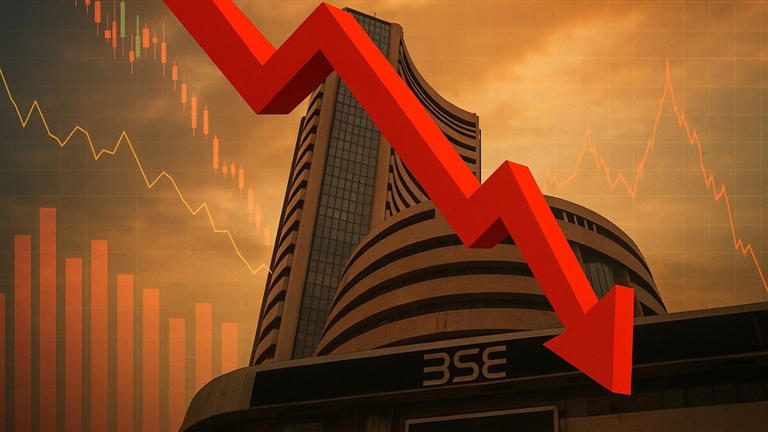
The Indian stock market witnessed a sharp correction today. Sensex crashes over 950 points, investors lose ₹4 lakh crore — that’s the headline dominating Dalal Street conversations.
It wasn’t a slow drift lower. It was a sudden wave of selling across sectors.
Profit booking. Global uncertainty. Rising crude oil. And a lack of fresh domestic triggers.
Let’s break it down calmly and clearly.
Market Performance: Broad-Based Selloff Across Indices
The fall was swift and visible across the board.
- Sensex crashed over 950 points
- Nifty 50 touched an intraday low of 25,544.90
- BSE market capitalisation dropped from ₹472 lakh crore to ₹468 lakh crore
- Investors lost nearly ₹4 lakh crore in a single session
- Mid-cap and small-cap indices declined over 0.5% each
When Sensex crashes over 950 points, it usually reflects fear spreading beyond just one or two sectors. That’s exactly what happened today.
There was no sector immunity. The selloff was broad-based.
Midcaps and small caps, which had seen strong participation in recent sessions, also felt the pressure. The drop in market capitalisation clearly shows the scale of today’s fall.
Main News: Why Is the Stock Market Falling?
The question investors are asking: Why did Sensex crash over 950 points today?
Let’s examine the five key factors influencing market sentiment.
1. Profit Booking After Recent Gains
Markets had gained for three consecutive sessions before today.
After steady upward movement, some investors decided to book profits.
Recent macro events — including the Budget, India-US deal discussions, RBI policy updates, and Q3 results — are now behind us.
With:
- No fresh domestic triggers
- Earnings season largely over
- Major announcements already factored in
The market moved into stock-specific action. And in such situations, broader indices can slip when profit-taking increases.
When Sensex crashes over 950 points, investors lose ₹4 lakh crore, profit booking is often one of the first reasons.
 2. US Fed’s Mixed Signals Weigh on Global Markets

Global cues played a strong role.
Minutes from the US Federal Reserve’s January meeting showed divided views among officials:
- Some see scope for easing if inflation cools
- Others are ready to tighten policy if price pressures continue
Uncertainty around US rate policy creates volatility in emerging markets like India.
Why?
Because:
- A stronger US dollar can impact foreign capital flows
- India had seen FII inflows resume in February
- Before that, there were seven consecutive months of sell-offs in the cash segment
Rate uncertainty always brings caution. And caution often leads to selling.
3. Geopolitical Tension: Focus on US-Iran Developments
Global headlines added more pressure.
Reports claimed that the US military could potentially launch a strike on Iran soon.
Another report suggested that any such move could turn into a prolonged campaign rather than a limited operation.
Markets do not like geopolitical tension.
Investors prefer certainty. When escalation risks rise, many participants reduce exposure before weekends or major developments.
That mood was visible today.
Money came off the table. Risk appetite reduced.
4. Surge in Crude Oil Prices Adds Pressure
Oil prices jumped sharply, influencing market sentiment.
Previous session:
- WTI crude rose 4.60% to $65.19 per barrel
- Brent crude gained 4.35% to $70.35 per barrel
Today:
- Brent crude moved up to $70.53 per barrel
- WTI crude climbed to $65.4 per barrel
Elevated crude oil prices are negative for India.
Why?
- India is one of the largest crude oil importers
- Higher oil prices impact inflation
- They can pressure the rupee
- They affect fiscal stability
When crude rises sharply along with global uncertainty, markets react.
The timing couldn’t have been worse.
5. Lack of Immediate Positive Triggers
Another key reason behind the fall is the absence of fresh momentum drivers.
The major domestic events are already behind us:
- Budget announcements
- RBI policy decision
- Q3 earnings season
Markets now search for fresh cues.
Without immediate catalysts, indices struggle to build on recent gains.
Valuations also remain a talking point:
- Nifty is trading around 20 times FY27 estimated earnings
- NSE midcap index at 28 times
- NSE small-cap index at 24 times FY27 earnings
When valuations remain elevated and fresh triggers are missing, markets often turn range-bound or volatile.
Today’s sharp dip reflects that fragility.
Impact on Investors: ₹4 Lakh Crore Erosion
Let’s put today in perspective.
- BSE market cap yesterday: ₹472 lakh crore
- BSE market cap today: ₹468 lakh crore
- Wealth erosion: ₹4 lakh crore
When Sensex crashes over 950 points, investors lose ₹4 lakh crore, it affects:
- Retail investors
- Mutual fund portfolios
- Institutional holdings
- Short-term traders
But importantly, today’s fall reflects sentiment adjustment, not structural breakdown.
Company & Sector-Wise Participation
This was not a single-sector fall.
- Large caps faced selling pressure
- Midcaps declined over 0.5%
- Small caps also slipped over 0.5%
The selling was broad-based.
There was no isolated trigger from one specific industry.
It was macro-driven.
How the Market Mood Shifted?
For three sessions, the mood was constructive.
But markets rarely move in a straight line.
After gains:
- Some investors locked profits
- Global risks resurfaced
- Crude oil spiked
- US Fed uncertainty increased
And within hours, Sensex crashes over 950 points, investors lose ₹4 lakh crore became the day’s defining market event.
Summary: What Today’s Market Fall Really Means?
Let’s recap calmly.
Today’s correction was driven by a mix of:
- Profit booking after recent gains
- US Fed policy uncertainty
- Geopolitical concerns around US-Iran
- Sharp rise in crude oil prices
- Lack of fresh domestic triggers
Key numbers:
- Sensex down over 950 points
- Nifty 50 touched 25,544.90
- Market cap fell from ₹472 lakh crore to ₹468 lakh crore
- ₹4 lakh crore wealth erosion
- Brent crude at $70.53
- WTI crude at $65.4
The fall was sharp. Sentiment-driven. Broad-based.
Markets move in cycles. Gains invite profit booking. External uncertainty adds volatility.
Today was one of those sessions where everything aligned on the negative side at once.
And when that happens, the headline writes itself:
Sensex crashes over 950 points, investors lose ₹4 lakh crore.
We continue to track the evolving global and domestic cues closely.
Source: Livemint




 Easy & quick
Leave A Comment?