

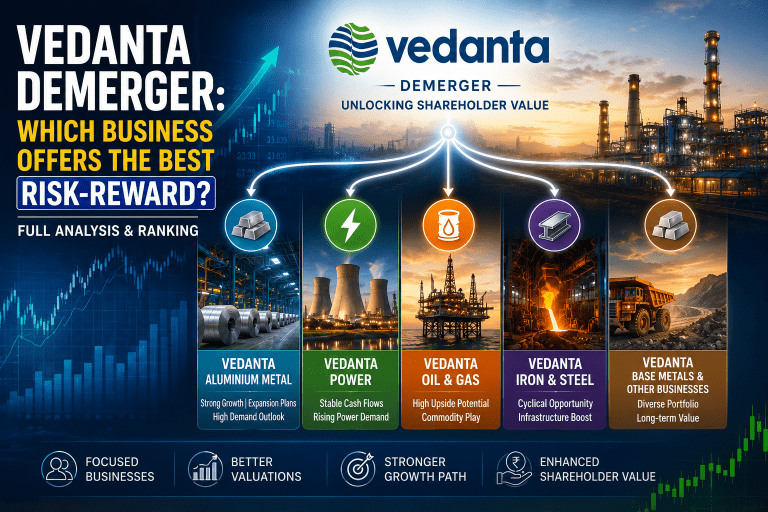
The much-awaited Vedanta demerger has finally reached its last phase, creating five focused listed companies from the diversified Vedanta empire. The restructuring aims to unlock shareholder value by allowing investors to independently evaluate businesses operating in aluminium, power, oil & gas, iron & steel, and base metals. Recent listings of the demerged entities have already resulted in a significant increase in combined market capitalization, highlighting the market’s positive response to the move.
For investors, the key question is no longer whether the demerger was beneficial—but which of the newly listed companies offers the best long-term risk-reward opportunity.
Understanding the Vedanta Demerger
Under the demerger scheme, shareholders of Vedanta received one share each in the newly created businesses while continuing to hold shares of the parent company. The restructuring created independent listed entities focused on:
-
Vedanta Aluminium Metal
-
Vedanta Power
-
Vedanta Oil & Gas
-
Vedanta Iron & Steel
-
Residual Vedanta Ltd (Base Metals & Other Businesses)
The objective is to provide greater transparency, operational focus, and sector-specific valuations. (ICICI Direct)
Why Investors Are Excited About the Demerger
Historically, conglomerates often trade at a “holding company discount” because investors struggle to accurately value multiple businesses under a single umbrella.
The Vedanta split aims to address this by:
-
Improving business-specific valuation
-
Allowing focused capital allocation
-
Attracting sector-focused institutional investors
-
Enhancing operational accountability
-
Unlocking hidden shareholder value
Following the listing of the demerged entities, the combined market value of the group surged significantly compared to the pre-demerger valuation, suggesting investors see potential in the standalone businesses.
Analysis of Each Demerged Business
1. Vedanta Aluminium Metal
Business Overview
Vedanta Aluminium is among India’s largest aluminium producers and contributes a substantial portion of the group’s revenues. Aluminium demand is expected to benefit from:
-
Electric vehicles
-
Renewable energy infrastructure
-
Transmission projects
-
Aerospace applications
-
Construction demand
The company has announced aggressive expansion plans and management continues to view aluminium as a major growth engine.
Growth Drivers
-
Rising domestic manufacturing activity
-
Government infrastructure spending
-
Energy transition demand
-
Export opportunities
-
Capacity expansion roadmap
Risks
-
Dependence on global aluminium prices
-
Energy costs
-
Commodity cycle volatility
Risk-Reward Assessment
High Growth + Moderate Risk
Several market observers have highlighted Vedanta Aluminium as one of the strongest businesses emerging from the demerger due to its scale, profitability, and expansion potential. (The Economic Times)
2. Vedanta Power
Business Overview
Vedanta Power operates thermal power assets that support both captive and commercial power generation.
Power demand in India continues to rise due to:
-
Industrial expansion
-
Data center growth
-
Manufacturing initiatives
-
Electrification trends
Growth Drivers
-
Growing electricity demand
-
Stable cash generation
-
Long-term industrial consumption
Risks
-
Coal price volatility
-
Environmental regulations
-
Transition toward renewable energy
Risk-Reward Assessment
Moderate Growth + Moderate Risk
While the power business can generate predictable cash flows, investors may assign lower valuation multiples due to environmental concerns and slower growth compared to metals and energy businesses.
3. Vedanta Oil & Gas
Business Overview
The oil and gas business gives investors exposure to India’s energy sector.
Growth Drivers
-
Domestic energy demand
-
Reduced import dependence
-
Potential production growth
-
Strategic importance to India’s energy security
Risks
-
Crude oil price volatility
-
Regulatory changes
-
Exploration risks
Risk-Reward Assessment
High Reward + High Risk
Oil & Gas offers strong upside during favorable commodity cycles but can experience significant earnings swings when oil prices decline. Investors comfortable with commodity volatility may find this business attractive.
4. Vedanta Iron & Steel
Business Overview
The company provides exposure to India’s infrastructure and manufacturing growth story.
Growth Drivers
-
Infrastructure spending
-
Railways and construction projects
-
Manufacturing expansion
Risks
-
Cyclical steel prices
-
Raw material costs
-
Competitive industry structure
Risk-Reward Assessment
Moderate Reward + High Cyclicality
Steel remains a highly cyclical sector. Returns can be substantial during economic expansion but may weaken sharply during downturns.
5. Residual Vedanta Ltd
Business Overview
The remaining Vedanta entity continues to house key base metal assets and strategic investments.
Growth Drivers
-
Diversified exposure
-
Zinc and copper demand
-
Commodity supercycle opportunities
Risks
-
Debt concerns
-
Commodity price fluctuations
-
Global economic slowdown
Risk-Reward Assessment
Balanced Risk-Reward
Investors seeking diversification across metals may continue to find value in the residual company. The parent entity remains a major natural resources player with exposure to multiple commodities. (Screener)
Risk-Reward Ranking of Vedanta Demerger Stocks
| Rank | Company | Growth Potential | Risk Level | Overall View |
|---|---|---|---|---|
| 1 | Vedanta Aluminium Metal | Very High | Moderate | Most attractive risk-reward |
2 |
Vedanta Oil & Gas | High | High | Suitable for aggressive investors |
| 3 | Residual Vedanta Ltd | Moderate-High | Moderate | Diversified exposure |
| 4 | Vedanta Power | Moderate | Moderate | Stable cash-flow business |
| 5 | Vedanta Iron & Steel | Moderate | High | Cyclical opportunity |
Key Factors Investors Should Monitor
Before investing in any demerged entity, consider:
Commodity Prices
The performance of aluminium, zinc, oil, and steel prices can significantly influence earnings. Recent metal price strength has supported profitability across the Vedanta group. (Reuters)
Debt Allocation
The final debt structure of each company will play a crucial role in determining long-term shareholder returns.
Dividend Policy
Vedanta has historically attracted investors due to dividends. Management has indicated continued focus on shareholder returns, though each company will decide its own payout policy.
Expansion Plans
The group has announced significant capital expenditure plans across aluminium, steel, power, and other businesses over the coming years.
Conclusion
The Vedanta demerger marks one of the largest value-unlocking exercises in India’s metals and mining sector. While all the newly listed companies offer distinct investment opportunities, Vedanta Aluminium Metal currently appears to have the strongest combination of scale, growth visibility, industry tailwinds, and valuation potential. Meanwhile, Vedanta Oil & Gas offers higher upside for investors willing to tolerate commodity-driven volatility.
Investors should remember that demerged companies often experience significant price discovery and volatility in the initial months after listing. Therefore, investment decisions should be based on business fundamentals, risk tolerance, and long-term financial goals rather than short-term market movements.
Disclaimer: This article is for educational and informational purposes only and should not be construed as investment advice, stock recommendations, or a solicitation to buy or sell securities. Investors should conduct their own research and consult a registered financial advisor before making investment decisions.