

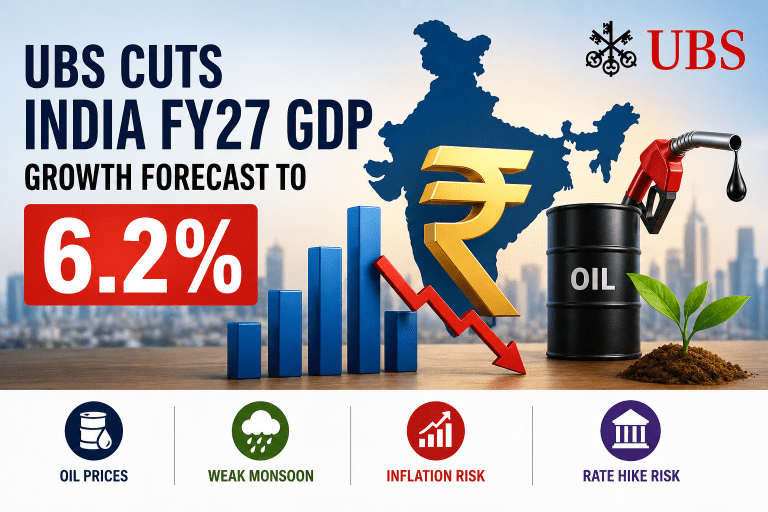
India’s growth story remains strong—but not without challenges. Recently, UBS Group AG revised India’s FY27 GDP growth forecast to 6.2%, down from 6.7%.
This has raised important questions:
- Is India’s growth slowing down?
- What role do oil prices and monsoon play?
- Should investors be worried?
Let’s decode this in a simple, investor-focused way.
Quick Overview
India’s GDP growth forecast for FY27 has been cut to 6.2% by UBS due to:
- Rising crude oil prices
- Weak monsoon risks
- Persistent inflation
Despite this, India remains one of the fastest-growing major economies globally.
What Led to the GDP Forecast Cut?
1. Crude Oil Price Shock
India imports ~85% of its crude oil needs. When global prices rise, the impact is immediate.
Impact of crude oil on Indian economy:
- Higher fuel and logistics costs
- Increased inflation
- Pressure on fiscal deficit
This directly affects both businesses and consumers.
2. Weak Monsoon Risk & Rural Slowdown
A large portion of India still depends on agriculture. UBS highlighted concerns around a below-normal monsoon.
Why monsoon matters:
- Drives rural income
- Impacts FMCG demand
- Influences food inflation
A weak monsoon = weaker rural demand = slower GDP growth.
3. Sticky Inflation
Inflation remains a key risk, especially with rising:
- Food prices
- Fuel costs
This puts pressure on the Reserve Bank of India to act.
Will RBI Increase Interest Rates in FY27?
UBS expects a possible rate hike in H2 FY27 if inflation remains high.
What happens when interest rates rise?
- Loans (home, auto, business) become expensive
- Spending slows down
- Markets may turn volatile
However, rate hikes also help in controlling inflation—so it’s a balancing act.
Sector-Wise Impact: Who Wins, Who Loses?
Likely Under Pressure
- Oil-sensitive sectors: Aviation, Paints, Logistics
- Rural-driven sectors: FMCG, Tractors
Mixed Impact
- Banking & NBFCs (due to rate cycle)
- Real Estate (interest rate sensitivity)
Relatively Stable (Long-Term)
- Infrastructure
- Capital Goods
- Export-oriented sectors
What Should Investors Do Now?
Instead of reacting emotionally to headlines, focus on strategy:
Smart Moves in Current Scenario
- Diversify across sectors
- Focus on fundamentally strong stocks
- Avoid overexposure to oil-sensitive sectors
- Stay long-term focused
Remember: GDP slowdown ≠ market crash
India Growth Story: Still Intact?
Yes.
Even at 6.2% GDP growth, India remains among the fastest-growing large economies. Structural drivers like:
- Digital adoption
- Manufacturing push
- Strong domestic consumption
continue to support long-term growth.
Frequently Asked Questions
What is India’s GDP forecast for FY27?
UBS estimates India’s GDP growth at 6.2%.
Why did UBS cut India’s growth forecast?
Due to rising oil prices, weak monsoon risks, and inflation concerns.
Will RBI hike interest rates?
There is a possibility of rate hikes in the second half of FY27 if inflation remains high.
Is this bad for stock market investors?
Not necessarily. It may cause short-term volatility, but long-term growth remains intact.
Final Takeaway
The UBS downgrade is a caution signal, not a red flag.
Short-term risks like oil prices and monsoon variability may create volatility—but India’s long-term fundamentals remain strong. For investors, this is a phase to stay disciplined, not defensive.
Disclaimer
This content is for educational and informational purposes only and should not be considered investment advice. Please consult a SEBI-registered financial advisor before making investment decisions. Investments in securities markets are subject to market risks.