


Introduction: What Is a Nifty Option?
A Nifty option is a derivative contract that derives its value from the Nifty 50 index, which tracks the performance of the top 50 large-cap companies listed on the National Stock Exchange (NSE). In simple terms, Nifty options allow traders to take positions on the overall direction of the Indian stock market without buying individual shares.
When traders ask “what are Nifty options?, they are essentially referring to contracts that give the buyer the right, but not the obligation, to buy or sell the Nifty 50 index at a fixed price (called the strike price) on or before a specific expiry date.
Nifty options are among the most actively traded option contracts in India due to their high liquidity, tight spreads, and flexibility across market conditions. Traders, investors, and institutions widely use these contracts for hedging, directional trading, and income generation.
Basics of Nifty Options
Nifty 50 as the Underlying Asset
The Nifty 50 index represents India’s benchmark equity index, comprising companies from key sectors such as banking, IT, FMCG, automobiles, metals, and energy. Since Nifty reflects broader market sentiment, Nifty options are influenced by:
- RBI monetary policy decisions
- Inflation and interest rate movements
- Global equity market trends
- FII and DII flows
Unlike stock options, Nifty options are index options, meaning they are cash-settled and unaffected by company-specific news such as earnings or management changes. This makes Nifty options ideal for traders seeking exposure to market-wide movements.
Components of a Nifty Option Contract
Understanding how Nifty options work requires clarity on their core components.
Strike Price
The strike price is the predetermined level at which the option holder can buy or sell the Nifty index.
Example:
If Nifty is trading at 22,000, strike prices such as 21,900, 22,000, and 22,100 will be available.
Option Premium
The option premium is the price the option buyer pays to the seller. This premium represents the maximum loss the buyer could incur.
Example:
If a Nifty 22,000 Call option is priced at ₹120, then:
Total cost = ₹120 × 75 = ₹9,000
Lot Size
The current Nifty option lot size is 75 units. Every 1-point movement in premium results in a ₹75 profit or loss per lot.
Expiry Date
Nifty options are available in:
- Weekly expiry contracts (every Thursday)
- Monthly expiry contracts (last Thursday of the month)
All Nifty options are cash-settled.
Types of Nifty Options
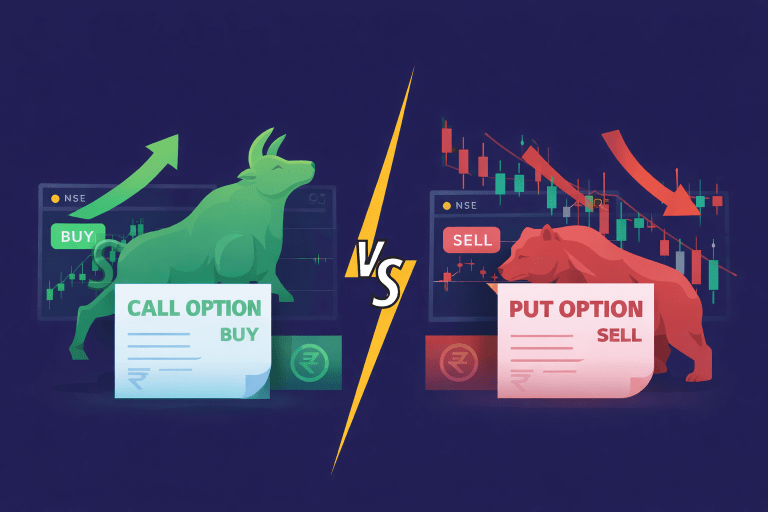
There are two primary types of Nifty options:
Nifty Call Option – Meaning and Example
A Nifty Call option gives the buyer the right to buy the Nifty index at a specific strike price.
Traders buy Nifty Call options when they expect the market to move upward.
When Does a Nifty Call Option Make Money?
- When Nifty rises above the strike price
- When volatility increases
- When sufficient time is left until expiry
Nifty Call Option Example
- Nifty at 22,000
- Buy 22,100 Call at ₹80
- Nifty rises to 22,250
- Premium rises to ₹140
Profit = (140 − 80) × 75 = ₹4,500
Nifty Put Option – Meaning and Example
A Nifty Put option gives the buyer the right to sell the Nifty index at a fixed strike price.
Traders buy Nifty Put options when they expect the market to decline.
When Does a Nifty Put Option Make Money?
- When Nifty falls below the strike price
- During market corrections or bearish phases
- When volatility rises sharply
Nifty Put Option Example
- Nifty at 22,000
- Buy 21,900 Put at ₹90
- Nifty falls to 21,700
- Premium rises to ₹160
Profit = (160 − 90) × 75 = ₹5,250
How Nifty Options Work: Step-by-Step Practical Examples
Example 1: How a Nifty Call Option Works
- Nifty trading at 22,000
- The trader expects an upside move
- Buys 22,100 Call at ₹100
- Capital deployed = ₹7,500
If Nifty rises to 22,300
Premium increases to ₹180
Profit = (180 − 100) × 75 = ₹6,000
If Nifty remains flat
Premium decays to ₹50
Loss = (100 − 50) × 75 = ₹3,750
This demonstrates how direction + time impact option pricing.
Example 2: How a Nifty Put Option Works
If Nifty declines sharply, Put options gain value. However, if the market remains sideways, the Put option loses value due to Theta (time decay).
Why Traders Use Nifty Options
Hedging Portfolio Risk
Investors buy Nifty Put options to protect equity portfolios during volatile periods.
Directional Trading
Traders express bullish or bearish views with limited capital and defined risk.
Lower Capital Requirement
Buying Nifty options requires significantly less capital compared to Nifty futures.
Income Generation
Option sellers generate income by collecting premiums in sideways markets.
Nifty Option Contract Specifications
- Underlying: Nifty 50 Index
- Lot Size: 75
- Tick Size: ₹0.05
- Expiry: Weekly & Monthly
- Settlement: Cash-settled
- Trading Hours: 9:15 AM – 3:30 PM
Understanding Nifty Option Price Movement
Delta
Measures how much an option’s premium changes when Nifty moves by one point.
Theta
Represents time decay — the erosion of option value as expiry approaches.
Vega
Indicates sensitivity of option prices to changes in market volatility.
Nifty Options Payoff Explained (Text-Based Diagram)
Call Option Buyer
- Limited loss (premium paid)
- Unlimited profit potential
Call Option Seller
- Limited profit (premium received)
- Unlimited risk
Put Option Buyer
- Profits when Nifty falls
- Loss limited to premium
Put Option Seller
- Profits if Nifty stays above strike
- High downside risk
Common Mistakes in Nifty Option Trading
- Over-leveraging positions
- Ignoring time decay
- Selling options without risk management
- Trading without understanding the volatility impact
How to Trade Nifty Options on the Samco Platform
Traders can:
- Identify Nifty option chains
- Analyse strike-wise data
- Understand margin requirements
- Execute trades efficiently using analytical tools
Risks Involved in Nifty Options
- Sharp losses near expiry due to Gamma
- Volatility spikes
- Liquidity risk in far OTM strikes
- Emotional trading without discipline
Conclusion: Should You Trade Nifty Options?
Nifty options are versatile financial instruments that allow traders and investors to participate in market movements with flexibility and efficiency. Whether used for hedging, short-term trading, or income strategies, understanding how Nifty options work is critical before deploying capital. With proper risk management and discipline, Nifty options can be an effective tool in the Indian stock market.