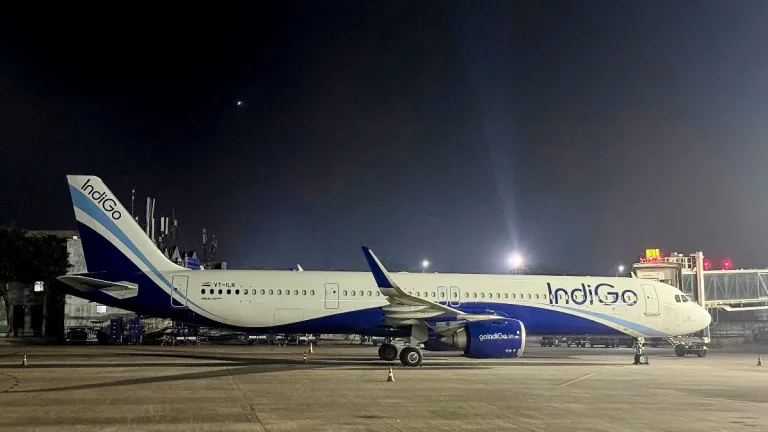
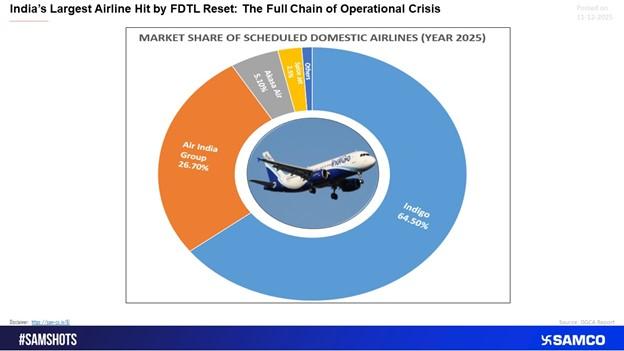
India’s aviation sector has entered a turbulent phase after the Directorate General of Civil Aviation (DGCA) implemented the revised Flight Duty Time Limitations (FDTL) norms in November 2025. The regulatory update, introduced to reduce pilot fatigue, has unexpectedly triggered widespread disruption, with IndiGo, the country’s largest airline by market share (64.50% as per the 2025 DGCA data), facing the sharpest impact.
This article explains what caused the crisis, how the operational fallout unfolded, and what the road to recovery looks like for India’s aviation giant.
What Triggered the Crisis? DGCA’s New FDTL Norms
To strengthen aviation safety, DGCA tightened flight duty regulations for pilots. Key changes included:
1. Longer Weekly Rest Hours
- New rule: 48 hours rest per week
- Earlier requirement: 36 hours
This significantly reduced weekly pilot availability.
2. Limits on Consecutive Night Landings
- Pilots can now perform only two consecutive night landings.
- High-density sectors with multiple night arrivals were affected the most.
3. Fatigue-Based Scheduling Mandate
Airlines must now create rosters prioritizing scientific fatigue assessment, not just operational convenience.
While the rules improved safety, they required immediate recalibration of airline rosters, something IndiGo could not fully implement for the Winter 2025 schedule.
How IndiGo’s Winter Roster Failed to Adapt
IndiGo’s winter schedule was already tight, with several aircraft performing back-to-back night rotations. When DGCA introduced the new norms:
- The existing pilot pairings became invalid overnight.
- Numerous flight rotations exceeded the new duty limits.
- A shortage of deployable crew emerged instantly.
This created a significant mismatch between scheduled flights and available pilots, especially during peak winter travel demand.
Sectors Hit the Hardest
Routes heavily dependent on late-evening and night operations saw the most significant disruptions:
- Delhi – Mumbai
- Delhi – Bengaluru
- Hyderabad – Delhi
These trunk sectors operate with narrow turnaround windows, making them highly sensitive to crew duty limits.
5,000 Flights Cancelled in December Alone
The operational mismatch quickly snowballed:
- 5,000 flights cancelled so far in December 2025
- Ground operations overstretched
- Passenger handling systems are overwhelmed
- Network reliability dropped sharply
IndiGo’s on-time performance and customer experience metrics faced a major setback as cancellations piled up.
Regulator Steps In: DGCA Oversight and Corrective Measures
To restore stability, DGCA initiated strong intervention:
Special audits of pilot rosters
Deployment of oversight teams at major hubs
Short-term operational relaxations
Mandatory recovery roadmap from IndiGo
The aviation regulator is now closely monitoring compliance to ensure both safety and operational recovery.
Way Forward: How IndiGo Can Recover From the Crisis
To stabilize operations and avoid future disruptions, IndiGo must rebuild its scheduling framework around the updated FDTL norms:
1. Expand Reserve Crew Strength
More standby pilots are essential to handle unforeseen disruptions.
2. Rework Pilot Pairings & Duty Patterns
New pairings must fully adhere to the revised fatigue-based rules.
3. Accelerate Hiring & Training
Fresh recruitment and quicker type-rating cycles can ease crew shortage.
4. Increase Operational Buffers
Especially on trunk routes where tight night rotations are common.
5. Improve Crew Planning Systems
AI-based roster management can help predict fatigue and ensure compliance.
Conclusion
The FDTL reset, though necessary for pilot safety, has exposed structural gaps in crew planning across India’s aviation industry. IndiGo, which controls over 64% of the domestic market, has been hit the hardest due to its high aircraft utilization model.
With DGCA monitoring recovery closely and IndiGo implementing corrective actions, the airline is expected to regain stability, though the next few weeks may continue to see intermittent disruptions.