For most of the last two decades, Nifty IT has traded at a median PE of 22.2x. Today, the sector is available at around 20x earnings, placing valuations below long term averages and near levels typically seen during periods of pessimism.
Historically, similar valuation zones have emerged during major global slowdowns such as the Global Financial Crisis, the Eurozone debt crisis, and the recent post-pandemic technology correction. In each instance, investor concerns revolved around slowing client spending and weaker demand visibility.
The current discount reflects fears of delayed technology budgets, economic uncertainty in the US, and concerns around the impact of AI on traditional IT services.
However, valuations are now pricing in a meaningful amount of caution.
The key question for investors is whether earnings are deteriorating or whether market sentiment has become excessively negative.
To answer that, we need to examine what is actually happening to the financial performance of Indian IT companies…
Despite widespread concerns around the sector, the earnings picture tells a different story.
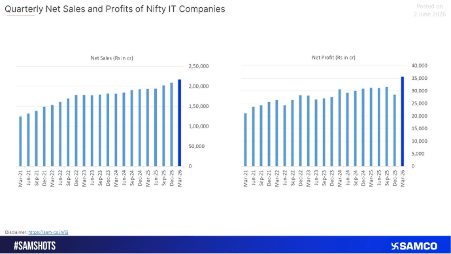
Aggregate quarterly sales of Nifty IT companies have steadily risen from nearly ₹1.25 lakh crore in Mar’21 to over ₹2.2 lakh crore in the latest quarter. Profitability has also remained resilient, with quarterly profits touching a record high of around ₹35,000 crore.
Importantly, this growth has been achieved despite a challenging demand environment, project delays, and cautious spending by global clients. The sector has not experienced an earnings collapse. Instead, growth has moderated while profitability remains intact.
This creates an interesting divergence. Earnings are making new highs, but valuations have compressed significantly over the past few years.
When profits continue to grow while valuation multiples contract, future returns often become increasingly dependent on whether sentiment eventually catches up with fundamentals.
The next chart helps us understand whether investors may already be positioning for such a recovery.
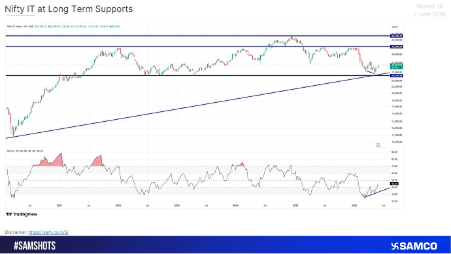
Price action suggests that investors are beginning to defend the sector near important long term support zones.
Nifty IT has corrected sharply from its 2025 highs and is currently trading close to a major support area near 26,000, a level that has repeatedly acted as resistance and support over the last several years. The sector is also approaching a rising trendline that has guided the broader uptrend since 2020.
At the same time, RSI has formed a positive divergence. While prices made fresh lows, momentum indicators failed to confirm the weakness, often an early sign that selling pressure is losing strength.
Technical indicators do not guarantee a reversal, but they do help identify zones where risk-reward begins to improve.
If fundamentals remain resilient and valuations stay attractive, support levels often become areas where long term investors start accumulating.
Interestingly, market positioning data suggests that investors may have already become significantly underweight the sector…
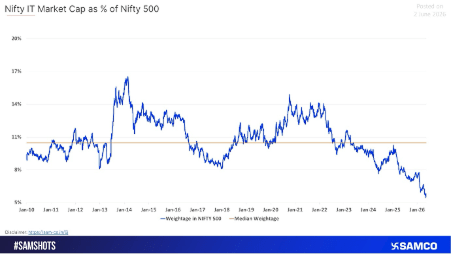
The weight of Nifty IT within the Nifty 500 has fallen to just around 5.5%, the lowest level in more than a decade and well below its long term median of 10.5%.
In simple terms, the sector now represents a much smaller portion of the Indian equity market than it has historically. This decline reflects years of underperformance relative to sectors such as financials, manufacturing, defence, and capital goods.
Market leadership rarely remains permanent. Periods of extreme underweight positioning often coincide with phases when expectations are already very low.
Today, investors are looking at a sector where valuations are below historical averages, earnings are at record highs, prices are testing major support levels, and market representation has fallen to multi-year lows.
Whether this becomes a value opportunity or a value trap will ultimately depend on global technology spending. But from a historical perspective, Nifty IT appears to be trading from a position of pessimism rather than optimism. And that is point of maximum opportunity too.
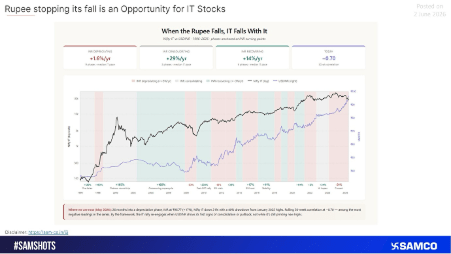
For years, investors believed that a weakening rupee was automatically positive for Indian IT companies. Since most revenues are earned in US dollars, a depreciating rupee boosts reported earnings and margins when converted back into Indian currency.
However, history tells a more nuanced story.
Since 1996, Nifty IT has delivered a median annual return of just 1.6% during periods of sustained rupee depreciation. In contrast, the sector generated 29% annual returns when the rupee was consolidating and 14% annual returns when the rupee was strengthening.
Why? Because a falling rupee is often a symptom of broader global stress. During such periods, clients become cautious, technology budgets are delayed, and discretionary spending slows. The currency benefit is frequently offset by weaker business demand.
Today, the rupee is near record lows against the US dollar and the rolling correlation between Nifty IT and USDINR stands at -0.70, among the most negative readings in the dataset. Nifty IT has already corrected over 20% from its highs despite continued rupee weakness.
History suggests that the next meaningful recovery in IT stocks may not come from further rupee depreciation, but from signs that the currency is stabilising.
In other words, for IT investors, the rupee falling is often not the opportunity… the rupee stopping its fall usually is.