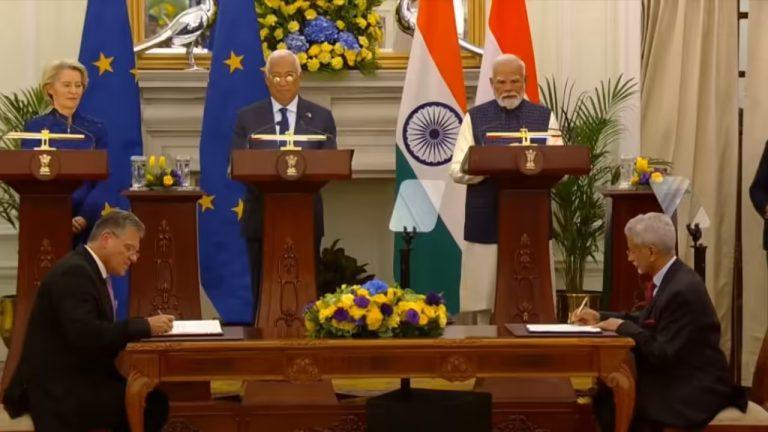
The India-EU Free Trade Agreement marks a decisive shift in how India and Europe plan their economic future together. Years of negotiations have now crystallised into a structured framework that connects trade, security, and workforce movement under one strategic umbrella.
Rather than being limited to tariffs or goods, this agreement reflects a wider intent—to build resilience, balance global dependencies, and deepen long-term cooperation.
Market Context: Why the India-EU Free Trade Agreement Stands Out?
Trade pacts matter when they bring predictability. The India-EU Free Trade Agreement does exactly that by laying down a clear roadmap for engagement across critical sectors.
The discussions revolved around:
- Trade and commercial cooperation
- Defence and security coordination
- Climate priorities
- Critical and emerging technologies
Together, these elements add stability to bilateral ties rather than short-term excitement.
Main Development: India-EU Summit Sets the Tone
The announcement came during a high-level summit hosted by Prime Minister Narendra Modi, signalling strong political backing.
The meeting saw participation from European Commission head Ursula von der Leyen and European Council chief Antonio Costa. Both leaders also attended India’s 77th Republic Day celebrations at Kartavya Path, reinforcing the diplomatic weight of the engagement.
Beyond Commerce: What the India-EU Free Trade Deal Covers?
The agreement is designed to operate across multiple layers, not just trade flows.
Core focus areas include:
- Strengthening economic linkages
- Enhancing defence cooperation
- Climate collaboration
- Joint efforts in critical technologies
This structure helps both sides align strategic interests alongside commercial goals.
Why the EU Is Rebalancing Toward India?
Europe is actively diversifying its global partnerships as it reduces reliance on the US and China. India’s growing economy and geopolitical position make it central to this recalibration.
The India-EU Free Trade Agreement supports this shift, giving Europe deeper access to India while integrating India further into global value chains.
Scale of the Deal: Nearly 2 Billion Consumers
According to European leadership, the agreement could connect economies representing close to 2 billion people.
This combined market:
- Represents almost 25% of global GDP
- Brings developed and emerging markets together
- Enhances long-term trade balance
Few bilateral trade initiatives match this scale.
Defence Cooperation: A Formal Security Framework
India and the EU have shared a strategic relationship since 2004. The latest talks introduce a proposed Security and Defence Partnership (SDP) to formalise cooperation.
Key objectives include:
- Deeper defence engagement
- Improved coordination
- Industrial collaboration
This moves defence ties from dialogue to structured cooperation.
SAFE Programme: Defence Readiness in Focus
A significant element of the defence discussion is the EU’s SAFE (Security Action for Europe) programme.
Key facts:
- Total funding: 150 billion euros
- Purpose: Enhancing defence readiness
- Approach: Financial backing for EU member states
Through the SDP, Indian companies may explore participation within this framework.
India-EU Free Trade Negotiations: A Long Timeline
The road to the India-EU Free Trade Agreement has spanned nearly two decades.
Milestones include:
- Initial talks launched in 2007
- Negotiations halted in 2013
- Discussions restarted in June 2022
The current outcome reflects renewed alignment after years of recalibration.
Worker Mobility Gains Formal Structure
One of the key outcomes of the summit is a memorandum of understanding on worker mobility.
The framework aims to:
- Support movement of Indian professionals to Europe
- Enable structured mobility programmes
- Strengthen people-to-people connections
This adds a practical dimension to the broader agreement.
EU Nations Already Engaged on Mobility
Several European countries already maintain mobility arrangements with India, including:
- France
- Germany
- Italy
The new framework places these efforts within a wider India-EU structure.
Global Issues Also on the Table
Leaders also exchanged views on global developments, including the Russia-Ukraine conflict.
Despite differing perspectives, both sides align on:
- Maintaining global stability
- Supporting a rules-based order
- Strengthening long-term security cooperation
These shared principles support continuity in the partnership.
Trade Numbers: India-EU Economic Snapshot
The EU continues to be India’s largest trading partner in goods.
For FY 2024–25, trade data shows:
- Total goods trade: $136 billion
- Exports from India: $76 billion
- Imports into India: $60 billion
These figures underline the economic depth of the India-EU Free Trade Agreement.
Why This Agreement Matters Over Time?
The strength of the India-EU Free Trade Agreement lies in its long-term design.
It delivers:
- Policy consistency
- Institutional clarity
- Strategic direction
Such frameworks gradually shape trade and cooperation rather than creating short-term shifts.
Summary: India-EU Free Trade Agreement at a Glance
The India-EU Free Trade Agreement is a major step forward in India’s global economic engagement.
Key points:
- A comprehensive pact covering trade, defence, and mobility
- A potential market nearing 2 billion people
- Defence cooperation under the SAFE framework
- Structured worker mobility mechanisms
- Existing goods trade of $136 billion
The agreement strengthens foundations quietly—focusing on durability, scale, and strategic alignment rather than immediate headlines.
Source: NDTV