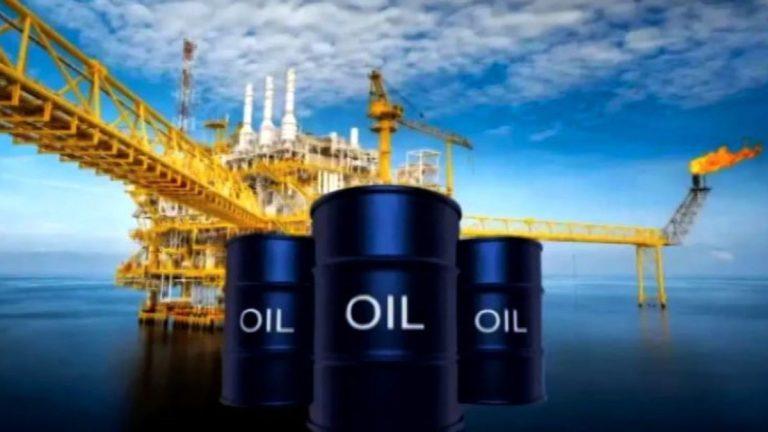
Oil surges dominated global headlines on Monday. Markets reacted instantly. Crude prices jumped. Stocks slipped. Investors moved into safe havens.
The trigger was simple — rising military conflict in West Asia. And when oil surges at this scale, financial markets do not stay calm.
Let’s break it down, step by step.
Market Performance: Oil Surges, Stocks Slide, Gold Shines
The first reaction came from crude oil.
- Brent crude surged 6.4% to $77.57 per barrel
- It briefly crossed $82.00 per barrel
- U.S. crude climbed 6.2% to $71.17 per barrel
- Gold rose 1.6% to $5,360 per ounce
Oil surges of this scale signal stress. When crude jumps above $77 with intraday spikes above $82, it tells us supply fears are real.
Equity markets responded with caution:
- S&P 500 futures fell 0.8%
- Nasdaq futures slipped 0.8%
- EUROSTOXX 50 futures dropped 1.3%
- DAX futures declined 1.4%
- FTSE futures eased 0.6%
- Nikkei lost 1.3%
- MSCI Asia-Pacific ex-Japan index fell 1.2%
- Chinese blue chips slipped 0.1%
This is classic risk-off behavior. Oil surges. Stocks slide. Gold gains.
 Main News: Military Conflict Fuels the Oil Surge

The oil surge comes as military strikes between the United States, Israel, and Iran intensified.
Missile exchanges continue across the region. There are no signs of easing.
U.S. President Donald Trump indicated that the conflict could last four more weeks. He added that attacks would continue until U.S. objectives are achieved.
Markets are not waiting for clarity. They are pricing in uncertainty.
And uncertainty is what fuels volatility.
Strait of Hormuz: The Real Pressure Point Behind Oil Surges
All eyes are now on the Strait of Hormuz.
This narrow waterway handles:
- Around 20% of global seaborne oil trade
- Roughly 20% of global liquefied natural gas flows
- Nearly 15 million barrels per day (bpd) of crude oil
As of now, it has not been officially blocked.
But marine tracking data shows tankers piling up on both sides. Ships are hesitant to pass. Insurance risks are rising. Fear is real.
If traffic slows or stops, 15 million bpd is at risk.
That is why oil surges are happening now — not later.
OPEC+ Output Boost: Too Small for Current Stress?
Even as tensions escalated, OPEC+ agreed to increase oil output.
The group approved a modest production boost of:
- 206,000 barrels per day for April
But here’s the catch.
That oil still has to move. And much of it must pass through the same stressed region.
So while oil supply on paper increases by 206,000 bpd, the market is worried about the 15 million bpd potentially disrupted.
That math explains why oil surges overpower output news.
Inflation Risk Returns as Oil Surges
When oil surges 6% in a single session, inflation concerns follow quickly.
Oil affects:
- Transportation costs
- Manufacturing costs
- Consumer fuel bills
- Air travel
- Shipping expenses
A prolonged spike in crude prices acts like a tax.
Higher oil prices raise business costs. Businesses pass costs to consumers. Inflation pressure builds.
And inflation disrupts economic recovery.
That is the macro chain reaction investors are watching.
Currency Markets React to Oil Surges
The foreign exchange market also felt the ripple effect.
- The dollar gained
- Euro slipped 0.2% to $1.1787
- Dollar rose 0.3% to 156.44 yen
The United States is a net energy exporter. That supports the dollar when oil surges.
Japan imports all of its oil. That adds pressure when energy prices spike. The Nikkei’s 1.3% drop reflects that reality.
Currency movements are telling us that oil surges are reshaping global flows, not just oil charts.
Bond Markets Stabilize After Volatility
- 10-year Treasury yields steadied at 3.970%
- They briefly touched an 11-month low of 3.926%
Bonds saw demand as investors searched for safety.
Risk-off flows are clear:
- Oil surges
- Stocks slide
- Bonds stabilize
- Gold rises
This pattern shows stress but not panic — yet.
Middle East Market Reaction
Within the region:
- UAE stock markets were temporarily closed
- Kuwait stock markets also shut citing “exceptional circumstances”
Market closures are rare. They signal seriousness.
When exchanges pause trading, it underlines how deeply the oil surge connects to regional stability.
A Big U.S. Economic Data Week Adds More Tension
As if oil surges weren’t enough, investors now face major U.S. economic releases:
- ISM Manufacturing Survey
- Retail Sales Data
- Payrolls Report
Markets are already pricing:
- 50% probability of a rate cut in June
- Around 58 basis points of cuts this year
Oil surges complicate this picture.
Stronger inflation from energy may impact rate expectations. Weak data may increase rate cut bets.
This week carries weight.
Why Oil Surges Matter Beyond Energy Stocks?
When oil surges, the impact spreads across sectors:
- Airlines feel fuel pressure
- Transport stocks react
- Manufacturing sectors adjust
- Consumer sentiment can shift
Japan’s market reaction showed airlines among the hardest hit.
Energy is not isolated. It is a chain reaction.
That is why oil surges instantly become a global macro story.
Historical Context Adds Perspective
Past oil shocks have reshaped economies.
In the 1970s, oil prices surged dramatically. Comparisons are being drawn again.
While today’s levels are different, the market memory is still fresh.
History shows one thing clearly:
Sustained oil surges alter inflation paths, currency moves, and stock valuations.
Banking Stress and Market Fragility
Adding to the global tension, UK mortgage lender MFS was placed into administration after allegations of financial irregularities.
It had borrowed:
- 2 billion pounds ($2.69 billion)
Its collapse pressured banking stocks and dented confidence.
So markets are not just handling oil surges.
They are handling:
- Energy volatility
- Banking stress
- AI-stock jitters
- Major economic data ahead
That combination keeps risk appetite fragile.
Summary: Oil Surges Signal a Global Stress Test
Let’s recap clearly.
- Oil surges: Brent +6.4% to $77.57, briefly over $82
- U.S. crude +6.2% to $71.17
- Gold +1.6% to $5,360
- Global equities decline across Asia, Europe, and the U.S.
- Strait of Hormuz handles 20% of oil trade and 15 million bpd
- OPEC+ adds 206,000 bpd in April
- Markets price 50% chance of June rate cut
The oil surge is not just a commodity story. It is a confidence story.
When 20% of global oil supply sits near a conflict zone, markets react first and ask questions later.
For now, volatility defines sentiment.
The coming days depend on two things:
- Whether tensions ease
- Whether oil surges sustain above current levels
Until then, markets remain cautious.
And when oil surges, the world listens.
Source: Moneycontrol