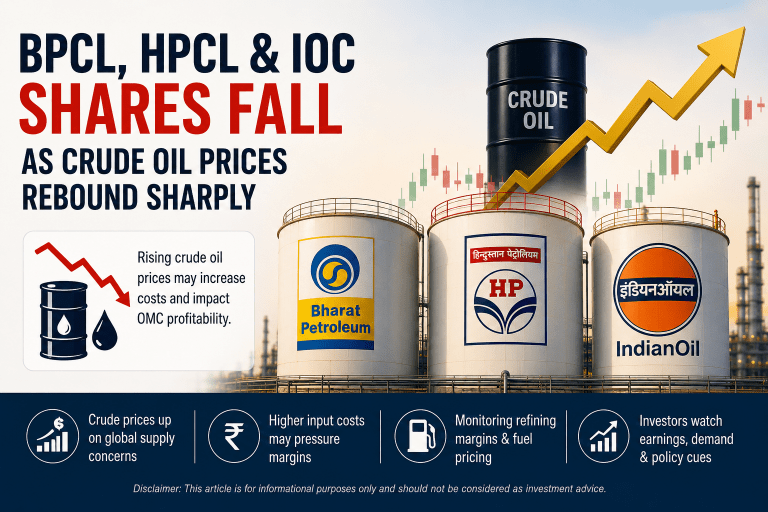
The Indian stock market is grappling with a new wave of uncertainty as the US-Iran conflict escalates, sending crude oil prices above the $100 mark. For Dalal Street and the broader economy, this surge is more than just a headline—it has real implications for corporate margins, inflation, and the rupee.
Investors are keeping a close eye on Nifty 50 earnings, which had recently shown signs of recovery after a period of muted growth. Rising energy costs threaten to slow this momentum, affecting multiple sectors across the index.
Market Performance Amid Global Tensions
The US-Iran war has introduced renewed volatility in global markets. Rising crude prices are at the heart of India’s current market stress:
- Crude oil prices: Crossed $100 per barrel amid Middle East tensions.
- Impact on Indian economy: Higher energy costs feed inflation and increase the import bill.
- Currency pressure: A weaker rupee could influence foreign investment flows and investor sentiment.
This combination of factors creates a challenging environment for market participants, where earnings growth may not keep pace with expectations.
 Earnings Impact on Nifty 50

Nifty 50 earnings had been improving, with expectations of 12–14% growth in FY27. However, sustained high crude prices could cut this growth by up to 4%, bringing it closer to 10%.
- Rising input costs: Higher energy prices increase operating expenses across manufacturing, transportation, and other energy-intensive sectors.
- Margin pressures: Companies could see their profit margins tighten, affecting overall earnings growth.
- Sectoral ripple effect: Most industries in the Nifty index are sensitive to energy costs, making this a broad-based concern.
The story is clear: prolonged high oil prices translate into higher costs, lower profits, and a modest slowdown in earnings growth across India’s benchmark index.
Foreign Investment Flows Under Pressure
India depends heavily on oil imports, and higher global crude prices increase the import burden, putting pressure on the current account. Simultaneously, a softer rupee lowers foreign investors’ returns, prompting caution in equity investments.
Key points:
- FII sentiment: Rising crude and currency volatility may prompt caution among foreign investors.
- Investment flows: Potential reduction in equity exposure as investors seek more stable returns elsewhere.
- Market liquidity: Domestic investment through SIPs can help offset some foreign outflows, keeping equity markets supported.
Sectoral Observations
Certain sectors are showing resilience despite the global headwinds:
- IT: Recently faced declines but valuations now appear attractive. Uncertainty remains around AI adoption and its long-term business impact.
- Defence & Pharma: Considered defensive plays with stable demand and government support.
- Banking & Financial Services: Benefiting from improving balance sheets, steady credit growth, and strong fundamentals.
Investors are increasingly evaluating portfolios based on stability and structural strength, focusing on sectors that can weather geopolitical and commodity-driven volatility.
Portfolio Insights for Current Market
Even as Nifty valuations hover around 21 times earnings (forward 18–19x), market participants are taking a measured approach:
- Focus on large-cap companies: Strong balance sheets and predictable earnings provide relative safety.
- Limited mid- and small-cap exposure: Higher volatility may affect risk-adjusted returns.
- Disciplined investment: Systematic investment plans (SIPs) remain effective in averaging costs and capturing long-term gains.
While short-term volatility is present, disciplined investing and sector focus continue to support steady equity market participation.
Summary
The US-Iran war and surging crude oil prices are sending ripples through India’s financial markets. Nifty 50 earnings, which had shown recent recovery, may see growth trimmed by up to 4%. Rising input costs, margin pressures, and currency volatility are creating a challenging environment.
- Defensive sectors like defence, pharma, and banking are showing resilience.
- Foreign flows may remain cautious amid a weak rupee and elevated oil prices.
- Domestic SIPs continue to provide stability and long-term market support.
The market narrative is one of caution but not panic—investors are navigating geopolitical uncertainty while keeping an eye on earnings growth, sectoral strength, and disciplined investment strategies.
Source: Livemint