


The Indian Rupee has breached the crucial 93 per US dollar mark, signalling rising stress in India’s external sector. This move is not a one-off spike but reflects a combination of global risk factors and structural macro pressures building over time.
What Triggered the Fall in INR?
The immediate catalyst behind the rupee’s sharp depreciation has been the surge in Brent Crude Oil, which climbed to around $112 per barrel.
This spike is driven by escalating geopolitical tensions in the Middle East, including:
- Iran’s strike on Qatar’s Ras Laffan LNG facility
- Ongoing attacks on energy infrastructure in the region
- Rising risks around the Strait of Hormuz, a key global oil transit route
These developments have heightened fears of supply disruptions, pushing crude prices sharply higher.
Why a Rising Crude Price Hurts the Rupee?
India imports nearly 85% of its crude oil requirements, making it highly sensitive to oil price movements.
Higher crude prices lead to:
- Increased dollar demand from oil importers
- Widening current account deficit (CAD)
- Rising imported inflation
- Pressure on the fiscal balance
All these factors contribute to weakening the rupee.
RBI Intervention: Temporary Relief, Not a Trend Reversal
The Reserve Bank of India stepped in around the 92 level, likely through:
- Dollar sales in spot and forward markets
- Liquidity management measures
While this helped stabilise the rupee temporarily, it has not reversed the broader trend. The depreciation pressure remains intact due to persistent external headwinds.
Layered Risks Keeping the Rupee Under Pressure
The rupee’s weakness is being driven by multiple overlapping factors:
1. Elevated Crude Oil Prices
Sustained high oil prices continue to increase India’s import bill.
2. Strong US Dollar
Global risk-off sentiment has strengthened the US Dollar, putting pressure on emerging market currencies.
3. FII Outflows
Foreign institutional investors (FIIs) have been pulling capital out, increasing dollar demand and weakening the rupee further.
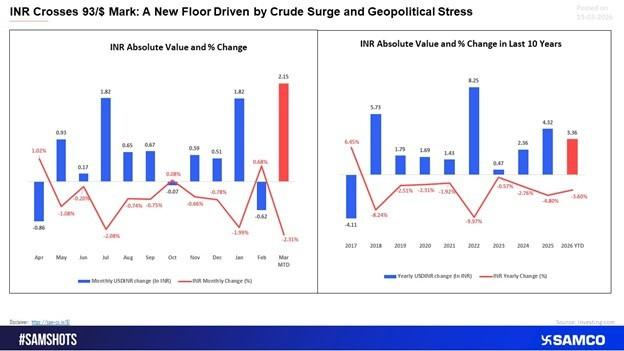
What the Data and Trend Suggest?
The chart indicates that the rupee’s depreciation is:
- Persistent, not temporary
- Driven by macro fundamentals, not just sentiment
- Part of a broader weakening trend over time
This suggests that the current move beyond 93/$ could act as a new base rather than a peak.
What It Means for India?
A weaker rupee has mixed implications:
Negatives:
- Higher import costs
- Rising inflation pressure
- Strain on current account and fiscal balance
Positives:
- Boost for export-oriented sectors (IT, pharma)
- Improved competitiveness of Indian goods globally
Outlook: Can the Rupee Stabilize?
The near-term outlook for the rupee will depend on:
- Direction of crude oil prices
- Evolution of geopolitical tensions
- Strength of the US dollar
- RBI’s intervention strategy
Unless crude prices cool significantly or global risk sentiment improves, the rupee is likely to remain under pressure with a depreciating bias.
Conclusion
The breach of 93 per dollar marks an important psychological and macro milestone for the Indian rupee. With crude oil shock, geopolitical risks, and capital outflows all at play, the currency’s weakness appears structural rather than temporary.
For investors and policymakers alike, the focus now shifts to whether this level becomes a new normal or a launchpad for further depreciation.