

Key Highlights
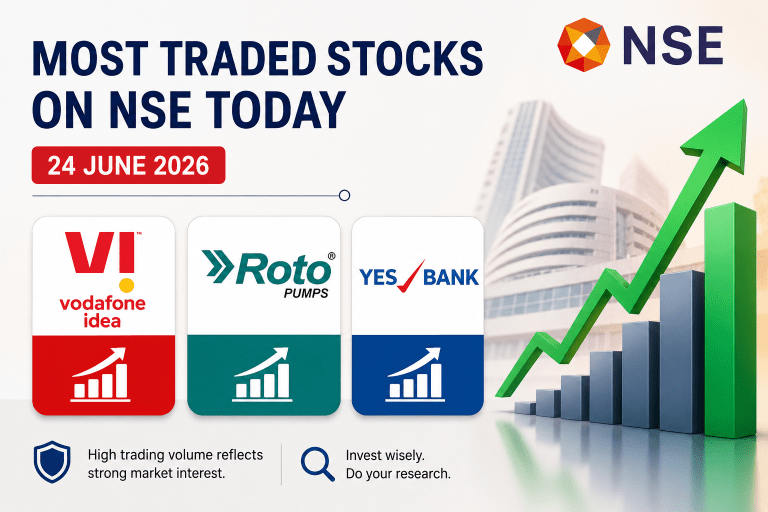
- Vodafone Idea, Roto Pumps and YES Bank were among the most actively traded stocks on NSE on 24 June 2026.
- High trading volume often signals increased investor participation and market interest.
- Trading activity alone should not be considered a buy or sell signal.
- Investors should evaluate fundamentals, valuations, earnings growth and risks before making investment decisions.
Vodafone Idea, Roto Pumps, YES Bank Among Most Traded Stocks on NSE Today
Indian stock market participants closely track the list of most traded stocks because unusual volume often highlights where investor attention is concentrated.
On 24 June 2026, stocks such as Vodafone Idea, Roto Pumps, and YES Bank featured among the most actively traded counters on the National Stock Exchange (NSE). Increased trading activity was observed amid broader market movements and stock-specific developments.
However, high volume does not automatically indicate a bullish or bearish trend. Instead, it reflects heightened participation from traders and investors.
What Does “Most Traded Stock” Mean?
A stock enters the “most traded” category when it records exceptionally high trading volume during a market session.
Trading volume represents the total number of shares exchanged between buyers and sellers over a specific period.
Why Volume Matters
High trading volume can indicate:
- Strong investor interest
- Increased liquidity
- Institutional participation
- News-driven market activity
- Technical breakout or breakdown attempts
Volume is often used alongside price action to assess the strength of a market trend.
Vodafone Idea Remains in Investor Spotlight
Telecom operator Vodafone Idea frequently appears among India’s most actively traded stocks due to its large retail investor base and ongoing business transformation efforts.
The company continues to attract attention because of:
- Network expansion initiatives
- Capital raising efforts
- 5G-related developments
- Industry competition dynamics
Historically, Vodafone Idea has remained one of the highest-volume stocks on Indian exchanges, making it a regular feature in active-trading lists.
What Investors Should Monitor
- Subscriber growth trends
- Average Revenue Per User (ARPU)
- Debt reduction efforts
- Spectrum and network investments
- Regulatory developments
YES Bank Sees Strong Trading Activity
YES Bank also remained among the heavily traded stocks during the session.
The private sector lender continues to attract investor attention because of:
- Asset quality improvements
- Business growth initiatives
- Digital banking expansion
- Management and governance updates
Recent market activity suggests traders remain focused on the bank’s recovery trajectory and long-term growth prospects.
Key Metrics to Watch
Investors tracking YES Bank may focus on:
- Net Interest Margin (NIM)
- Gross and Net NPA levels
- Deposit growth
- Loan book expansion
- Return on Assets (ROA)
Why Roto Pumps Is Gaining Market Attention
Roto Pumps has emerged as a stock that market participants are actively monitoring.
The company operates in the industrial and engineering segment and is known for manufacturing positive displacement pumps used across multiple industries.
Factors that typically drive investor interest in industrial companies include:
- Order book growth
- Export opportunities
- Infrastructure spending
- Manufacturing expansion
- Margin improvement
Investors should review the company’s latest financial disclosures and management commentary before making any investment decisions.
How Should Investors Interpret High Trading Volumes?
High trading volume can be useful, but it should never be viewed in isolation.
Positive Interpretation
If a stock rises alongside increasing volume, it may indicate:
- Strong buying interest
- Institutional accumulation
- Positive market sentiment
Cautious Interpretation
If a stock falls despite high volume, it could indicate:
- Profit booking
- Distribution by large investors
- Negative sentiment
Therefore, combining volume analysis with technical and fundamental research is generally considered a more comprehensive approach.
Factors Driving Trading Activity in Indian Markets
Several factors can contribute to unusual trading volumes:
1. Corporate Announcements
- Earnings releases
- Mergers and acquisitions
- Fundraising plans
- Management changes
2. Sector Developments
- Telecom policy changes
- Banking regulations
- Infrastructure spending announcements
3. Market Sentiment
- Domestic economic data
- Global market cues
- Interest rate expectations
4. Institutional Participation
Large trades by mutual funds, insurance companies and foreign investors can significantly increase volume levels.
Risk Factors Investors Should Consider
Before investing in any actively traded stock, investors should evaluate:
- Business fundamentals
- Revenue growth trends
- Profitability metrics
- Debt levels
- Industry outlook
- Valuation multiples
A stock appearing in the most-traded list does not guarantee future returns.
Frequently Asked Questions
What is a most traded stock?
A most traded stock is one that records exceptionally high trading volume during a trading session, indicating significant investor participation.
Is high trading volume a bullish signal?
Not necessarily. Volume should be analysed along with price movement, company fundamentals and broader market conditions.
Why is Vodafone Idea frequently among the most traded stocks?
Vodafone Idea has a large retail investor base and regularly attracts market attention due to developments related to fundraising, telecom competition and network expansion.
Why do traders monitor volume?
Volume helps traders assess liquidity, market interest and the strength of price trends.
Should investors buy stocks solely based on trading volume?
No. Investment decisions should be based on comprehensive research, financial analysis and individual risk tolerance.
Conclusion
Vodafone Idea, Roto Pumps and YES Bank emerged among the most actively traded stocks on NSE on 24 June 2026, reflecting strong market participation and investor interest. While trading volume can provide valuable insights into market sentiment, investors should avoid relying solely on volume-based signals.
A balanced approach that combines fundamental analysis, technical indicators, sector trends and risk assessment is generally more effective for making informed investment decisions.
SEBI Disclaimer
This article is intended solely for educational and informational purposes. It should not be construed as investment advice, stock recommendation, research report, buy/sell call, or solicitation to invest in securities. Investors should conduct their own research and consult a SEBI-registered investment adviser before making investment decisions.