

Business Overview
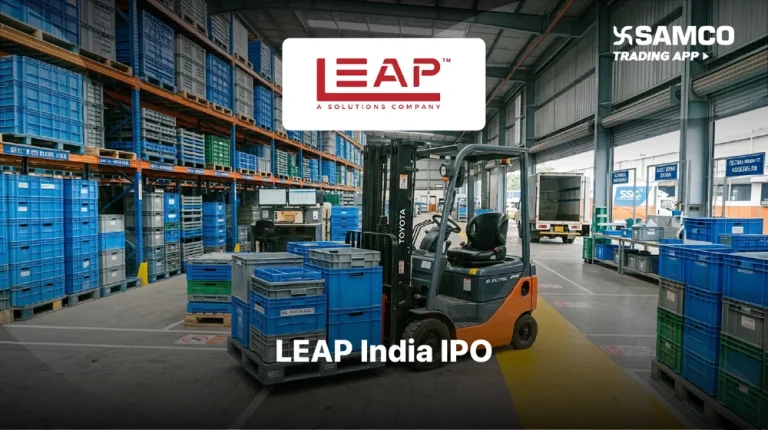
LEAP India Limited operates a ‘share and reuse’ asset pooling model in India’s supply chain management sector. It hires out pallets, containers and material handling equipment (MHE) on a pooling basis, so customers access standardised supply chain assets as a service rather than buying and maintaining their own. According to the Frost & Sullivan report commissioned for the Offer, it is the largest on-demand asset pooling provider in India by number of pooled assets.
As of March 31, 2026, the company had 14.70 million pooled assets, a pan-India network of over 10,100 customer touchpoints and 29 fulfilment centres, serving more than 1,000 customers across FMCG, food and beverage, third-party logistics, e-commerce and quick commerce, automotive and industrials. It consolidated its position by acquiring CHEP India in January 2025, completed on January 8, 2025 and since merged into the company. Its subsidiary TARON is the second-largest forklift pooling player in India by volume in Fiscal 2026 and a leader in lithium-ion MHE.
Incorporated in 2013 and headquartered at Goregaon (East), Mumbai, the company is promoted by Sunu Mathew, its Chairman, Managing Director and Chief Executive Officer, and Vertical Holdings II Pte. Ltd., which is affiliated with funds and entities managed or advised by KKR. It held an A (stable) credit rating from India Ratings and had 419 permanent employees as of March 31, 2026.
IPO Details
| Particulars | Details |
|---|---|
| IPO Date | 7 August 2026 to 11 August 2026 |
| Issue Type | Book Built Issue |
| Tentative Listing Date | 14 August 2026 |
| Face Value | ₹1 per share |
| Price Band | ₹151 – ₹159 per share |
| Lot Size | 94 shares |
| Minimum Retail Investment | ₹14,946 (94 shares × ₹159) |
| Issue Size | ₹2,480 crore |
| Fresh Issue | ₹480 crore |
| Offer for Sale | ₹2,000 crore |
| Post-Issue Market Cap | ₹7,004.53 crore (at upper price band) |
Objects of the Offer
The company intends to utilise the net proceeds from the Fresh Issue of ₹480 crore for the following purposes:
| Issue Objects | Estimated Amount (₹ crore) |
|---|---|
| Repayment or prepayment, in full or in part, of certain borrowings availed by the Company | 360.00 |
| General Corporate Purposes | 120.00 |
Key Strengths and Opportunities
-
Market Leadership in an Industry with High Barriers to Entry
According to the F&S Report, the company is the largest on-demand asset pooling provider in India by number of pooled assets and the only player currently operating at considerable scale and at a national level in the pallet pooling segment. Its asset base reached 14.70 million units as of March 31, 2026 from 13.30 million a year earlier and 7.92 million as of March 31, 2024, supported by 10,100 customer touchpoints and 29 fulfilment centres. The acquisition of CHEP India in January 2025 integrated an established competing pooling network into its own and broadened its industry reach. The F&S Report notes that building a comparable fleet would require substantial investment over multiple years with no assurance of immediate customer demand or established distribution channels. Scale and network, customer relationships, product quality, network effects and accumulated knowledge are identified as the five barriers to entry. -
Structurally Underpenetrated Market with a Long Runway
India remains one of the most underpenetrated pallet pooling markets globally, with just 10 million pooled pallets representing 9.4% of its 106 million total pallets, according to the F&S Report. By contrast, North America has 1,114 million pooled units at 55% penetration of total pallet circulation and the European Union has 1,530 million pooled units at 45% penetration, while palletisation levels stood at 89% in North America, 91% in the EU, 94% in Australia and New Zealand and 60% in China in CY2025. The F&S Report projects pallet use by the food and beverage industry to grow at a 7.88% CAGR from 26.41 million in Fiscal 2026 to 38.59 million in Fiscal 2031, and pallet pooling use by industrials and other sectors at a 7.99% CAGR from 9.61 million to 14.11 million over the same period. Grade A warehousing expansion, supply chain automation and ESG commitments are the identified demand drivers. -
Blue-Chip Customer Base with Near-Zero Churn and Contracted Revenue
The customer base grew to over 1,000 as of March 31, 2026 from over 500 as of March 31, 2024, and includes Hindustan Coca-Cola Beverages, Marico, Toll (India) Logistics, Daikin Airconditioning India, Panasonic Life Solutions India, Haier Appliances India, Daimler India Commercial Vehicles, Autoliv India and Sanathan Textiles. Churn among the top 100 customers was 0.00% in Fiscal 2026, against 0.19% in Fiscal 2025 and 0.75% in Fiscal 2024, and several of the top 10 customers by revenue have been with the company for more than five years. Customer contracts run one to five years with auto-renewal provisions, periodic price escalations, cost pass-throughs and clauses for recovery of pallet repair, breakage and loss costs. Because pooled assets are embedded in customer supply chains, switching would require re-palletisation across all touchpoints. -
Technology-Led Asset Management Driving High Utilisation
According to the F&S Report, the company was the first in India to introduce passive RFID-tagged containers, and its MHE fleet is IoT-enabled for movement tracking at customer locations. It operates the MyLEAP customer portal for real-time asset tracking and inventory management, a Docket System for asset monitoring, an Asset & Audit Application for retrieval, and Sorting, Repair and Conditioning systems within fulfilment centres. It applies AI and machine learning to forecast pallet demand and balance inventory across the network. Purpose-built applications support the operation, including the Asset App for on-site physical audits, the RFID App for cycle counts integrated with ERP transactions and the POD App for proof-of-delivery traceability, alongside mobile repair units for on-site maintenance and regular hire stock audits reconciling system records to physical counts. The company trains approximately 35,000 to 40,000 customer employees each year in equipment handling, which it links to reduced asset damage and better safety of customer products. -
Established Profitability with High Operating Margins and Cash Generation
Revenue from operations grew 56.39% to ₹729.53 crore in Fiscal 2026 after 27.81% growth in Fiscal 2025, and the company has remained profit-after-tax positive in each of the last three fiscals and, as per the Red Herring Prospectus, since 2020. Net profit rose to ₹62.34 crore from ₹37.56 crore, while EBITDA of ₹378.83 crore translated to a 50.69% EBITDA margin and Cash PAT margin stood at 35.68%. Net working capital days reduced to 88.57 from 100.08 in Fiscal 2025. The company attributes its margins to operating leverage from optimised asset pool management, economies of scale and consistently high asset utilisation, and holds an A (stable) credit rating from India Ratings.
Key Risks
-
Rapid Growth and Profitability May Not Be Sustainable
Year-on-year revenue growth rose from 27.81% in Fiscal 2025 to 56.39% in Fiscal 2026, taking revenue from operations to ₹729.53 crore, but EBITDA margin fell to 50.69% from 56.45% over the same period. The Red Herring Prospectus states that historical growth rates and profitability may not be indicative of future growth and profitability, and gives no assurance that the company can maintain its past growth rate or enhance profitability. It further cautions that any failure to manage growth effectively or integrate acquisitions could disrupt the business, distract management and increase expenses. -
Majority of Revenue Is Derived from Pallets
Pallets contributed 62.17%, 67.90% and 72.23% of revenue from operations in Fiscals 2026, 2025 and 2024 respectively, and the company primarily offers wooden pallets on a pooling basis. If market preferences shift towards plastic or metal pallets, or if customers begin to favour one-way pallets over pooled solutions, the company could lose market share, face underutilisation of its existing assets and potential obsolescence of its wooden pallet inventory, and incur additional capital expenditure to diversify its offering. -
Exposure to Counterparty Credit Risk and Rising Receivables
Trade receivables grew to ₹262.32 crore in Fiscal 2026 from ₹199.15 crore in Fiscal 2025 and ₹143.62 crore in Fiscal 2024, equal to 35.96% of revenue from operations. The Red Herring Prospectus attributes this build-up to the SKAN Marine and CHEP India acquisitions, noting that integrating newly acquired customers and aligning their contractual commercial terms required additional time and contributed to delays in collections. Any significant delay or default in customer payments could have a material adverse effect on results of operations, financial condition and cash flows. -
Operations Require a Significant Amount of Working Capital
Net working capital requirements rose to ₹209.22 crore in Fiscal 2026 from ₹144.82 crore in Fiscal 2025 and ₹110.98 crore in Fiscal 2024, with net working capital days at 88.57 and the working capital turnover ratio at 4.12 times. The Red Herring Prospectus states that an inability to source the required working capital may lead to under-production, decreased revenues and a dissatisfied customer base, and that continued increases in working capital requirements may leave the company unable to grow at its current rate.
Financial Snapshot
| Key Performance Indicator | Units | FY26 | FY25 | FY24 |
|---|---|---|---|---|
| Revenue from Operations | ₹ Cr. | 729.53 | 466.47 | 364.97 |
| Revenue Growth | % | 56.39 | 27.81 | NA |
| EBITDA | ₹ Cr. | 378.83 | 273.80 | 209.92 |
| EBITDA Margin | % | 50.69 | 56.45 | 56.44 |
| Profit After Tax (PAT) | ₹ Cr. | 62.34 | 37.56 | 37.17 |
| PAT Margin | % | 8.34 | 7.74 | 9.99 |
| Cash PAT | ₹ Cr. | 266.67 | 191.29 | 149.78 |
| Return on Equity (RoE) | % | 6.48 | 4.60 | 5.79 |
| Return on Capital Employed (RoCE) | % | 19.06 | 18.01 | 20.33 |
| Total Borrowings | ₹ Cr. | 1,017.73 | 801.66 | 513.07 |
| Debt to Equity | (x) | 1.01 | 0.87 | 0.72 |
| Net Working Capital Days | Days | 88.57 | 100.08 | 83.38 |
| Pooled Assets | Million units | 14.70 | 13.30 | 7.92 |
| Pallet Utilisation Rate | % | 89.34 | 87.46 | 87.75 |
Figures are as per the Restated Consolidated Financial Information.
Conclusion
LEAP India operates India’s only nationwide pallet pooling platform, supported by 14.7 million pooled assets, a 10,100-touchpoint network and negligible customer churn, positioning it to benefit from the underpenetrated pallet pooling market. The company delivered strong FY26 growth, with revenue rising 56.4%, a healthy 50.7% EBITDA margin and robust operating cash flow. However, its asset-heavy business model results in high depreciation and finance costs, limiting ROE to 6.5% despite strong operating performance. Rising borrowings and continued capital expenditure also remain key monitorables. Additionally, most of the IPO comprises an Offer for Sale, with a significant portion of the fresh issue earmarked for debt repayment. At the upper price band, the IPO is valued at a P/E of 104.6x based on FY26 earnings. Considering the rich valuation, modest return ratios and asset-heavy business model, we recommend investors avoid the IPO at the current price point.