

Union Budget days tend to command outsized attention in the equity markets. From sectoral expectations to headline-driven trading calls, market participants often anticipate sharp moves on Budget day. However, historical data since 2010 suggests that the real market impact of the Budget unfolds after the event, not on the day itself.
An analysis of Nifty 50 and Bank Nifty performance around Budget announcements reveals a clear pattern, muted Budget-day reactions, cautious pre-Budget positioning, and more consistent post-Budget returns.
Budget Day Reaction: More Noise Than Signal
Contrary to popular belief, Budget day volatility has historically been limited and inconsistent.
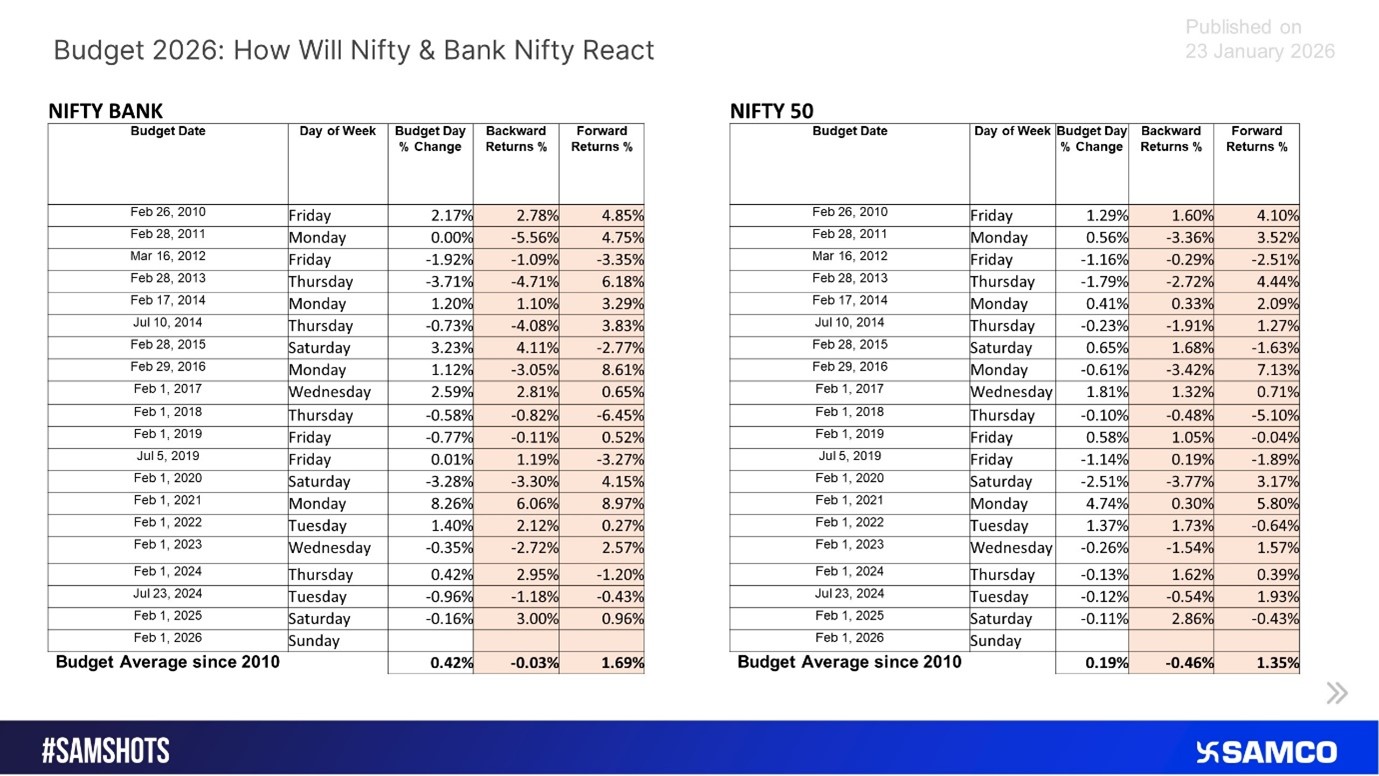
- Nifty 50 average Budget day return: +0.19%
- Bank Nifty average Budget day return: +0.42%
Returns on the day of the Budget have varied widely across years, swinging between gains and losses depending on market positioning, expectations, and global cues rather than Budget announcements alone. This reinforces the view that Budget day price action is often sentiment-driven and short-lived, offering limited directional clarity.
Pre-Budget Phase: Markets Turn Cautious
The period leading up to the Budget tells a more consistent story. Historical data shows that markets tend to de-risk ahead of the event, reflecting uncertainty around fiscal priorities, taxation, and policy direction.
- Average one-week backward returns (pre-Budget):
- Nifty 50: −0.46%
- Bank Nifty: −0.03%
- Nifty 50: −0.46%
This marginal weakness suggests profit-booking and risk reduction, especially after pre-Budget rallies. Investors and traders often prefer to wait on the sidelines rather than carry aggressive positions into a high-event risk day.
Post-Budget Phase: Where Conviction Returns
The most meaningful trend emerges after the Budget. Once policy clarity is established, markets typically shift focus back to liquidity conditions, earnings visibility, growth outlook, and sectoral execution.
- Average one-week forward returns (post-Budget):
- Nifty 50: +1.35%
- Bank Nifty: +1.69%
- Nifty 50: +1.35%
Historically, the post-Budget phase has delivered more consistent and directional returns compared to both the pre-Budget and Budget-day sessions. This indicates that clarity, rather than announcements, drives sustained market participation.
Nifty vs Bank Nifty: Who Responds Better?
While both indices follow a similar pattern, Bank Nifty tends to show slightly stronger post-Budget follow-through. This reflects the banking sector’s sensitivity to:
- Fiscal deficit targets
- Government borrowing plans
- Credit growth outlook
- Policy support for capex and infrastructure
Once uncertainty fades, banking stocks often reprice more quickly with greater macro clarity.
Key Takeaways for Investors and Traders
- Budget day itself is rarely the opportunity; price action is often volatile but directionless
- Pre-Budget weakness is common due to uncertainty and position trimming
- Post-Budget phase has historically delivered better risk-reward, especially for positional trades
- Patience has paid more than prediction—positioning after clarity has mattered more than guessing. Budget headlines
Budget 2026 Strategy Perspective
As markets approach Budget 2026, history suggests that investors should:
- Avoid overreacting to Budget Day volatility
- Use pre-Budget uncertainty to identify quality positioning opportunities
- Focus on post-Budget confirmation rather than headline-driven moves
In past cycles, reacting less and positioning better has consistently outperformed headline chasing.



 Easy & quick
Leave A Comment?