

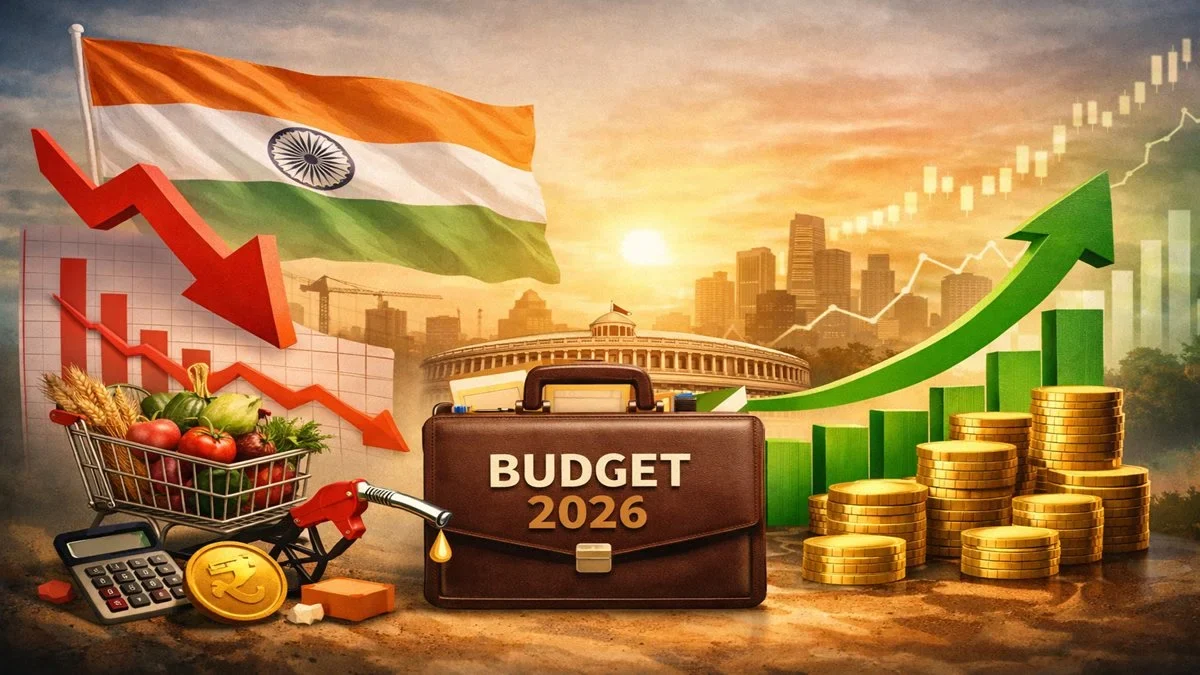
As Budget 2026 approaches, all eyes are on North Block. On February 1, Finance Minister Nirmala Sitharaman is set to present the Union Budget for FY27 at a time when global trade remains tense and geopolitical risks continue to cloud growth visibility.
Yet, amid tariff pressures and cross-border uncertainties, India’s economic story looks steadier than most. The focus of Budget 2026 is expected to stay grounded—less noise, more structure. Fiscal discipline, capital spending, and long-term capacity building appear to be the core pillars shaping the narrative.
From infrastructure to telecom, autos to defence, here’s how Budget 2026 could shape sectoral priorities—based strictly on the reference framework—explained in a clear, market-focused, and reader-first manner.
Market Performance: India Stays Steady Despite Global Stress
The global environment remains volatile. Trade disruptions, tariff concerns, and geopolitical tensions continue to test economies worldwide. Even so, India’s macro stability has held up.
Fiscal consolidation remains central to policymaking. The government has already shown restraint, avoiding aggressive populist measures in recent budgets. Budget 2026 is expected to continue this approach, balancing growth needs with fiscal discipline.
Key fiscal data highlights the broader backdrop:
- Fiscal deficit (FY27 target): 4.2% of GDP
- Fiscal deficit target (FY26): 4.4%
- Fiscal deficit Apr–Oct 2025: ₹8.25 trillion
- Share of full-year FY26 target: 52.6%
- FY25 fiscal deficit: 4.8% (lower than revised 4.9%)
These numbers underline a slow but deliberate glide path toward consolidation.
Main News: Budget 2026 Themes Take Shape
At its core, Budget 2026 is expected to reflect continuity rather than surprise. The government appears focused on strengthening fundamentals rather than chasing short-term gains.
The broad themes emerging around Budget 2026 include:
- Expansion of social and physical infrastructure
- Measures to improve ease of doing business
- Policies aimed at job creation and workforce skilling
- Push to boost manufacturing capabilities
- Initiatives that enhance ease of living
These priorities align closely with the government’s longer-term objective of reducing the debt-to-GDP ratio while sustaining growth momentum.
Some key debt and fiscal metrics add context:
- Central government debt (FY25): 57.1% of GDP
- Debt level in FY21 (pandemic year): 61.4% of GDP
- FY26 debt estimate: 56.1%
- FY27 projected debt: 55.1%
Over the medium term, the target remains to bring government debt down to 50% (±1%) of GDP by FY31.
Sector-Wise View Under Budget 2026
Real Estate: Demand Revival Back in Focus
For real estate, Budget 2026 could address long-standing demand challenges, especially in affordable and mid-income housing.
Key sector-related points include:
- Scope for interest deduction on home loans for self-occupied properties under the new tax regime
- Existing deduction under old regime: up to ₹2 lakh annually
- Discussion around reviving the Credit Linked Subsidy Scheme (CLSS)
- CLSS subsidies could range between 3% and 4%
- Possible revision of affordable housing price cap:
- Current cap: ₹45 lakh
- Proposed revision: ₹75 lakh
These measures, if implemented, could widen eligibility and improve project-level economics.
Automobile: EV Push and Manufacturing Clarity
The automobile segment remains closely linked to India’s manufacturing ambitions.
Under Budget 2026, attention areas include:
- Higher budgetary support for EV charging infrastructure
- Greater policy clarity on promoting domestic manufacturing of sintered rare earth permanent magnets
Both elements are critical for the long-term EV ecosystem and supply chain security.
Hotels: Infrastructure Status in Sight
For the hospitality industry, Budget 2026 may offer structural relief.
- Possible pan-India inclusion of hotels under infrastructure status
- This could help lower borrowing costs and improve funding access
Such a move would align tourism growth with infrastructure development.
Financials: Simplification and Digital Push
The financial sector could see targeted refinements rather than sweeping changes.
Areas highlighted include:
- Incentives to promote digital payments
- Uniform tax treatment on interest income across deposit types
- Expansion of credit guarantee schemes for MSMEs and MFIs
- Simplified access to interest subsidies under PMAY 2.0
- Discussion around raising life insurance tax rates to standard corporate levels
These steps aim to improve system efficiency without adding fiscal stress.
Energy and Chemicals: Fuel Taxes in Focus
Energy remains a sensitive but important lever.
- Possibility of a ₹2 per litre increase in fuel taxes
This would be a fiscal measure with potential downstream effects across sectors.
Metals and Cement: Riding the Infra Cycle
Infrastructure-linked sectors like cement and steel remain central to the government’s growth strategy.
Key areas to watch:
- Higher outlays toward cement- and steel-intensive projects
- Increased focus on affordable housing under PMAY
- Policy or spending support for critical minerals and rare earth elements
These segments directly link into India’s infrastructure and manufacturing ambitions.
Consumer: Boosting Demand Gradually
Consumption remains an important pillar of growth.
- General measures in Budget 2026 may aim to revive consumer demand
- No sharp stimulus, but supportive policy signals could help sentiment
Telecom: Cost Relief and Regulatory Reset
The telecom sector may see meaningful structural relief.
Key points include:
- Relief on USOF charges until the existing corpus is exhausted
- Reform package linked to AGR dues
- Exemption of service tax on incremental licence fees and spectrum usage charges related to AGR
- Reduction in overall licence fees
- Extension of business loss carry-forward from 8 years to 16 years
Support for data centres may also involve:
- Conditional tax holidays tied to capacity or green energy usage
- Customs duty waivers on imported equipment like GPUs
- Higher GST input tax credits
Industrials: Capex Momentum Continues
Infrastructure spending remains a cornerstone of Budget 2026.
- Overall infrastructure allocation growth: 8–10%
- Focus on growth over revised FY26 expenditure
Railways
- Expected allocation growth: 5–6%
- Focus areas:
- Track infrastructure
- New routes
- Safety systems
- Rolling stock
- Possible announcements on:
- Three new corridors
- New Vande Bharat and Amrit Bharat trains
Defence
- Expected allocation growth: 12–15%
- Emphasis on local and private defence manufacturing
Energy Generation
- Continued push toward:
- Renewable energy
- BESS adoption
- Nuclear energy (including SMRs)
- Pumped storage projects
Energy Distribution
- Financial package for discoms
- Linked to reform measures aimed at improving financial health
- Potential steps toward privatisation or strategic stake sales
Electronics
- Work underway on Semiconductor 2.0
- Goal: Increase value addition and deepen the domestic ecosystem
Internet, eCommerce: Emerging Tech Support
The digital economy remains a long-term focus.
- Incentives for startups using AI, ML, quantum computing, and blockchain
- Broader tax benefits on ESOPs, extending coverage to more startup employees
Media: Policy Tweaks on DTH
For the media segment:
- Potential reduction in DTH licence fees
- Policy changes aligned with TRAI recommendations
Pharma: Healthcare Spending Stays Central
Healthcare continues to command attention under Budget 2026.
Likely focus areas include:
- Increased public health spending
- Emphasis on:
- Primary healthcare
- Hospital infrastructure
- Workforce capacity
- Incentives for innovation and R&D
- Measures to enhance cost competitiveness
Other themes include:
- Continued support for APIs through PLI schemes
- Reduced import dependence for critical drugs
- Expansion of Ayushman Bharat
- Improved access to essential medicines and chronic disease care
Summary: What Budget 2026 Really Tells Us?
At its heart, Budget 2026 looks set to reinforce discipline over drama. The government appears committed to gradual fiscal consolidation while keeping the growth engine running through targeted capital spending and sector-specific refinements.
There are no loud promises—just steady alignment toward infrastructure, manufacturing, employment, and long-term resilience. For markets and businesses, the message is clear: continuity, structure, and patience remain the guiding themes as India moves deeper into its FY27 journey.
Source: Livemint




 Easy & quick
Leave A Comment?