Why Asset Allocation Matters More Than Market Predictions
Periods of stock market volatility often lead investors to ask a common question: Should they invest in equities, gold, or fixed-income instruments?
Financial experts generally emphasize that long-term wealth creation is less about predicting market movements and more about maintaining a disciplined asset allocation strategy. Diversification across multiple asset classes can help investors manage risk while participating in different market opportunities.
Understanding the Three Major Asset Classes
Equity: Growth-Oriented Investments
Equities represent ownership in businesses and are commonly considered a long-term growth asset.
Potential characteristics of equities include:
- Long-term capital appreciation potential
- Participation in economic growth
- Higher short-term volatility
- Suitable for long-term financial goals
However, equity investments can experience significant fluctuations during periods of market uncertainty.
Gold: Portfolio Diversifier
Gold is often viewed as a diversification tool rather than a primary growth asset.
Investors may consider gold because:
- It can behave differently from equities during certain market conditions.
- It may act as a hedge during geopolitical uncertainty.
- It can help diversify portfolio risk.
Experts generally view gold as one component of a broader investment strategy rather than a standalone solution.
Fixed Income: Stability and Income
Fixed-income instruments such as bonds, government securities, and debt funds are typically associated with:
- Relative stability
- Predictable income streams
- Lower volatility compared to equities
- Capital preservation objectives
Fixed-income investments often play an important role in balancing portfolio risk.
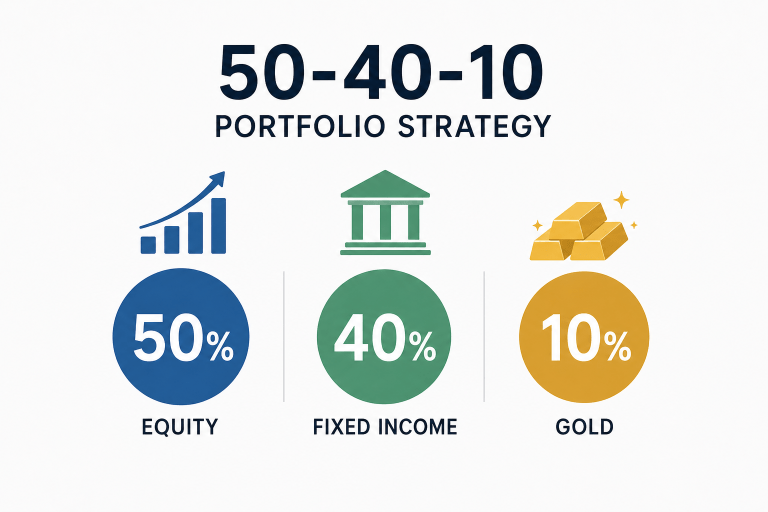
Understanding the 50-40-10 Asset Allocation Approach
According to a portfolio allocation framework discussed by market experts, investors may consider diversification across multiple asset classes rather than concentrating investments in a single category.
The suggested framework consists of:
50% Equity Allocation
The equity portion seeks to provide long-term growth potential and participation in economic expansion.
40% Fixed Income Allocation
Fixed-income assets may help reduce overall portfolio volatility while providing stability and income generation.
10% Gold Allocation
Gold serves as a diversification component that may help balance portfolio risks during periods of uncertainty.
Why Diversification Becomes Important During Volatile Markets
Market volatility can affect different asset classes in different ways.
Diversification aims to:
- Reduce concentration risk
- Balance portfolio fluctuations
- Improve risk-adjusted outcomes
- Help investors remain disciplined during market cycles
Research and investment professionals increasingly advocate diversified portfolios rather than relying solely on a single asset class.
Factors Investors Should Consider Before Choosing an Asset Allocation
Investment Horizon
Long-term investors may have different allocation needs than those with short-term financial goals.
Risk Tolerance
An investor’s ability to withstand market fluctuations often influences asset allocation decisions.
Liquidity Requirements
Investors may need to consider upcoming financial obligations when determining portfolio composition.
Financial Goals
Retirement planning, wealth creation, education funding, and income generation may require different allocation strategies.
Common Asset Allocation Mistakes to Avoid
Chasing Recent Performance
Investing heavily in an asset class simply because it has recently performed well can increase portfolio risk.
Ignoring Diversification
Concentrating investments in a single asset class may expose investors to unnecessary volatility.
Frequent Portfolio Changes
Constantly changing allocations based on short-term market movements can affect long-term investment outcomes.
Neglecting Periodic Rebalancing
Regular portfolio reviews can help maintain the intended asset allocation over time.
Equity vs Gold vs Fixed Income: Which Is Better?
There is no universally “best” asset class.
Each serves a different purpose:
| Asset Class | Primary Objective |
|---|---|
| Equity | Long-term growth |
| Gold | Diversification |
| Fixed Income | Stability and income |
Rather than choosing one over another, many financial professionals emphasize combining asset classes based on individual goals, risk tolerance, and investment horizon.
Conclusion
During periods of market volatility, investors often focus on where to invest next. However, a diversified asset allocation approach may be more important than attempting to predict short-term market movements. Equities, gold, and fixed-income investments each serve different roles within a portfolio. Understanding these roles and maintaining a disciplined allocation strategy can help investors navigate changing market conditions more effectively.
Disclaimer
This article is for educational and informational purposes only. It should not be construed as investment advice, stock recommendations, financial planning advice, or a solicitation to buy or sell securities. Asset allocation examples discussed are illustrative in nature and may not be suitable for all investors. Readers should consult a qualified financial advisor before making investment decisions.