The long-running EU-India FTA talks have finally reached a decisive moment. After years of slow progress, pauses, and hard negotiations, officials in New Delhi have confirmed that discussions at the official level are now complete.
For markets, policymakers, and global trade watchers, this marks the close of a chapter that began nearly two decades ago—and the opening of a far more consequential one.
Market Performance: Why EU-India FTA Talks Matter Now?
The conclusion of EU-India FTA talks comes at a time when India is positioning itself as a stable, long-term trade partner in a changing global order.
- India and the European Union already record bilateral trade of over $136 billion
- The EU functions as a single customs bloc of 27 countries
- Any agreement with the EU carries scale, consistency, and long-term impact
From a market sentiment lens, the completion of talks reduces policy uncertainty. It signals continuity, predictability, and deeper economic engagement between two of the world’s largest democratic economies.
Main News: EU-India FTA Talks Officially Concluded
Officials have confirmed that EU-India FTA talks are now concluded, with a formal announcement expected on January 27, 2026, during the EU-India summit.
According to Commerce Secretary Rajesh Agrawal, official-level negotiations have wrapped up, and both sides are prepared to publicly announce the successful conclusion.
Timeline of how this unfolded:
- January 23, 2026: Negotiations concluded
- January 24, 2026: Deal approved by both sides
- January 27, 2026: Formal announcement expected at the summit
The final agreement text is currently undergoing legal scrubbing by teams on both sides. Once completed, it will be translated and circulated among all 27 EU member states before moving to the European Parliament for ratification.
Company Details: Not About Companies, But Policy Scale
While the EU-India FTA talks are not tied to individual companies, the scale of the agreement matters.
- The EU has FTAs with eight countries
- Recently signed an FTA with the MERCOSUR bloc
- Acts as a unified market rather than country-by-country
This structure makes the EU fundamentally different from trade blocs like ASEAN. Any deal with the EU automatically spans multiple economies under one customs framework.
For India, this is not just another trade agreement—it is among the largest bilateral deals in the world by scope.
The Summit Context: More Than Just Trade
The FTA is expected to be announced alongside other agreements during the EU-India summit on January 27.
Key agreements expected at the summit:
- Security and Defence Partnership
- Energy cooperation
- Mobility agreement
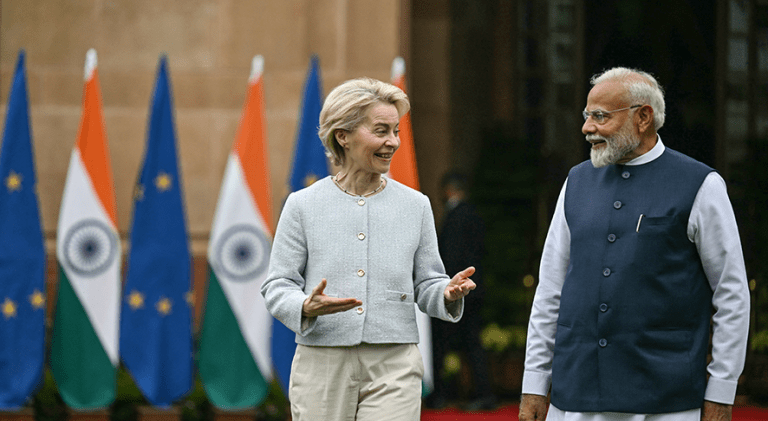
The summit will bring together:
- Prime Minister Narendra Modi
- EU Commission President Ursula von der Leyen
- European Council President Antonio Costa
The presence of the EU’s top leadership in New Delhi signals the strategic depth of the partnership, beyond trade alone.
Republic Day Diplomacy and Strategic Signals
A day before the summit, EU leaders attended India’s Republic Day parade on January 26.
Notable moments:
- EU defence commanders participated for the first time
- Leaders were hosted at Rashtrapati Bhawan by President Droupadi Murmu
- India showcased military hardware and contingents involved in Operation Sindoor (May 2025)
European leaders also highlighted shared commitments to stability, security, and democratic values, while carefully avoiding contentious geopolitical references.
Why It Took 20 Years: A Long Negotiation Arc?
The story of EU-India FTA talks stretches back to 2007.
Over the years, talks stalled multiple times due to disagreements over:
- Market access for European agricultural and dairy products
- Environmental regulations
- Investment frameworks
- Immigration-related concerns
Between 2014 and 2022, negotiations were frozen. When talks resumed, both sides adopted a more pragmatic approach—agreeing to set aside sectors where consensus proved impossible.
That realism is what finally moved the process forward.
What Happens Next After EU-India FTA Talks?
Once announced, the agreement will follow a procedural path:
- Legal vetting and final text completion
- Translation into EU languages
- Circulation across all 27 EU states
- Ratification by the European Parliament
In parallel, India and the EU are also moving to upgrade their strategic partnership, first signed in 2004, expanding cooperation in areas such as:
- Maritime security
- Cyber security
- Counter-terrorism
Summary: Why This Moment Matters?
The conclusion of EU-India FTA talks ends a 20-year negotiation cycle and sets the stage for deeper economic and strategic engagement.
Key takeaways:
- Talks officially concluded after nearly two decades
- Announcement expected on January 27, 2026
- Bilateral trade already above $136 billion
- Agreement ranks among the largest global trade deals
- Reinforces India-EU ties across trade, defence, and security
From a market perspective, this is a structural development—not a short-term trigger, but a long-term framework. It reflects where global trade partnerships are heading and how India is positioning itself within them.
And after 20 years of starts and stops, the finish line is finally in sight.
Source: The Hindu