


Owning a piece of Apple, Microsoft, Amazon, or Nvidia is no longer reserved for global fund managers. Indian investors can invest in US stocks from India legally, in minutes, and with as little as $1 thanks to fractional shares. If you’re just starting out, this guide is your map: it answers the five questions every beginner asks before placing their first order, and links you to a detailed walkthrough for each.
By the end you’ll know how to get started, whether it’s legal, the best way to buy US stocks in India, how much money you actually need, and when the US market is open in Indian time.
Why Indian Investors Are Going Global
Before the “how,” a quick word on the “why.” Adding US stocks to an Indian portfolio does three useful things: it diversifies your wealth across the world’s two largest economies, gives you access to global leaders in technology and innovation that have no listed equivalent in India, and provides a natural currency hedge, since US stocks are held in dollars.
You can explore the full range of US stocks and ETFs, along with research-backed recommendations, on Samco’s US Stocks platform. Now, let’s get you started.
1. How to Invest in US Stocks from India
Getting started is simpler than most beginners expect. The process comes down to four steps:
- Open a demat and trading account with a SEBI-registered broker, then activate the US stocks segment.
- Complete a quick verification (KYC and a few declarations).
- Fund your account by remitting US dollars under the RBI’s Liberalised Remittance Scheme (LRS).
- Start buying US stocks and ETFs — whole shares or fractions.
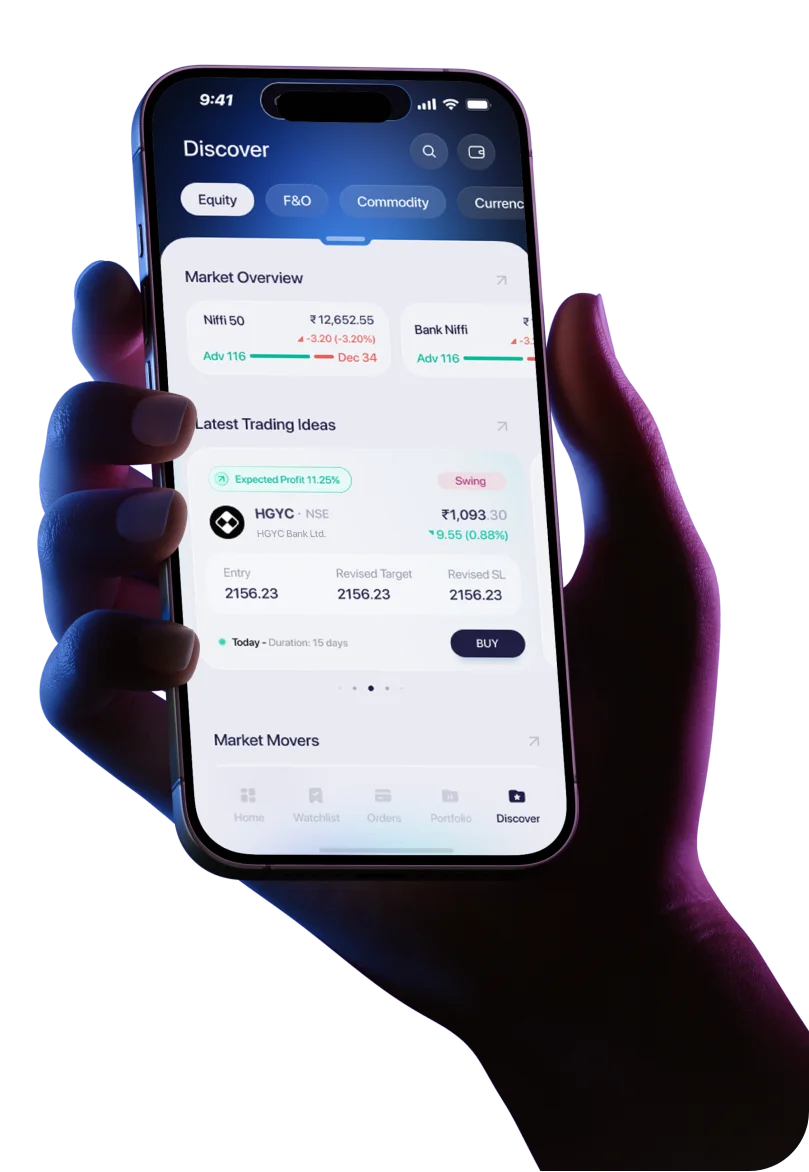
With Samco, new users open a free demat account and activate US stocks via DigiLocker, while existing users simply tap “Activate US Stocks A/C” in the app. Activation is typically completed within 30–60 minutes during business hours.
→ Read the full step-by-step guide: How to Invest in US Stocks from India
2. Is It Legal to Invest in US Stocks from India?
Yes — and this is the question that stops many beginners before they start, so let’s be clear. It is fully legal for resident Indians to invest in US stocks under the Reserve Bank of India’s Liberalised Remittance Scheme (LRS).
Under LRS, every resident individual (including minors) can remit up to USD 250,000 per financial year (April–March) for permissible transactions, which include buying foreign shares and ETFs. The limit is per person, so a family can pool their individual limits.
The only tax touchpoint at the remittance stage is TCS (Tax Collected at Source), which applies only once your total LRS remittances cross ₹10 lakh in a financial year — and even then, TCS is an advance tax that you can fully adjust against your income tax liability or claim back as a refund. It is not an additional cost.
3. The Best Way to Buy US Stocks in India
There’s more than one route to buy US stocks in India, and the right one depends on how much control and choice you want:
- Direct investing through a broker — you buy individual US shares and ETFs in your own name. This offers the widest choice, full ownership, and the ability to build a tailored portfolio. It’s the route most serious long-term investors prefer.
- Indian mutual funds / fund-of-funds with US exposure — indirect exposure without a separate US account, but with less control over which companies you hold.
For most investors who want genuine ownership, transparency, and flexibility, direct investing through a regulated broker is the best way. What to look for in a platform:
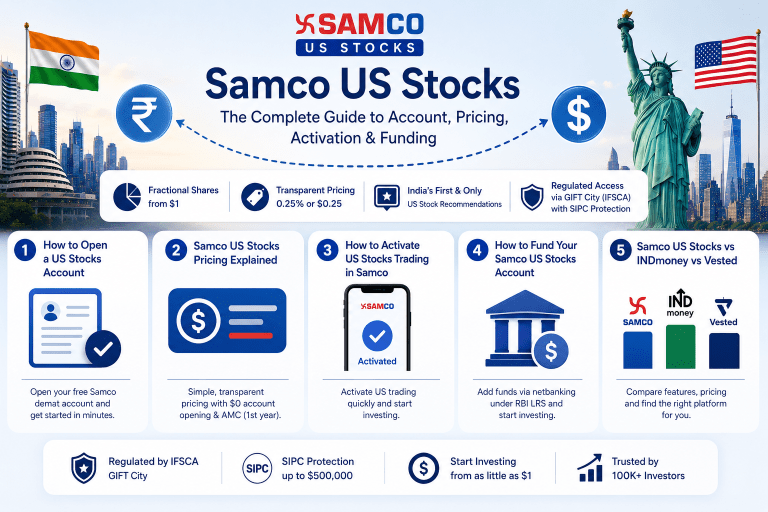
- Low, transparent costs — Samco charges $0 for account opening, $0 account maintenance in the first year, and brokerage of 0.25% or $0.25, whichever is higher, with transparent pricing and no hidden fees.
- Fractional shares so you can start small.
- Strong regulation — Samco’s US investing is offered via its GIFT City unit under IFSCA, with SIPC protection in the US up to $500,000 per account.
- Research and recommendations — Samco is India’s first and only broker to offer US stock recommendations, not just execution.
- Automation — set up a Stock SIP to invest in US stocks systematically.
4. How Much Money Do You Need to Invest in US Stocks?
Less than you think. Thanks to fractional investing, you don’t need to afford a full share of an expensive company to own a piece of it.
A single share of some US companies trades at several hundred dollars, but fractional shares let you buy a portion of one. On Samco, you can start investing in US stocks from as little as $1, which means there’s effectively no minimum investment amount. You can also begin with a small recurring SIP and build your position over time through rupee-cost averaging.
The practical things to budget for are: the amount you want to invest, your broker’s brokerage charge, and any foreign-exchange/remittance costs from your bank. Keeping total annual remittances under ₹10 lakh also means you avoid TCS paperwork entirely.
5. US Stock Market Timings for Indian Investors
Because the US runs on Eastern Time (ET), the market is open during the evening and late night in India — which is convenient for working professionals who can trade after the Indian market closes.
The regular US session runs 9:30 AM to 4:00 PM ET (6.5 hours), Monday to Friday. In Indian time, this shifts by an hour twice a year because the US observes Daylight Saving Time, while India does not:
- Standard Time (roughly November to mid-March): the market is open 8:00 PM to 2:30 AM IST.
- Daylight Saving Time (roughly mid-March to November): the market is open 7:00 PM to 1:30 AM IST.
India is 10.5 hours ahead of US Eastern Time during US Standard Time, and 9.5 hours ahead during Daylight Saving Time. There are also pre-market and after-hours sessions for those who want to react to news outside core hours, and US exchanges stay closed on major US federal holidays.
→ See the full timing guide, including pre-market and holidays: US Stock Market Timings in India
Your First Steps, Summarised
Putting the five pieces together, here’s the beginner’s path:
- Confirm you’re comfortable with the basics — it’s legal, you invest under LRS, and TCS (if any) is recoverable.
- Choose direct investing through a regulated broker as the cleanest way to buy US stocks in India.
- Open and activate a US investing account — fast and free with Samco.
- Start small with fractional shares, and consider a Stock SIP for discipline.
- Note the US market timings in India so you can place orders during live hours.
When you’re ready, you can begin by opening a free demat account and activating the US Stocks segment.
Frequently Asked Questions
Is it legal to invest in US stocks from India? Yes. Resident Indians can invest in US stocks under the RBI’s Liberalised Remittance Scheme, which permits remittances of up to USD 250,000 per individual per financial year for permissible transactions, including foreign shares and ETFs.
How do I buy US stocks in India as a beginner? Open a demat and trading account with a SEBI-registered broker, activate the US stocks segment, complete KYC, fund the account in USD under LRS, and start buying. With Samco, US stocks activation is typically completed within 30–60 minutes during business hours.
How much money do I need to start? Very little — fractional investing means there’s effectively no minimum. On Samco you can start from as little as $1.
What are US stock market timings in India? The regular US session is 9:30 AM–4:00 PM ET. In IST that is 8:00 PM–2:30 AM during US Standard Time and 7:00 PM–1:30 AM during Daylight Saving Time, Monday to Friday.
Will I pay extra tax just to send money abroad? TCS applies only when your total LRS remittances exceed ₹10 lakh in a financial year, and it is an advance tax that you can adjust against your income tax liability or claim as a refund — so it isn’t an additional cost.
Disclaimer: Investments in securities markets are subject to market risks. This content is for educational purposes only and does not constitute investment, legal, or tax advice. Tax and remittance rules are subject to change. Read all related documents carefully and consult a qualified financial or tax advisor before investing.