


Indian investors no longer have to watch companies like Apple, Microsoft, Amazon, and Nvidia compound wealth from the sidelines. US stocks investment from India is fully legal, accessible, and — with fractional shares — possible from as little as $1. Whether you want a single share of Tesla or broad exposure to the S&P 500 through an ETF, you can build a global portfolio without leaving your home.
This guide walks you through everything: what US stocks are, why they matter for an Indian portfolio, exactly how to buy US stocks in India, the taxation rules, the risks, and a step-by-step beginner roadmap. Wherever it helps, we show how a SEBI-registered broker like Samco fits into the picture.
What Are US Stocks?
US stocks are shares of companies listed on American exchanges — primarily the New York Stock Exchange (NYSE) and the NASDAQ. When you buy one, you own a small slice of that business and participate in its growth, profits, and (in some cases) dividends.
The US market is home to many of the world’s most recognised and innovative companies — Apple, Microsoft, Alphabet (Google), Amazon, Meta, Tesla, Nvidia, Netflix, and hundreds more. For Indian investors, these names represent something the domestic market can’t fully replicate: direct ownership in global technology leaders, consumer brands you already use daily, and sectors that are under-represented on Indian exchanges.
Two broad routes exist for international investing from India:
- Direct stocks — buying individual shares of a US-listed company.
- US ETFs (Exchange-Traded Funds) — funds that track an index, sector, or theme (like the S&P 500 or the Nasdaq-100) and trade on exchanges like a single stock. ETFs give you instant diversification across dozens or hundreds of companies in one purchase, usually at a low cost.
Why Invest in US Stocks from India?
The case for adding foreign stocks investment to an Indian portfolio rests on a few durable advantages.
1. Global diversification. Spreading capital across two of the world’s largest economies makes your portfolio more resilient. When Indian markets are flat or falling, US markets may behave differently, smoothing your overall returns.
2. Access to global leaders. The US market lets you own the companies defining artificial intelligence, cloud computing, semiconductors, electric vehicles, and global consumer brands — businesses with no listed equivalent in India.
3. A natural currency hedge. US stocks are denominated in US dollars. Historically, the rupee has tended to depreciate against the dollar over long periods. If that continues, dollar-denominated assets can cushion your portfolio against rupee weakness — a built-in hedge many Indian portfolios lack.
4. Depth, liquidity, and transparency. The US market is the deepest and most liquid in the world, with strong regulatory oversight and high disclosure standards. That makes entering and exiting positions easy even for retail investors.
5. A long track record of growth. Over multiple market cycles, US equities have delivered consistent long-term returns built on innovation and reinvestment. To make the point concrete, Samco’s own US Stock Returns Calculator illustrates how a hypothetical $1,000 invested in Apple in January 2010 could have grown to roughly $23,648 by early 2025 — a CAGR in the region of 25% (past performance, of course, is not a guarantee of future results).
How Indians Can Legally Invest in US Stocks
This is the heart of US stock market investing for Indians, so let’s be precise about the legal framework.
The Liberalised Remittance Scheme (LRS)
Indians can legally invest in US stocks under the Reserve Bank of India’s Liberalised Remittance Scheme (LRS). Under LRS, every resident individual — including minors — can remit up to USD 250,000 per financial year (April–March) for permissible current and capital account transactions, which includes buying foreign shares and ETFs.
A few important LRS details:
- The limit is per individual, per financial year, and is cumulative across all purposes (travel, education, investments, and so on).
- The limit does not carry forward — any unused portion expires on 31 March.
- A family of four adults could collectively remit up to USD 1 million in a year, each using their own limit.
Tax Collected at Source (TCS) on remittances
When you send money abroad under LRS, your bank collects TCS on the amount. As of the rules applicable for FY 2025–26 onward:
- TCS applies only once your total LRS remittances cross ₹10 lakh in a financial year (this threshold is PAN-based and cumulative across all banks and purposes).
- For investment remittances above ₹10 lakh, the TCS rate is 20%. (Budget 2026 reduced rates for education, medical, and tour-package remittances, but investment-related transfers continue at 20%.)
- Crucially, TCS is not an extra cost — it is an advance tax. You can adjust it against your total income tax liability when filing your return, or claim a refund if you’ve paid in excess.
So if you keep annual remittances under ₹10 lakh, no TCS applies at all. Above that, the TCS is recoverable.
Opening a US investing account
To actually buy shares, you need a brokerage account that provides access to US markets. The typical journey looks like this:
- Open a demat and trading account with a SEBI-registered broker.
- Activate the US stocks / global investing segment on that account.
- Complete verification — usually a quick KYC and declarations process.
- Fund the account by remitting USD under LRS.
- Start buying US stocks and ETFs.
How this works with Samco
Samco is India’s first and only broker offering US stock recommendations alongside execution, and the onboarding is built to be fast:
- New clients open a free demat account, then click “Get Started” to open a US trading account — entering investment details and declarations and submitting documents via DigiLocker for quick verification.
- Existing clients simply log in to the Samco app and tap “Activate US Stocks A/C” to upgrade their existing account.
- Once the activation form is submitted successfully, the US stocks account is typically activated within 30–60 minutes during business hours.
On regulation and safety, Samco’s US investing service is offered through SAMCO Securities Limited – Strategic Business Unit at GIFT City, regulated by the IFSCA, operating as an authorised Global Access Provider for US market access. Holdings also carry SIPC protection in the US up to $500,000 per account (including $250,000 for cash) in the event of broker failure.
Fractional Investing: Owning a Slice of Expensive Stocks
One of the biggest barriers to how to buy US stocks in India used to be price. A single share of some US companies can cost hundreds of dollars. Fractional investing removes that barrier.
Fractional investing lets you buy a portion of a share instead of a whole one. Want exposure to a company trading at $500 but only have $50 to invest? You can buy one-tenth of a share. This makes the most valuable companies in the world accessible regardless of your budget.
With Samco, you can start investing in US stocks from as little as $1 and buy fractional shares of leading global companies — there’s effectively no minimum investment amount. You can also automate this through a Stock SIP, setting up recurring investments to build a global portfolio in a disciplined, rupee-cost-averaged way.
US ETFs: Diversification in a Single Trade
If picking individual stocks feels daunting, US ETFs are often the smarter starting point.
A US ETF is a fund that tracks a US index, sector, bond basket, or theme, and trades on the exchange like an ordinary share. Buying one unit can give you exposure to hundreds of companies at once. For example, an S&P 500 ETF spreads your money across 500 of the largest US companies in a single purchase.
The advantages:
- Instant diversification without researching individual companies.
- Low cost, since most index ETFs charge minimal expense ratios.
- Simplicity — ideal for beginners and for the “core” of a long-term portfolio.
Samco offers US ETFs (including ETF ideas for the long term) so you can blend broad index exposure with selective stock picks.
Taxation of US Stocks for Indian Investors
Taxes are where many first-time global investors get caught out, so understand this section carefully. There are two layers: US tax and Indian tax.
Capital gains (taxed in India)
The US generally does not tax capital gains for non-resident Indian investors. Your gains are taxable in India, and the rate depends on your holding period — note that the threshold for foreign shares is 24 months, not the 12 months that applies to Indian listed equity:
- Short-Term Capital Gains (STCG) — shares held for 24 months or less. These are added to your total income and taxed at your applicable income tax slab rate. (The concessional 15%/20% STCG rate for Indian listed shares does not apply to foreign shares.)
- Long-Term Capital Gains (LTCG) — shares held for more than 24 months. These are taxed at a flat 12.5% without indexation (following the Budget 2024 change effective 23 July 2024), plus applicable surcharge and cess.
Important: the ₹1.25 lakh LTCG exemption that applies to Indian listed equity does not apply to US stocks — foreign-share LTCG is taxed from the first rupee of gain.
Dividends (taxed in the US, then in India with credit)
- US companies apply a 25% withholding tax on dividends paid to Indian investors, under the India–US Double Taxation Avoidance Agreement (DTAA) (provided Form W-8BEN is on file to claim treaty benefits).
- That dividend is also taxable in India, added to your income at your slab rate.
- To avoid being taxed twice, you can claim a Foreign Tax Credit (FTC) for the 25% already withheld in the US, offsetting your Indian liability on that dividend.
Compliance you can’t skip
- You must disclose foreign holdings under Schedule FA (Foreign Assets) in your income tax return — there is no minimum threshold, so even a few dollars of fractional shares must be reported.
- Capital gains and foreign income are reported via the relevant schedules (e.g., Schedule FSI for foreign-source income), typically using ITR-2 (or ITR-3 if you have business income).
- Convert all values to INR using the prescribed exchange rates.
Because individual situations differ, consult a tax professional before filing.
Currency Risk and How It Affects Your Returns
Since US stocks are priced in dollars, the USD–INR exchange rate directly affects your rupee returns.
- If the rupee weakens against the dollar while you’re invested, your returns increase when converted back to INR — a tailwind on top of the stock’s own performance.
- If the rupee strengthens, it eats into your returns.
This cuts both ways, which is why currency is listed under both “benefits” (the long-term hedge) and “risks” (short-term volatility). Over long horizons, the historical tendency of rupee depreciation has generally favoured Indian holders of dollar assets, but never count on it in any single year.
Risks of Investing in US Stocks
No discussion of US stocks investment from India is complete without the risks:
- Market volatility. US equities can swing sharply, especially concentrated tech names.
- Currency risk. As above, exchange-rate moves can amplify or erode returns.
- Geopolitical and regulatory risk. Policy shifts, trade tensions, and regulatory changes in either country can affect markets and the rules of remittance/taxation themselves.
- Concentration risk. Loading up on just two or three popular names leaves you exposed to single-company shocks.
- Behavioural risk. Chasing trends, ignoring research, panic-selling during downturns, and neglecting tax planning are the most common — and most avoidable — mistakes beginners make.
The antidote to most of these is diversification, a long-term horizon, and a written plan you actually stick to.
Portfolio Allocation: How Much Should Go into US Stocks?
There’s no single correct answer, because the right allocation depends on your age, goals, risk appetite, and existing exposure. But a few principles help frame the decision:
- Treat US stocks as a diversifier, not a replacement for your Indian core. Many advisors suggest international equities form a meaningful minority of the equity portion of a portfolio rather than the majority.
- Anchor with ETFs, satellite with stocks. A common structure is a broad US index ETF as the “core,” with a smaller “satellite” allocation to individual high-conviction stocks.
- Mind the holding period. Because LTCG treatment kicks in only after 24 months for foreign shares, planning exits around that mark can meaningfully improve your post-tax returns.
- Rebalance periodically. Currency moves and divergent market performance will drift your allocation over time; review it at least annually.
- Stay within your LRS comfort zone. If you’d rather avoid TCS paperwork entirely, keep total annual remittances under ₹10 lakh.
Match the allocation to a financial plan, not to whichever stock is trending this month.
Beginner Roadmap: Your First US Stock Investment, Step by Step
Here’s a clean sequence to go from zero to invested.
- Define your goal and horizon. Are you investing for long-term wealth (5+ years) or shorter-term exposure? This shapes everything that follows.
- Decide your allocation. Pick a target percentage of your portfolio for US equities, and decide your ETF-vs-stock split.
- Open and activate an account. Open a demat/trading account and activate the US investing segment. With Samco, new users open a free demat account and activate US stocks via DigiLocker; existing users activate from within the app — usually live within 30–60 minutes during business hours.
- Understand the costs. Know the brokerage and any FX/remittance charges before you fund (see Samco’s transparent pricing below).
- Fund within LRS. Remit USD under the Liberalised Remittance Scheme, keeping the ₹10 lakh TCS threshold and your annual USD 250,000 limit in mind.
- Start with an ETF, add stocks gradually. Begin with a broad index ETF for diversification, then layer in individual companies you understand.
- Use fractional shares and SIPs. Start small — even $1 — and automate with a recurring Stock SIP to average your cost over time.
- Track holdings and taxes. Keep records of every buy/sell and dividend in INR for Schedule FA disclosure and capital-gains reporting at tax time.
- Review and rebalance annually. Stay the course, avoid panic-selling, and adjust allocation as your goals evolve.
What Samco Offers for US Stock Investing
Bringing it together, here’s how Samco supports invest in US stocks from India end to end:
- US stock recommendations — India’s first and only platform offering research-backed US stock and ETF ideas (3-month, 6-month, 1-year, and long-term horizons), not just execution.
- Invest from $1 — fractional shares of leading global companies, with no effective minimum investment.
- Stock SIP for US stocks — automate recurring investments to build your global portfolio systematically.
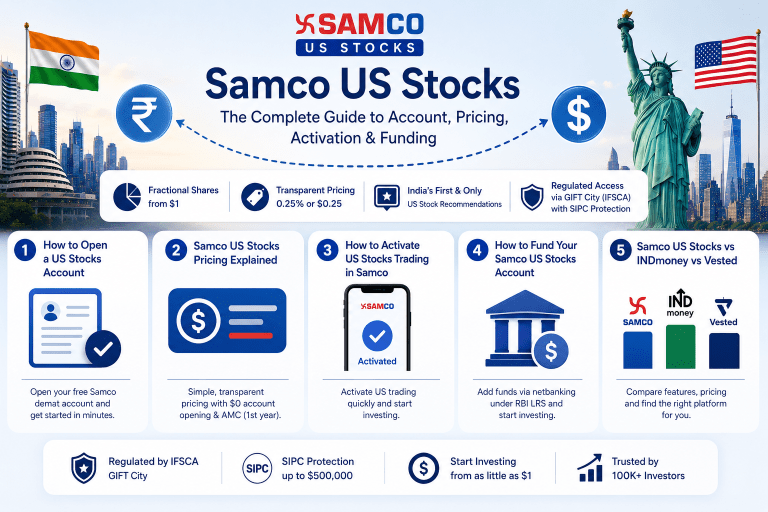
- Transparent pricing — $0 account opening, $0 account maintenance for the first year, $0 live-price tracking charges, and brokerage of 0.25% or $0.25 (25 cents), whichever is higher, with zero hidden fees.
- Regulated access — offered via SAMCO Securities Limited’s GIFT City unit under IFSCA, as an authorised Global Access Provider, with SIPC protection up to $500,000 per account.
- Fast onboarding — DigiLocker-based verification with activation typically in 30–60 minutes during business hours.
- Trusted scale — 5.5 lakh+ investors and a 4.5 app rating.
You can begin by opening a free demat account on Samco and activating the US stocks segment.
Frequently Asked Questions
How can I invest in US stocks from India? Open a demat and trading account with a SEBI-registered broker, activate the US stocks segment, complete KYC, fund the account by remitting USD under RBI’s LRS, and start buying. With Samco, you open a free demat account and activate US stocks via DigiLocker; activation is typically within 30–60 minutes during business hours.
Is it legal for Indians to invest in US stocks? Yes. It’s fully legal under the RBI’s Liberalised Remittance Scheme (LRS), which lets each resident individual remit up to USD 250,000 per financial year for permissible transactions, including foreign shares and ETFs.
What is the minimum amount needed to invest in US stocks? Thanks to fractional investing, there’s effectively no minimum — you can start with as little as $1 on Samco.
How are US stocks taxed for Indian investors? Capital gains are taxed in India: short-term (held ≤24 months) at your slab rate, and long-term (held >24 months) at a flat 12.5% without indexation. US dividends face a 25% US withholding tax, also taxable in India with a Foreign Tax Credit available under the DTAA. Foreign holdings must be disclosed in Schedule FA.
Will I have to pay TCS when I send money abroad to invest? TCS applies only when your total LRS remittances exceed ₹10 lakh in a financial year, at 20% on investment remittances above that threshold. TCS is an advance tax — fully adjustable against your income tax liability or refundable if excess.
Can I invest in US stocks through a SIP? Yes. Samco lets you set up a Stock SIP for US stocks, automating recurring investments to build your portfolio in a disciplined way.
What are US ETFs? US ETFs are funds that track a US index, sector, or theme and trade on the exchange like shares. They offer diversified exposure to many companies in a single, low-cost purchase.
How does the rupee–dollar exchange rate affect my returns? Because US stocks are dollar-denominated, a weaker rupee boosts your INR returns, while a stronger rupee reduces them — making USD–INR an important factor in your overall outcome.
Disclaimer: Investments in securities markets are subject to market risks. This content is for educational purposes only and does not constitute investment, legal, or tax advice. Tax and remittance rules are subject to change. Read all related documents carefully and consult a qualified financial or tax advisor before investing.