


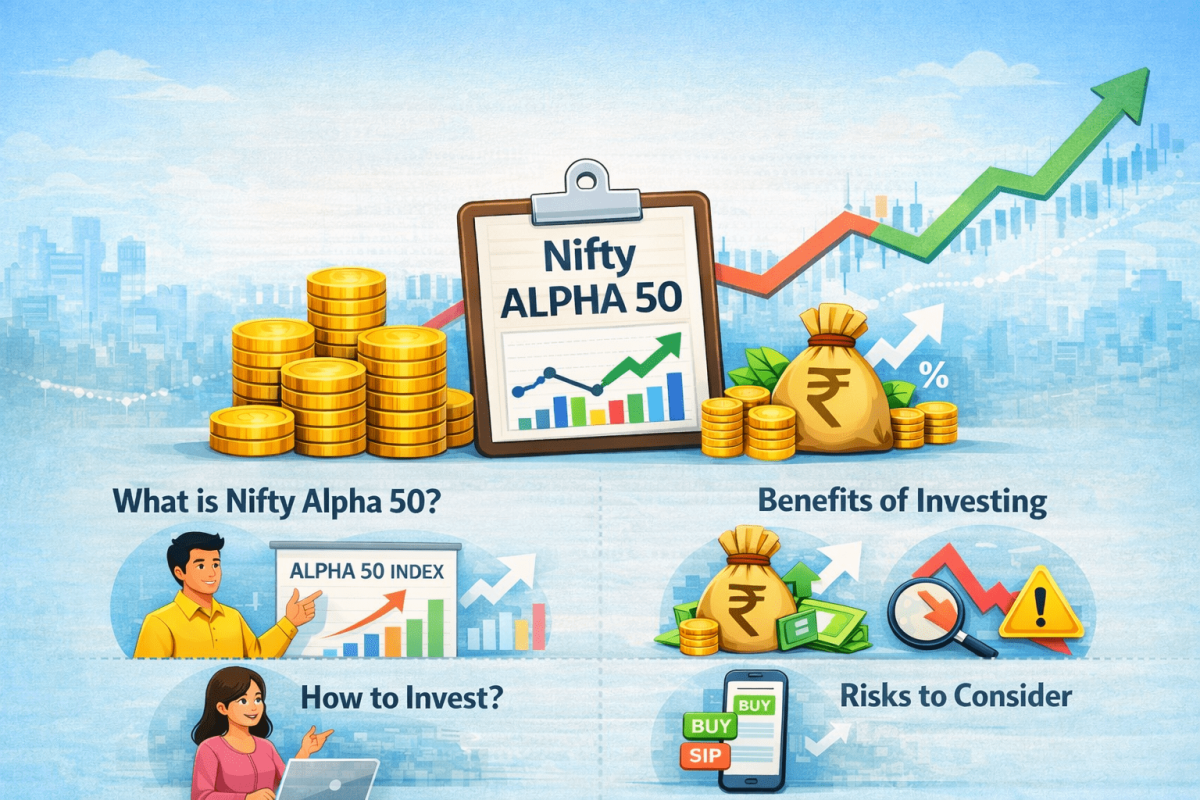
The nifty alpha 50 index represents a modern approach to stock market investing that goes beyond traditional market-cap weighting. If you are a retail investor seeking better returns than broad market indices, understanding factor-based investing through the nifty alpha 50 index is essential. This guide explains what the index is, how it works, and whether it fits your investment goals.
Most Indian investors stick to the Nifty 50 because it is familiar and straightforward. However, the nifty alpha 50 index offers a different strategy. It selects 50 stocks based on a mathematical formula that identifies companies likely to deliver excess returns. Think of it as using a smarter filter to pick stocks instead of simply choosing the largest 50 companies by market value.
Factor investing is gaining traction in India as investors realize that market-cap weighting has limitations. The nifty alpha 50 index taps into the "alpha factor," which measures the extra return a stock might deliver beyond what the broader market offers. This approach appeals to investors willing to accept higher volatility in exchange for potentially stronger long-term gains.
What Is the Nifty Alpha 50 Index?
The nifty alpha 50 index is a factor-based equity index launched by NSE (National Stock Exchange) to capture stocks with high alpha generation potential. Alpha, in simple terms, is the extra return you earn above what the market benchmark delivers. If the Nifty 50 rises 10 percent and your portfolio rises 15 percent, you have generated 5 percent alpha.
This index selects its 50 components from the broader Nifty 200 universe, not just the largest companies. The selection process uses a proprietary algorithm that evaluates each company's historical ability to deliver returns above the market average. Stocks scoring high on this alpha metric earn a place in the nifty alpha 50 index.
The methodology behind the nifty alpha 50 index involves analyzing factors like profitability, earnings growth, valuation metrics, and momentum. The index aims to blend quantitative rigor with practical investing logic. Unlike market-cap indices that automatically include the largest companies, the nifty alpha 50 index actively selects stocks based on their potential to outperform.
Periodic rebalancing ensures the index remains true to its alpha-generation mandate. Typically, the nifty alpha 50 index undergoes rebalancing quarterly or semi-annually. During rebalancing, underperforming stocks may exit, and new high-alpha candidates enter. This keeps the portfolio aligned with the factor it tracks.
How the Nifty Alpha 50 Index Works
Understanding the mechanics of the nifty alpha 50 index helps you make informed investment decisions. The index operates on a rules-based framework with no human discretion, ensuring transparency and consistency.
Stock Selection Criteria
The nifty alpha 50 index begins with the Nifty 200 universe of 200 large and mid-cap stocks. From this pool, it selects 50 stocks that score highest on the alpha metric. The alpha score is calculated using a combination of factors including earnings per share growth, return on equity, profit margins, and price momentum.
Alpha Scoring Methodology
Alpha scoring in the nifty alpha 50 index relies on multiple financial metrics that historically correlate with stock outperformance. The index committee assigns weights to each factor based on statistical analysis. Companies with consistent earnings growth, strong profitability, and reasonable valuations score higher. This weighting system is reviewed periodically to ensure relevance.
Weight Allocation Approach
Unlike the Nifty 50, which is market-cap weighted, the nifty alpha 50 index uses equal-weighting or modified weighting based on alpha scores. Each stock's position in the portfolio depends on its alpha ranking and the rebalancing rules. This approach ensures diversification while prioritizing high-alpha candidates.
Rebalancing Frequency
The nifty alpha 50 index rebalances quarterly or semi-annually, depending on NSE guidelines. During rebalancing, the index adds new high-scoring stocks and removes underperformers. This keeps the portfolio fresh and aligned with the factor strategy, though rebalancing can incur trading costs that affect returns.
Sector Concentration Impact
The nifty alpha 50 index may concentrate in specific sectors if those sectors have more high-alpha stocks. For example, if technology and financials show stronger alpha characteristics during a period, the index may become overweight in those sectors. This concentration increases both upside potential and downside risk compared to broad market indices.
Nifty Alpha 50 vs Nifty 50: Key Differences
Comparing the nifty alpha 50 index with the Nifty 50 reveals important distinctions that affect returns and risk.
Aspect | Nifty Alpha 50 | Nifty 50 |
Stock Universe | Selected from Nifty 200 | 50 largest listed companies |
Weighting Method | Alpha-based or equal-weighted | Market-cap weighted |
Volatility | Higher | Lower |
Concentration Risk | Moderate to high | Moderate |
Return Potential | Higher in bull markets | Steady, market-aligned |
Downside Risk | Sharper drawdowns possible | Less extreme |
Rebalancing | Quarterly or semi-annual | Annual or as needed |
Stock Universe Differences
The Nifty 50 includes the 50 largest companies by market capitalization, such as TCS, Reliance, HDFC Bank, and Infosys. The nifty alpha 50 index, by contrast, selects from a wider Nifty 200 pool, potentially including mid-cap companies that show strong alpha characteristics. This allows the nifty alpha 50 index to capture emerging winners before they reach mega-cap status.
Weighting and Concentration
The Nifty 50 is market-cap weighted, meaning the largest companies dominate the index. Reliance, for example, may represent 8-10 percent of the Nifty 50. The nifty alpha 50 index typically uses equal or modified weighting, spreading exposure more evenly. This reduces concentration in mega-cap stocks but may increase sector-level concentration.
Volatility and Return Patterns
The nifty alpha 50 index tends to be more volatile because it includes mid-cap stocks and smaller constituents than the Nifty 50. During bull markets, this extra volatility works in your favor, potentially delivering higher returns. During corrections, the nifty alpha 50 index may fall harder than the Nifty 50. This risk-return trade-off is central to factor investing.
Cyclical Performance
The Nifty 50 tends to be stable and predictable because mega-cap stocks are less volatile. The nifty alpha 50 index performs best when alpha factors are in favor, such as during periods when value stocks outperform or when earnings surprise on the upside. It may underperform during market rotations when size or quality preferences shift.
What Are Nifty Alpha 50 Index Funds?
An index fund that tracks the nifty alpha 50 index is a passive investment vehicle designed to replicate the index's performance. These funds aim to deliver returns matching the index minus a small fee. They are available in two main formats: mutual funds and exchange-traded funds (ETFs).
Passive Fund Structure
A nifty alpha 50 index fund holds all 50 stocks in the index in the same proportions. The fund manager does not pick stocks or time the market. Instead, the fund mechanically tracks the index by buying and holding the same securities. This passive approach keeps costs low and ensures predictable tracking.
ETF vs Index Mutual Fund
An ETF tracking the nifty alpha 50 index is traded on the stock exchange like a stock. You buy and sell shares through your brokerage account. The share price fluctuates during market hours based on supply and demand. An index mutual fund, in contrast, is purchased directly from the fund house. You buy and sell at the closing net asset value (NAV), not intraday prices.
For most retail investors, the difference is minimal. ETFs offer slightly better liquidity for large positions, while mutual funds are more convenient for small investors. Both track the nifty alpha 50 index closely if managed well.
Expense Ratio Matters
The expense ratio is the annual fee you pay the fund manager. For a nifty alpha 50 index fund, typical expense ratios range from 0.20 to 0.50 percent annually. A lower expense ratio means more of your returns stay with you. Over 20 years, a 0.30 percent lower expense ratio can add up to significant extra returns.
Tracking Error
Tracking error is the difference between the fund's returns and the actual nifty alpha 50 index returns. Ideally, this should be minimal, say 0.10 to 0.30 percent annually. Tracking error arises from cash holdings, trading costs, and rebalancing timing. A well-managed nifty alpha 50 index fund minimizes this error.
Liquidity Factors for ETFs
If you choose an ETF tracking the nifty alpha 50 index, check the trading volume. High volume means you can buy or sell shares quickly without moving the price. Low-volume ETFs may have wider bid-ask spreads, costing you extra when you trade. Always check average daily volume before investing.
Historical Performance and Risk Characteristics
The nifty alpha 50 index was launched relatively recently, but its historical performance since inception offers insights into its behavior. Understanding these patterns helps you set realistic return expectations.
Outperformance During Bull Markets
The nifty alpha 50 index has historically outperformed the Nifty 50 during strong bull markets. When investor risk appetite is high and earnings growth is strong, the alpha factor works well. Stocks scoring high on profitability and growth metrics tend to rally harder. In 2023 and early 2024, several alpha-heavy stocks in sectors like IT and select financials performed exceptionally well.
Underperformance During Corrections
When markets correct, the nifty alpha 50 index has sometimes underperformed the Nifty 50. The smaller and mid-cap constituents in the nifty alpha 50 index can sell off more aggressively during risk-off periods. If market sentiment turns negative, the index's higher volatility becomes a disadvantage rather than an advantage.
Higher Volatility Profile
Historical data shows the nifty alpha 50 index has higher annualized volatility than the Nifty 50. Volatility means larger swings up and down. For patient, long-term investors, volatility is not a problem. For those who panic-sell during downturns, it can hurt returns significantly.
Cyclical Nature of Factor Performance
The nifty alpha 50 index operates on factor cycles. Sometimes, value stocks (low price-to-earnings ratio) outperform growth stocks. Other times, growth dominates. The nifty alpha 50 index adapts through rebalancing, but timing mismatches can lead to periods of underperformance. This is normal and expected in factor investing.
Drawdown Behavior
During the COVID-19 market crash in March 2020, the nifty alpha 50 index experienced steeper drawdowns than the Nifty 50 due to its mid-cap exposure. However, the recovery was also faster. This pattern repeats: more downside risk paired with more upside potential over full market cycles.
Who Should Consider Investing in Nifty Alpha 50 Index Funds?
The nifty alpha 50 index is not suitable for all investors. Understanding your profile helps determine if this investment makes sense for you.
Suitable Investor Profiles
- Investors with high risk tolerance who can stomach 20-30 percent portfolio swings without panic.
- Long-term investors with a horizon of 5 or more years, ideally 10 years or longer.
- Those comfortable with volatility and seeking growth over stability.
- Investors already exposed to blue-chip stocks and seeking diversification into quality mid-caps.
- Individuals with steady income who can invest regularly through SIPs without worrying about market timing.
- Sophisticated investors interested in factor-based or smart beta strategies.
Not Suitable For
- Conservative investors prioritizing capital preservation and stable returns.
- Short-term traders looking for quick profits.
- Retirees dependent on portfolio income or capital.
- Risk-averse individuals who would sell during market downturns.
- Those with an investment horizon shorter than 3 years.
- Investors who cannot afford temporary losses without financial stress.
Portfolio Allocation Strategy
If you decide the nifty alpha 50 index suits your profile, allocate it thoughtfully. Many advisors suggest a blended approach: core exposure to broad indices like Nifty 50 or Nifty 100, with a satellite allocation to factor-based indices like nifty alpha 50 index funds. This balance captures upside potential while managing risk.
Risks of Investing in Nifty Alpha 50 Index Funds
Every investment carries risk. Understanding the specific risks of the nifty alpha 50 index helps you invest with eyes open.
Higher Volatility
The nifty alpha 50 index swings more sharply than broad market indices. A 15-20 percent annual decline is possible during bear markets. If you have a weak stomach for volatility, you may make poor decisions at the worst times, like selling during crashes. This emotional risk is real and often overlooked.
Sector Concentration Risk
If most high-alpha stocks come from technology or a particular sector, the nifty alpha 50 index becomes overweight in that sector. This means sector-specific shocks hit the index harder. For example, if tech stocks underperform, the nifty alpha 50 index could suffer disproportionately compared to a balanced index.
Factor Cyclicality Risk
The alpha factor works best during certain market regimes. When investors favor large-cap, defensive stocks, the nifty alpha 50 index lags. Extended periods of underperformance are possible. This is different from a permanent loss, but it tests investor patience.
Rebalancing Impact
Rebalancing the nifty alpha 50 index incurs trading costs. Frequent rebalancing can drag on returns by 0.10-0.30 percent annually. While this may seem small, it compounds over time. Ensure your fund manager minimizes rebalancing-related costs through intelligent execution.
Market Downturn Sensitivity
During severe bear markets, the nifty alpha 50 index often falls harder than defensive indices. The alpha factor loses relevance when investors prioritize survival over returns. Your portfolio may experience significant temporary losses, though recovery typically follows over time.
Liquidity Risk for Smaller Constituents
Some stocks in the nifty alpha 50 index may be less liquid than mega-cap stocks. During market stress, selling positions in smaller stocks can be challenging. This is a minor risk for passive investors holding long-term, but it matters during forced liquidations.
How to Invest in Nifty Alpha 50 Index Funds in India
Investing in a nifty alpha 50 index fund is straightforward. Here is a step-by-step guide.
Step 1: Open a Demat and Trading Account (for ETFs)
If you want to invest in an ETF tracking the nifty alpha 50 index, you need a demat account and trading account. Most brokers in India offer these in tandem. The process is online and takes a few days. Choose a broker with low brokerage fees and good customer service.
Step 2: Open a Mutual Fund Account (for Index Mutual Funds)
For nifty alpha 50 index mutual funds, you can invest directly through the fund house website or through a broker. KYC (know your customer) verification is mandatory. You will provide proof of identity, address, and bank details. This process is also online and quick.
Step 3: Compare Available Funds
Research available nifty alpha 50 index funds and ETFs in the market. Check their expense ratios, assets under management (AUM), and tracking error. Larger funds with higher AUM typically track the index more closely. Look for funds with consistent, low tracking error.
Step 4: Check Expense Ratios and Fees
The expense ratio directly reduces your returns. A 0.30 percent expense ratio is excellent for a nifty alpha 50 index fund. Compare this across different options. Also, check brokerage fees if buying an ETF. Choose the lowest-cost option that meets your needs.
Step 5: Decide Between SIP and Lump Sum
SIP (systematic investment plan) means investing a fixed amount monthly. Lump sum means investing a large amount at once. SIP suits those with steady income and is ideal during volatile periods. Lump sum works if you have a large corpus and believe the market offers good value now.
Step 6: Execute Your Investment
Place your order to buy nifty alpha 50 index fund units or ETF shares. For mutual funds, the order is processed at the closing NAV. For ETFs, the price is determined by intraday trading. Confirm your investment and ensure it reflects in your account.
Step 7: Monitor Periodically
After investing, review your nifty alpha 50 index fund holdings annually. Check if the fund is tracking the index well, if expense ratios remain competitive, and if your allocation still matches your goals. Avoid checking too frequently, as this can lead to emotional decisions.
SIP vs Lump Sum in Nifty Alpha 50 Index Funds
Deciding between SIP and lump sum investing depends on your situation, market conditions, and psychology.
SIP Advantages
A systematic investment plan in the nifty alpha 50 index smooths out market volatility. By investing fixed amounts regularly, you buy more units when prices are low and fewer when prices are high. This cost-averaging strategy reduces timing risk. For most retail investors, SIP is psychologically easier because you invest small amounts regularly rather than facing the pressure of investing a large amount at the "right" time.
Lump Sum Advantages
If you have a large corpus from a bonus, inheritance, or sale, lump sum investing in the nifty alpha 50 index gets your money to work immediately. Historically, lump sum investing has outperformed SIP during bull markets. You avoid the regret of having waited if the market rises sharply. However, lump sum carries the risk of buying at market peaks.
Market Phase Considerations
During secular bull markets, lump sum investing in the nifty alpha 50 index has often delivered better results. During choppy or declining markets, SIP minimizes downside exposure. If the market is near historical highs and you are unsure, SIP is safer. If valuations are extremely depressed and you are confident, lump sum may work better.
Hybrid Approach
Many investors use a hybrid: invest half via lump sum and start a SIP with the remaining half. This approach captures some immediate market exposure while averaging into the position. It balances the benefits of both strategies and reduces regret risk.
Taxation of Nifty Alpha 50 Index Funds
Understanding how the government taxes nifty alpha 50 index investments helps you plan your post-tax returns.
Equity Classification
Funds tracking the nifty alpha 50 index typically qualify as equity funds if at least 65 percent of the portfolio is in equities, which they are. This classification provides favorable tax treatment compared to debt funds.
Short-Term Capital Gains Tax (STCG)
If you sell your nifty alpha 50 index fund units within 12 months of purchase, the profit is short-term capital gain. STCG on equity funds is taxed as income at your slab rate, which can be as high as 42 percent including surcharge. To minimize STCG, hold your investments for at least 12 months.
Long-Term Capital Gains Tax (LTCG)
Gains on nifty alpha 50 index funds held for more than 12 months qualify as long-term capital gains. LTCG on equity funds is taxed at 20 percent plus a surcharge, with indexation benefit available on acquisition cost. If your gain is less than INR 1 lakh, no tax applies. This favorable treatment encourages long-term investing.
ETF Taxation
ETFs tracking the nifty alpha 50 index are taxed identically to mutual funds. STCG applies within 12 months, LTCG thereafter. The difference is that ETF transactions on the exchange do not trigger TDS, whereas mutual fund redemptions may. Consult your tax advisor for specific details.
Dividend Distributions
If your nifty alpha 50 index fund distributes dividends, those dividends are taxable in the year of receipt as per your income slab. However, most index funds reinvest dividends, which simplifies taxation.
Final Thoughts
The nifty alpha 50 index represents a modern approach to equity investing, blending quantitative factor analysis with the stability of passive index funds. It is designed for investors seeking higher returns than broad-based indices, with the trade-off of accepting higher volatility and factor cycle risk. The index's methodology is transparent, its tracking is efficient, and its potential for long-term wealth creation is real for the right investor.
Success with nifty alpha 50 index funds requires a long-term perspective of at least 5-10 years, patience through market cycles, and conviction in the factor-based investing approach. This is not a strategy for timing the market or quick gains. Instead, it is a commitment to systematic investing in a diversified portfolio of stocks selected for their potential to generate alpha. If your profile matches the requirements, consider allocating a portion of your portfolio to nifty alpha 50 index funds as a satellite holding alongside your core equity investments.
Frequently Asked Questions
Q1: What is the difference between the Nifty Alpha 50 Index and the Nifty 50 Index?
The Nifty 50 includes the 50 largest companies by market value, weighted by market cap. The nifty alpha 50 index selects 50 stocks from the broader Nifty 200 based on their potential to deliver excess returns above the market. The nifty alpha 50 index has higher volatility, is more concentrated in growth factors, and typically outperforms during bull markets but may underperform during corrections.
Q2: Can I invest in Nifty Alpha 50 Index through my regular broker?
Yes, you can invest in nifty alpha 50 index ETFs through any broker with a trading account. For nifty alpha 50 index mutual funds, you can invest through the fund house directly or via your broker's mutual fund platform. Both options are easily accessible to retail investors in India.
Q3: Is the Nifty Alpha 50 Index suitable for conservative investors?
No, the nifty alpha 50 index is not ideal for conservative investors. Its higher volatility and growth focus make it more suitable for aggressive investors with long-term horizons. Conservative investors should stick to broad-based indices like the Nifty 50 or consider balanced funds.
Q4: How often is the Nifty Alpha 50 Index rebalanced?
The nifty alpha 50 index is typically rebalanced quarterly or semi-annually. During rebalancing, underperforming stocks exit and new high-alpha candidates enter. This keeps the index aligned with its factor methodology.
Q5: What are the best Nifty Alpha 50 Index funds available in India?
Several asset management companies offer nifty alpha 50 index funds and ETFs. Compare them based on expense ratios, tracking error, assets under management, and fund manager experience. Lower expense ratios and minimal tracking error are key indicators of quality.
Q6: Can I do SIP in Nifty Alpha 50 Index mutual funds?
Yes, most nifty alpha 50 index mutual funds allow SIPs. You can set up monthly SIPs as low as INR 500 to 1,000 with many fund houses. SIP is an excellent way to build wealth in the nifty alpha 50 index over time while managing volatility.
Q7: Are there any hidden charges in Nifty Alpha 50 Index funds?
Expense ratios are transparent and disclosed upfront. However, some funds may have exit loads if you sell within a specific period (typically 1 year for index funds). Always read the fund fact sheet carefully before investing in a nifty alpha 50 index fund.
Q8: How much should I allocate to Nifty Alpha 50 Index in my portfolio?
Allocation depends on your risk profile and goals. Many advisors suggest 15-30 percent of an aggressive investor's equity portfolio in factor-based indices like nifty alpha 50 index, with the rest in broad market indices. Avoid over-concentrating in any single factor.



 Easy & quick
Leave A Comment?