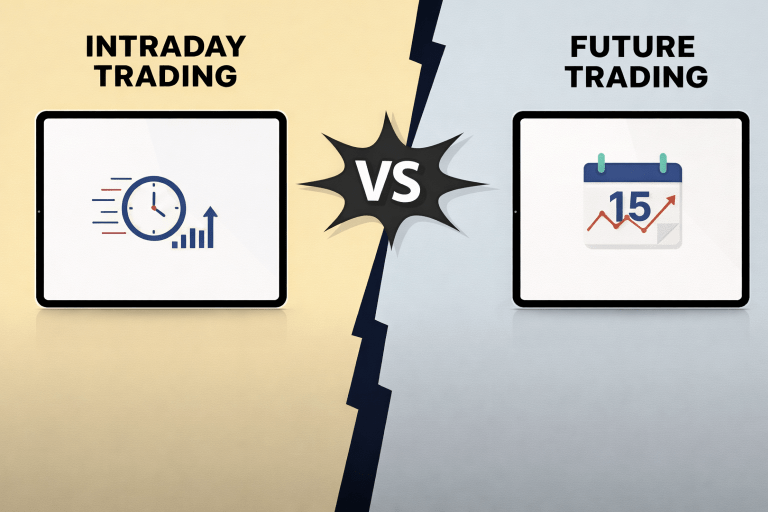
Intraday Trading vs Future Trading – A Common Trader Dilemma
One of the most common questions faced by new and active traders in the Indian stock market is: Which is better, intraday trading or future trading? The confusion is understandable. Both intraday and futures trading are popular, both involve leverage, and both are widely discussed across trading communities. However, many traders choose between them without fully understanding how different these two trading styles actually are.
At first glance, intraday trading may appear simpler because positions are closed on the same day, while future trading seems more complex due to margins, expiries, and overnight risks. On the other hand, some traders feel futures trading is “easier” because it allows more time for trades to work out, unlike intraday trading, which demands constant attention.
The truth is that neither intraday nor future trading is universally better. The right choice depends on several personal factors such as:
- Available capital
- Risk appetite
- Time commitment
- Emotional discipline
- Trading experience
Many traders struggle not because they choose the wrong market direction, but because they choose the wrong trading style for their personality and circumstances. This article aims to solve that exact problem.
By the end of this article, you will clearly understand:
- What is intraday trading
- What is future trading
- The difference between intraday & future trading
- Advantages and disadvantages of intraday trading
- Advantages and disadvantages of future trading
- Which trading style suits which type of trader
The goal is not to promote one over the other, but to help you make an informed and practical decision.
Traders who prefer holding positions for a few days rather than exiting the same day can also explore Stocks Options to Buy for 5 days where trades are typically planned for a 3–5 day timeframe based on momentum and trend confirmation.
What Is Intraday Trading?
To understand the debate of intraday vs future trading, we must first clearly define each.
Intraday trading refers to buying and selling stocks, indices, or other instruments within the same trading day. All positions must be squared off before market close. Traders do not carry intraday positions overnight.
How Intraday Trading Works in India
In the Indian stock market, intraday traders attempt to profit from small price movements during market hours. These movements may be driven by:
- Market opening momentum
- News flows
- Technical breakouts
- Index movements
For example, if a trader buys a stock at ₹500 in the morning and sells it at ₹505 within a few hours, the ₹5 difference becomes the profit (before costs). The same applies to losses if the price moves against the trader.
Key Characteristics of Intraday Trading
- Trades are short-term and time-bound
- Leverage is provided by brokers in the form of intraday margin
- Profits and losses are realised the same day
- No exposure to overnight news or global events
Intraday trading is often chosen by traders who enjoy fast-paced decision-making and want to remain active in the markets without carrying positions beyond the trading session.
Advantages and Disadvantages of Intraday Trading
Understanding the advantages and disadvantages of intraday trading is crucial before deciding if it suits you.
Advantages of Intraday Trading
- No Overnight Risk
One of the biggest advantages of intraday trading is that positions are closed before the market shuts. This protects traders from overnight risks such as:
- Global market volatility
- Geopolitical events
- Unexpected corporate announcements
For traders who prefer certainty and dislike uncertainty outside market hours, this is a major benefit.
- Lower Capital Requirement
Intraday trading generally requires less capital because brokers provide higher leverage for same-day trades. A trader can take positions worth several times their actual capital, making intraday trading accessible even with limited funds. - Faster Profit Booking
Intraday traders do not wait days or weeks for trades to work out. Profits, if any, are realised within hours. This quick feedback loop appeals to traders who prefer immediate results.
Disadvantages of Intraday Trading
- High Emotional Pressure
Intraday trading demands quick decisions under pressure. Prices fluctuate rapidly, and small delays can turn profits into losses. This often leads to emotional trading, especially for beginners. - Requires Constant Monitoring
Intraday trading is not a “set and forget” approach. Traders must actively monitor charts, prices, and orders throughout the trading session. This makes it unsuitable for those with full-time jobs or limited screen time. - Transaction Costs Add Up
Frequent buying and selling result in higher brokerage, taxes, and slippage. Over time, these costs can significantly impact profitability, especially for traders who overtrade.
What Is Future Trading?
To fairly assess intraday vs future trading, it is essential to understand what is future trading.
Future trading involves buying or selling a futures contract, which is an agreement to transact an underlying asset (stock or index) at a predetermined price on a future date. Unlike intraday trades, futures positions can be held for multiple days or even weeks, up to the contract’s expiry.
How Futures Trading Works in India
In India, futures contracts are available on:
- Indices like Nifty 50 and Bank Nifty
- Select stocks approved by exchanges
When a trader enters a futures trade, they do not pay the full contract value. Instead, they deposit a margin amount, which is a percentage of the contract value. Profits and losses are adjusted daily through mark-to-market settlement.
Nature of Futures Trading
- Futures involve obligation, not choice
- Positions can be carried overnight
- Leverage amplifies both gains and losses
- Contracts have fixed expiry dates
Futures trading is often preferred by traders who follow market trends rather than intraday price noise.
Advantages and Disadvantages of Future Trading
Understanding the advantages and disadvantages of future trading helps traders assess whether it aligns with their trading style.
Advantages of Future Trading
- Ability to Capture Larger Price Moves
Unlike intraday trading, futures trading allows traders to hold positions over several days. This makes it possible to benefit from sustained trends rather than just short-term fluctuations. - Suitable for Trend-Based Strategies
Traders who rely on technical trends, macroeconomic cues, or sectoral momentum often prefer futures. These strategies need time to play out, which futures trading provides. - Less Impact of Intraday Noise
Intraday price fluctuations caused by short-term volatility are less relevant for futures traders. This reduces the need for constant monitoring and helps traders stay focused on the bigger picture.
Disadvantages of Future Trading
- Overnight and Event Risk
Futures positions are exposed to risks arising outside market hours. Global events, policy announcements, or unexpected news can lead to sharp price gaps at market open. - Higher Capital and Margin Requirement
Compared to intraday trading, futures require higher margins. This makes futures trading less accessible for traders with very limited capital. - Requires Strong Risk Management
Because futures involve obligation and leverage, losses can accumulate quickly if trades go wrong. Strict stop-loss discipline is essential.
Difference Between Intraday & Future Trading
To clearly understand the difference between intraday & future trading, a structured comparison is essential.
|
Aspect |
Intraday Trading |
Future Trading |
|---|---|---|
|
Time Horizon |
Same trading day |
Multiple days or weeks |
|
Overnight Risk |
None |
Present |
|
Capital Required |
Lower |
Higher |
|
Margin Usage |
Higher intraday leverage |
Regulated margins |
|
Stress Level |
High |
Moderate |
|
Monitoring |
Constant |
Periodic |
|
Suitable For |
Short-term, active traders |
Trend-following traders |
This comparison highlights that the two are fundamentally different, despite both being leveraged forms of trading.
Intraday vs Future Trading: Which Is Better for You?
The real answer to which is better, intraday or future trade depends on who you are as a trader.
Choose Intraday Trading If:
- You prefer short-term opportunities
- You can actively monitor markets during trading hours
- You want to avoid overnight risk
- You are comfortable with fast decision-making
Intraday trading suits traders who enjoy action, speed, and daily participation in the market.
Choose Future Trading If:
- You follow market trends and macro news
- You can hold positions for several days
- You prefer less screen time
- You have disciplined risk management
Futures trading suits traders who value patience, structure, and trend-based strategies.
Practical Trading Opportunities and Strategy Alignment
Choosing between intraday and futures should also depend on the kind of opportunities you want to trade.
Short-term traders often focus on momentum-based setups, while futures traders look for broader market alignment. Understanding this alignment helps traders avoid strategy mismatch.
Platforms like Samco focus on enabling traders to align instruments with strategy rather than chasing instruments blindly.
Common Mistakes Traders Make
Many traders fail not because of the market, but because of avoidable mistakes.
- Choosing Intraday Without Discipline
Intraday trading without a clear plan leads to impulsive decisions and overtrading. - Using Futures Without Understanding Leverage
Many traders underestimate how quickly futures losses can grow due to leverage. - Ignoring Stop-Losses
Both intraday and futures trading demand strict stop-loss usage. Ignoring risk management is one of the fastest ways to lose capital. - Overtrading Due to Margin Availability
Easy access to leverage often tempts traders to trade excessively, leading to emotional fatigue and losses.
Conclusion: Intraday or Futures – Focus on Strategy, Not Hype
The debate of intraday vs future trading has no universal winner. Neither intraday trading nor future trading is inherently better or worse. Each serves a different purpose and suits a different type of trader.
Intraday trading offers speed, lower capital requirements, and freedom from overnight risk, but demands constant attention and emotional control. Future trading offers the ability to ride trends and avoid intraday noise, but requires patience, higher capital, and disciplined risk management.
The key takeaway is simple: choose the trading style that aligns with your capital, time availability, risk tolerance, and temperament. When strategy and personality are aligned, consistency becomes achievable.
Successful traders focus less on hype and more on suitability. That mindset, more than the instrument itself, determines long-term success in the Indian stock market.