


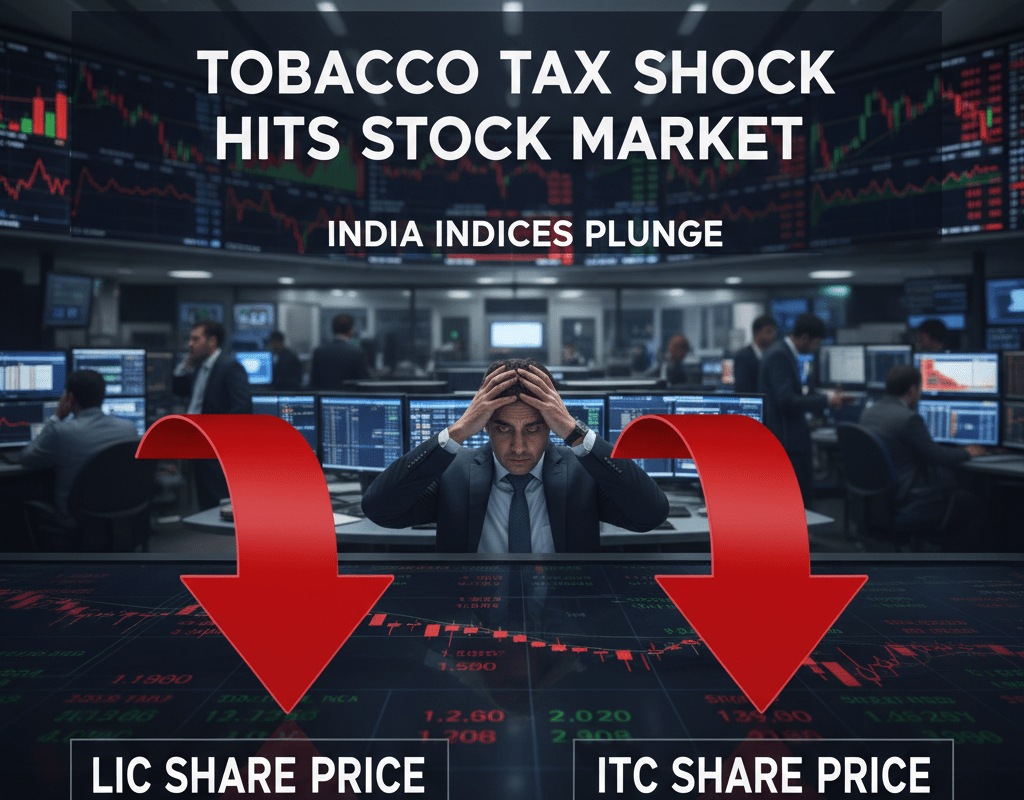
Market Performance: A Rough Start to the Year
The stock market today opened the new year on an uneasy note, and ITC share price stood right at the centre of the storm.
Within just two trading sessions, ITC shares slipped 14%, marking one of the sharpest short-term falls the stock has seen in recent years.
This sharp move erased nearly ₹72,300 crore of investor wealth. For a stock long seen as a steady heavyweight, the fall came fast and caught many off guard.
At the same time, the impact rippled beyond ITC alone. LIC share price exposure to ITC turned costly, dragging down the value of one of its largest equity holdings.
Main News: Tobacco Tax Hike Sparks Sudden Sell-Off
The trigger was clear and immediate.
Late Wednesday night, the government announced a steep hike in excise duty on tobacco products. The new levy ranges between ₹2,050 and ₹8,500 per 1,000 cigarette sticks, depending on cigarette length.
This comes over and above the 40% GST, both set to take effect from February 1.
Markets reacted without hesitation.
- ITC stock recorded a 10% fall in a single session, its worst one-day drop in nearly six years
- The decline extended further, with the stock sliding another 5%
- ITC touched a fresh 52-week low of ₹345.25 on the NSE
For investors, the message was simple: higher taxes mean pressure on pricing, volumes, and near-term earnings visibility.
LIC and ITC Share Price Connection: Big Holding, Bigger Impact
The fall in ITC share price directly hit LIC, India’s largest domestic institutional investor.
As of the September quarter, LIC holds:
- 1,98,58,07,233 shares of ITC
- A 15.86% stake in the company
Over just two days, the value erosion on this holding crossed ₹11,460 crore.
While this does not change LIC’s long-term ownership status, the scale of the mark-to-market loss highlights how closely LIC and ITC share price movements are linked.
Why the Market Reacted So Sharply?
Cigarettes remain ITC’s single largest profit contributor.
Any sudden change in taxation immediately alters how the market views future cash flows.
Here’s what spooked investors:
- Higher excise + higher GST starting the same date
- Pressure on companies to raise prices to protect margins
- Risk that higher prices could impact demand and volumes
In past instances of sharp cigarette tax hikes, volume declines have followed. That historical memory played on investor sentiment during the sell-off.
The result was swift profit-booking and defensive exits, especially from large institutional positions.
Stock Market Today: Sentiment Over Fundamentals
What stood out in this move was the speed, not just the size.
There was no gradual reassessment. The selling was immediate and broad-based, driven by sentiment rather than balance sheet changes.
The stock market today reflected a classic reaction to policy risk:
- Sudden regulatory announcement
- Uncertainty around pricing power
- Immediate repricing of the stock
In such moments, markets often choose caution first and clarity later.
Company Details: ITC’s Position in Focus
ITC has long been viewed as a defensive blue-chip, supported by:
- Strong cigarette business cash flows
- Diversified FMCG presence
- Institutional-heavy shareholding
But the recent move shows that even mature, stable companies are vulnerable to policy shocks—especially when core revenue streams are involved.
For LIC, the exposure reflects its long-standing role as a large, passive shareholder rather than a short-term trader.
Summary: What This Means for Investors?
The sharp fall in LIC and ITC share price underscores how quickly market sentiment can shift when regulatory changes enter the picture.
In simple terms:
- ITC shares fell 14% in two days
- Investor wealth erosion stood at nearly ₹72,300 crore
- LIC alone saw over ₹11,460 crore wiped off its ITC holding
- The trigger was a sharp tobacco excise duty hike, effective February 1
As the stock market today digests this development, the focus remains firmly on how higher taxes reshape the near-term outlook for tobacco-led businesses—without adding any expectations, forecasts, or recommendations.
For now, the story is about numbers, policy, and how fast sentiment can turn when certainty disappears.




 Easy & quick
Leave A Comment?