

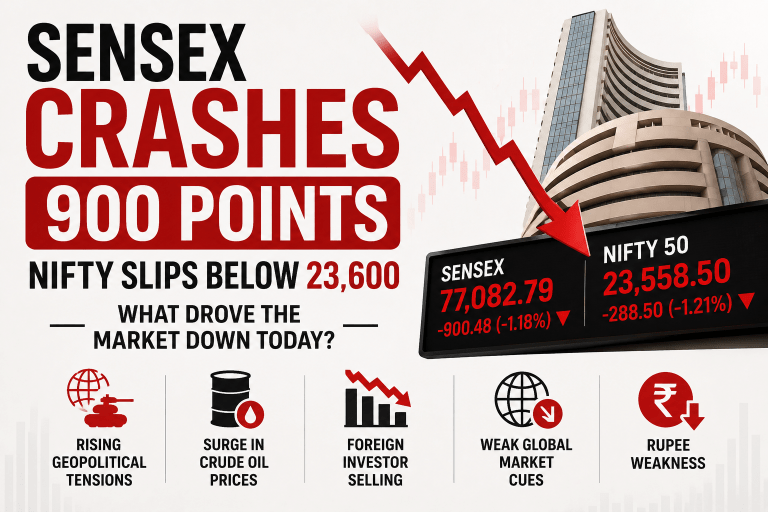
The Indian stock market witnessed a sharp correction as the BSE Sensex plunged more than 900 points while the Nifty 50 slipped below the crucial 23,600 mark. The broad-based sell-off wiped out significant investor wealth and triggered concerns among retail investors regarding the near-term outlook of Indian equities.
The market decline was not driven by a single factor. Instead, a combination of rising geopolitical tensions, surging crude oil prices, foreign institutional investor (FII) selling, global market weakness, and concerns about inflation contributed to the sharp fall.
While sudden market corrections often create panic among investors, understanding the reasons behind the decline can help investors make informed decisions rather than reacting emotionally.
How Much Did Sensex and Nifty Fall?
During the trading session, the benchmark indices witnessed heavy selling pressure across sectors.
Market Performance Highlights
- Sensex declined over 900 points
- Nifty 50 slipped below 23,600
- Banking and financial stocks led the decline
- IT, Auto and Metal stocks witnessed significant selling
- Mid-cap and small-cap stocks also came under pressure
The weakness was visible across the broader market, indicating a risk-off sentiment among investors.
Why Did the Stock Market Crash Today?
Several factors combined to trigger the sharp decline in Indian equities.
1. Rising Geopolitical Tensions
One of the biggest reasons behind the market fall was increasing geopolitical uncertainty in the Middle East.
Global investors tend to avoid risky assets during periods of geopolitical instability. Escalating tensions raise concerns about disruptions in global trade, energy supplies, and economic growth.
As uncertainty rises, investors often shift funds towards safer assets such as gold, government bonds, and the US dollar, leading to selling in equity markets.
This risk-averse sentiment was visible across global markets and also impacted Indian stocks.
2. Crude Oil Prices Continue to Rise
Crude oil remains one of the most important factors affecting the Indian economy.
India imports nearly 85% of its crude oil requirements. When oil prices rise sharply, several challenges emerge:
- Higher fuel costs
- Increased transportation expenses
- Rising inflation
- Pressure on corporate profit margins
- Larger import bills
Investors worry that sustained increases in crude oil prices can slow economic growth and reduce corporate earnings.
As a result, rising crude prices often lead to negative sentiment in Indian equity markets.
3. Foreign Institutional Investors Turn Sellers
Foreign Institutional Investors (FIIs) play a crucial role in determining market direction.
Recent data indicates that FIIs have been reducing exposure to Indian equities amid global uncertainty and valuation concerns.
When FIIs sell large quantities of shares:
- Market liquidity decreases
- Large-cap stocks face pressure
- Investor confidence weakens
- Market volatility increases
Banking, financial services, and large-cap stocks generally witness the highest impact from sustained FII selling.
4. Weak Global Market Cues
Indian markets are increasingly integrated with global financial markets.
Negative sentiment across international markets often influences domestic investor behaviour.
Concerns around:
- Global economic slowdown
- Rising interest rates
- Inflationary pressures
- Geopolitical risks
have created uncertainty among investors worldwide.
Weakness in Asian and European markets further contributed to selling pressure in Indian equities.
5. Profit Booking After Recent Rally
Markets had witnessed a strong rally over the past few months.
Whenever indices reach elevated levels, investors often book profits to protect gains.
Profit booking becomes more aggressive when external risks increase.
Many traders preferred reducing exposure rather than carrying positions amid uncertainty, accelerating the market decline.
Which Sectors Were Hit the Most?
The selling pressure was widespread, but certain sectors witnessed deeper corrections.
Banking Stocks
Banking shares contributed significantly to the decline in benchmark indices.
Investors remained cautious due to:
- Rising global uncertainty
- Foreign investor selling
- Concerns over economic growth
Major private and public sector banks faced heavy pressure.
IT Stocks
Information Technology stocks declined due to concerns regarding global economic growth.
A slowdown in developed markets such as the United States and Europe could impact future technology spending.
As a result, investors trimmed positions in IT companies.
Auto Sector
Automobile stocks came under pressure as higher crude oil prices raise concerns about:
- Consumer spending
- Vehicle demand
- Operating costs
The sector remains sensitive to inflation and interest-rate expectations.
Metal Stocks
Metal companies witnessed selling due to concerns over slowing global industrial activity and weaker commodity demand.
Mid-Cap and Small-Cap Stocks
Riskier segments of the market often witness sharper declines during volatile periods.
Many mid-cap and small-cap stocks corrected significantly as investors moved towards safety.
How Does Rising Crude Oil Impact Indian Markets?
The relationship between crude oil prices and Indian markets is extremely important.
When oil prices rise:
Inflation Increases
Fuel costs impact transportation, logistics, manufacturing, and consumer goods.
This eventually leads to higher inflation.
Corporate Margins Come Under Pressure
Companies face rising operational costs.
Unless businesses can pass these costs to customers, profit margins may decline.
Currency Weakness
Higher oil imports increase demand for dollars, putting pressure on the Indian rupee.
Interest Rate Concerns
Persistent inflation could force central banks to maintain tighter monetary policies.
These factors collectively affect investor sentiment and stock market performance.
Should Investors Be Worried?
Market corrections are a normal part of investing.
Historically, Indian markets have experienced multiple periods of volatility caused by:
- Global financial crises
- Geopolitical events
- Inflation shocks
- Economic slowdowns
- Interest-rate cycles
However, long-term investors who remain focused on quality businesses often benefit from market recoveries.
Instead of reacting emotionally, investors should evaluate:
- Company fundamentals
- Earnings growth
- Valuation levels
- Long-term business prospects
What Should Investors Do During a Market Fall?
Avoid Panic Selling
Selling quality investments solely because markets are falling can lead to poor long-term outcomes.
Review Portfolio Allocation
Investors should assess whether their portfolios remain aligned with their financial goals.
Focus on Fundamentals
Companies with strong earnings, healthy balance sheets, and competitive advantages often recover faster.
Continue SIP Investments
For mutual fund investors, systematic investment plans (SIPs) can help average purchase costs during volatile periods.
Maintain Cash for Opportunities
Market corrections often create opportunities to accumulate fundamentally strong stocks at attractive valuations.
What Could Drive Market Recovery?
Several factors could help markets stabilize:
- Easing geopolitical tensions
- Cooling crude oil prices
- Return of foreign investor inflows
- Strong corporate earnings
- Positive economic data
- Stable inflation trends
Investors will closely monitor these developments over the coming weeks.
Outlook for Indian Stock Markets
Despite short-term volatility, India’s long-term growth story remains intact.
Factors supporting long-term market growth include:
- Strong domestic consumption
- Infrastructure spending
- Digital transformation
- Manufacturing growth
- Rising retail participation
- Favourable demographic trends
While near-term fluctuations may continue, long-term investors often focus on economic fundamentals rather than daily market movements.
Conclusion
The sharp decline in Sensex and Nifty was driven by a combination of rising geopolitical tensions, higher crude oil prices, FII selling, weak global cues, and profit booking. Although the correction created concerns among investors, such periods of volatility are common in equity markets.
Investors should avoid making decisions based solely on short-term market movements and instead focus on long-term financial goals, portfolio quality, and disciplined investing. Monitoring crude oil prices, foreign investor activity, and global developments will remain crucial for understanding the market’s next move.
FAQs
Why did Sensex fall 900 points today?
Sensex declined due to rising geopolitical tensions, higher crude oil prices, foreign investor selling, weak global cues, and profit booking.
Why did Nifty fall below 23,600?
Broad-based selling across banking, financial, IT, and auto stocks pushed the Nifty below the 23,600 level.
How do crude oil prices affect the stock market?
Higher crude oil prices can increase inflation, pressure corporate earnings, weaken the rupee, and negatively impact investor sentiment.
Should investors sell during a market crash?
Investors should evaluate their financial goals and portfolio fundamentals before making decisions. Panic selling may not always be beneficial for long-term wealth creation.
Which sectors were most affected?
Banking, IT, auto, metals, and broader mid-cap and small-cap segments witnessed significant selling pressure.