


The Indian equity market ended the calendar year 2025 on a positive note, with the BSE Sensex delivering a return of 9.06%. This achievement marks a historic milestone—the 10th consecutive year of positive annual closing for India’s benchmark index, making it the longest winning streak in Sensex history. As investors look ahead to 2026, an important question emerges: Can the Sensex extend this remarkable run, or is a phase of consolidation due?
This article explores the Sensex’s decade-long performance, the significance of odd–even year trends, key sectoral rotations in 2025, and what historical patterns may indicate for 2026.
Sensex Performance in 2025: A Decade-Defining Close
Sharp sectoral rotations and uneven market participation characterised the year 2025. While headline indices posted steady gains, leadership shifted frequently across sectors, reflecting changing macroeconomic expectations and global developments.
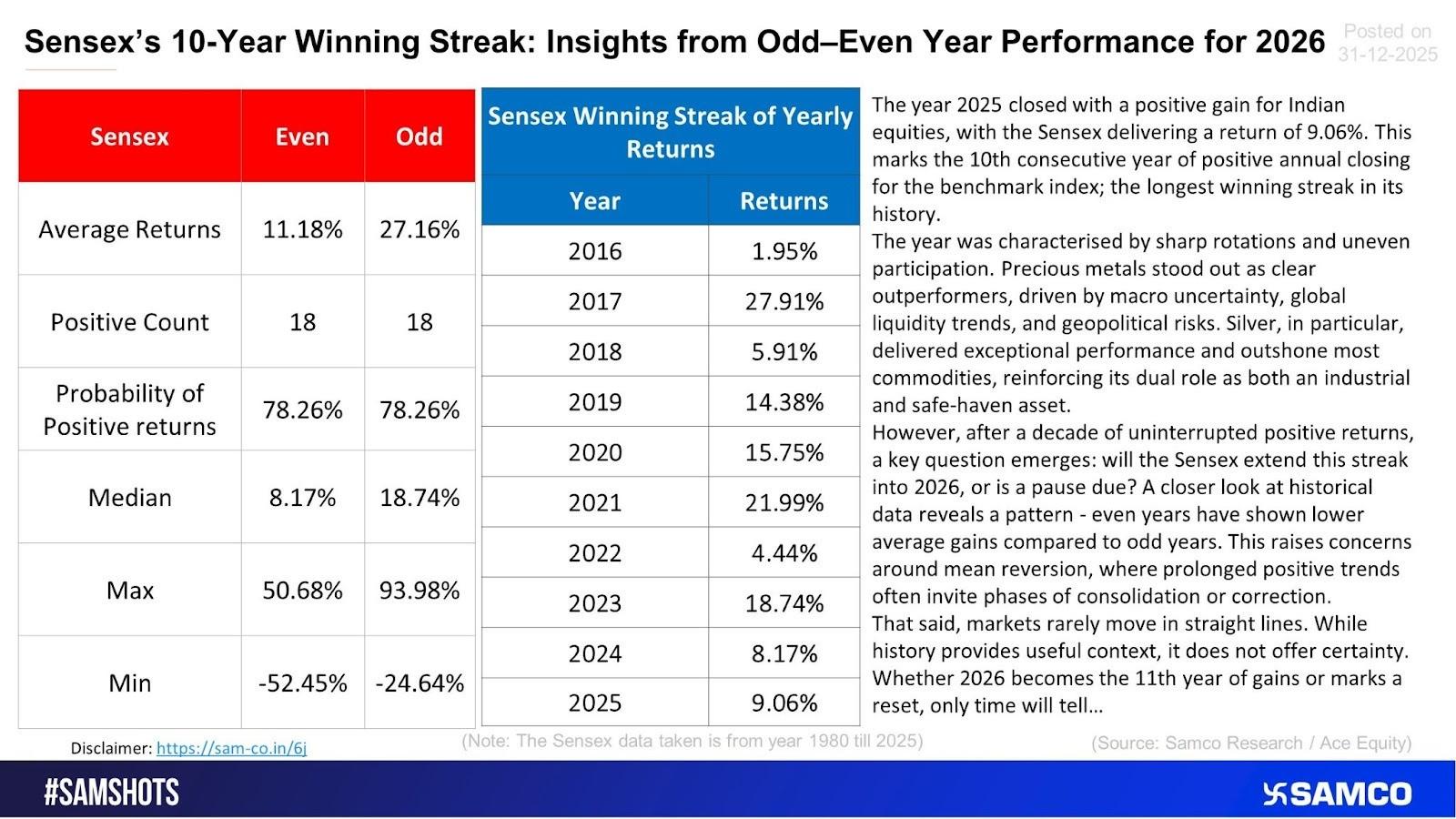
Despite these rotations, the Sensex closed the year with a 9.06% annual gain, reinforcing the broader structural strength of Indian equities. This performance capped a full decade of uninterrupted positive returns, highlighting the resilience of the Indian market through multiple global and domestic challenges.
Sectoral Trends in 2025: Precious Metals Take the Lead
One of the standout themes of 2025 was the strong outperformance of precious metals, driven by:
- Global macroeconomic uncertainty
- Shifting liquidity conditions
- Persistent geopolitical risks
Among commodities, silver emerged as a clear outperformer, outperforming most asset classes. Its rally reinforced silver’s dual role as an industrial metal and a safe-haven asset, benefiting from both manufacturing demand and defensive investor positioning.
Equities, meanwhile, showed selective strength rather than broad-based rallies, reflecting a more cautious and valuation-sensitive market environment.
Understanding the Odd–Even Year Pattern in Sensex Returns
A deeper analysis of long-term Sensex data (1980–2025) reveals an interesting historical pattern based on odd and even calendar years:
- Odd years have historically delivered higher average returns
- Even years tend to show relatively lower average gains
- The probability of positive returns, however, remains broadly similar across both
This pattern becomes particularly relevant as markets enter 2026—an even year—following an extended period of positive momentum.
What This Means for 2026?
After ten consecutive years of gains, markets naturally face the risk of mean reversion. Prolonged uptrends often lead to:
- Periods of consolidation
- Sideways movement
- Temporary corrections
Historically, even years have coincided with more moderate returns, raising the possibility that 2026 may see slower growth compared to recent years, rather than a sharp reversal.
Mean Reversion vs Structural Strength
While historical data offers valuable context, it does not guarantee outcomes. Markets rarely move in straight lines, and India’s long-term structural growth story remains intact, supported by:
- Strong domestic consumption
- Ongoing capital expenditure cycles
- Policy reforms and fiscal discipline
- Expanding participation from retail and institutional investors
Therefore, any consolidation in 2026 should be viewed through the lens of healthy market digestion, rather than a breakdown of the long-term trend.
Will Sensex Extend Its Winning Streak into 2026?
The key takeaway for investors is balance. While the odds of moderated returns or consolidation appear higher based on historical odd–even patterns, this does not necessarily imply negative performance.
- If earnings growth sustains and global conditions stabilise, the Sensex could still post gains, albeit at a slower pace.
- If volatility rises, markets may pause to recalibrate valuations before resuming their upward trajectory.
Whether 2026 marks the 11th consecutive year of gains or a temporary reset, the long-term outlook for Indian equities remains constructive.
Conclusion
The Sensex’s 10-year winning streak is a testament to the resilience and maturity of Indian equity markets. While historical trends suggest that even years like 2026 may deliver relatively lower returns compared to odd years, they also highlight that positive outcomes remain statistically probable.
For investors, the focus should remain on risk management, asset allocation, and long-term fundamentals, rather than short-term calendar-based predictions. History provides guidance, but in markets, certainty is never guaranteed.





 Easy & quick
Leave A Comment?