



The sharp decline in tobacco stocks following the February 2025 tax announcement has raised serious concerns among investors and market participants. Stocks such as ITC and Godfrey Phillips witnessed steep corrections of nearly 9% and 17%, respectively. The sell-off reflects fears of a significant structural shift in India’s cigarette taxation regime, which could negatively impact volumes, industry profitability, and government revenues.
What Triggered the Sell-Off in Tobacco Stocks?
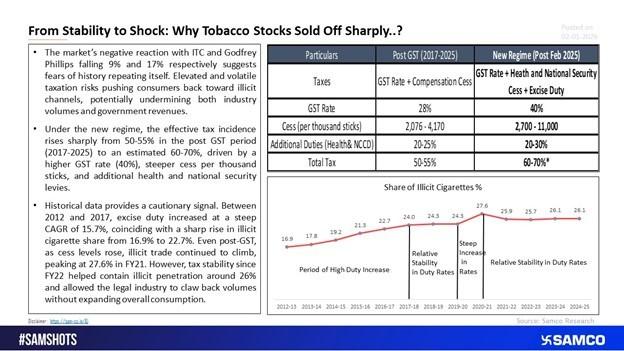
The primary trigger was a material increase in effective cigarette taxation under the new post-2025 tax framework. During the post-GST period from 2017 to 2025, the effective tax incidence on cigarettes remained relatively stable at around 50–55%. However, under the new regime, this figure is estimated to rise sharply to 60–70%.
This increase is driven by:
- A higher GST rate of 40%
- Steeper cess per thousand sticks
- Additional health and national security levies
This marks a clear departure from the relative tax stability seen over the past four years, which had played a crucial role in supporting volume recovery and revenue growth for the legal cigarette industry.
Historical Evidence Raises Red Flags
History suggests that aggressive taxation on cigarettes often leads to unintended consequences. Between 2012 and 2017, excise duties rose at a steep CAGR of 15.7%, during which the illicit cigarette market expanded significantly, with its share increasing from 16.9% to 22.7%.
Even after the introduction of GST, rising cess levels continued to push consumers toward illegal channels. Illicit cigarette penetration peaked at 27.6% in FY21, highlighting how excessive taxation can undermine both industry volumes and tax collections.
Why Tax Stability Matters?
From FY22 onwards, a period of relative tax stability helped:
- Contain illicit trade at around 26%
- Enable the legal cigarette industry to recover lost volumes
- Improve compliance without increasing overall consumption
This stability also resulted in strong fiscal outcomes, with cigarette tax revenues growing at a healthy CAGR of 10.7% between FY21 and FY25. The recent tax shock now threatens to reverse these gains.
Market Concerns: Déjà Vu for Investors?
The market’s negative reaction suggests that investors fear a repeat of past mistakes. Elevated and volatile taxation increases the risk of:
- Consumers shifting back to illicit products
- Declining legal industry volumes
- Weaker long-term government revenue collection
Past data consistently shows that sharp tax hikes lead to sub-optimal revenue outcomes, whereas moderate and predictable taxation encourages better compliance, healthier industry economics, and sustained fiscal growth.
Outlook for Tobacco Stocks
While tobacco companies remain fundamentally strong, the sudden shift in taxation policy introduces uncertainty. If high tax rates persist without adequate enforcement against illicit trade, both the industry and the exchequer could face long-term challenges.
For investors, the key variables to watch include:
- Government stance on tax predictability
- Measures to curb illicit cigarette trade
- Volume trends in the legal cigarette segment
Conclusion
The sell-off in tobacco stocks is not just a knee-jerk market reaction—it reflects deeper structural concerns around taxation policy and its long-term implications. History clearly indicates that stability, not shock, delivers better outcomes for industry, consumers, and government revenues alike. Whether policymakers recalibrate their approach will be crucial in determining the future trajectory of tobacco stocks in India.