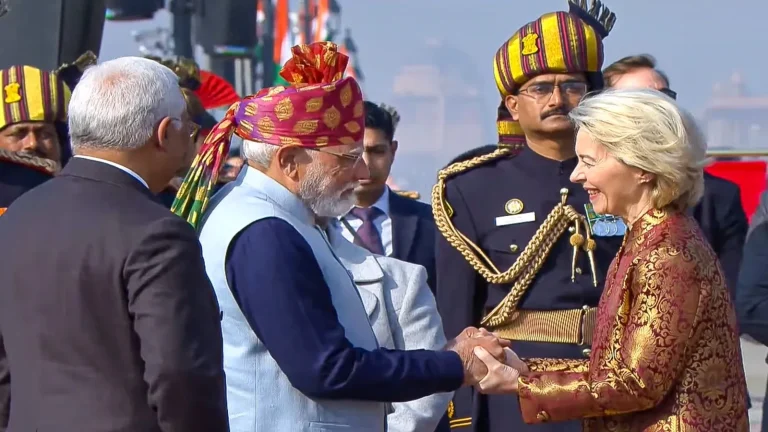
The India–EU free trade agreement is finally done.
After nearly two decades of on-and-off talks, India and the European Union have locked in a long-awaited trade pact—marking a key shift in India’s global trade strategy.
Markets have taken note. So has the global policy circle.
While the agreement directly reshapes India–EU trade flows, the bigger conversation now revolves around what this could mean for other stalled trade negotiations—especially between India and the United States.
Market Performance: Why Trade Deals Matter to Investors?
Trade agreements don’t move markets overnight.
But they change the direction of long-term capital flows.
The India–EU free trade agreement has strengthened confidence around India’s willingness to engage in broader, rules-based global trade frameworks. For market participants, this is less about instant gains and more about visibility, access, and policy clarity over time.
Investor attention, however, hasn’t shifted away from the bigger unresolved piece—the India–US trade equation.
Main News: India–EU Free Trade Agreement in Focus
India and the European Union have entered into a comprehensive free trade agreement, opening Indian markets further to European goods and deepening economic cooperation.
This agreement brings together two major economic blocs:
- The European Union, which contributes around 25% of global GDP
- And accounts for nearly 33% of global trade
For India, the EU already ranks among its largest trading partners. The new framework is expected to strengthen cooperation across multiple policy areas, including:
- Trade
- Security
- Defence
From a global standpoint, the agreement signals a clear intent—India is moving beyond a defensive trade posture and embracing broader economic integration.
Why the Spotlight Has Shifted to India–US Trade Talks?
With the India–EU free trade agreement finalised, market discussions have naturally turned toward the long-pending India–US trade deal.
The United States remains India’s largest trade partner, according to available reports. A deal between the two has been discussed repeatedly over the years, with several rounds of negotiations already completed—yet no final agreement so far.
The logic many are debating is simple:
If India could close a complex deal with the EU, does it increase the odds of progress with the US?
So far, the answer remains uncertain.
What’s Holding Back the India–US Trade Deal?
Unlike India–EU relations, India’s trade relationship with the US follows a different structure.
Key sticking points include:
- Greater market access for agriculture
- Pricing and access issues around medical devices
- Digital trade rules
- Labour and environmental standards
At the same time, India has maintained its position on protecting domestic sectors, particularly agriculture, while reiterating that national interest remains the priority.
Adding another layer of complexity, tariffs continue to play a central role in US trade policy. Recent developments have shown that trade decisions are often influenced by broader geopolitical considerations rather than economics alone.
Company & Economy-Level Implications
While the agreement is not company-specific, its impact cuts across sectors tied to exports, imports, logistics, and global supply chains.
At a broader level, the India–EU free trade agreement sends out a clear signal:
- India is open to comprehensive trade frameworks
- Policy direction is becoming more outward-looking
- Long-term economic positioning is being prioritised
For global counterparts, it highlights India’s growing role in shaping multi-country trade relationships.
How This Deal Changes the Bigger Picture?
Even as attention stays on the India–US trade deal, the EU agreement stands on its own significance.
It reflects:
- A strategic shift in India’s trade approach
- Willingness to engage with large economic blocs
- Recognition of evolving global trade dynamics
At the same time, whether this agreement accelerates or complicates negotiations with other partners—particularly the US—will depend on how geopolitical, economic, and sectoral factors evolve going forward.
Summary: What Investors Should Take Away?
The India–EU free trade agreement marks a major policy milestone after nearly 20 years of negotiations.
Key takeaways:
- India and the EU have formalised a comprehensive trade pact
- The EU represents 25% of global GDP and 33% of global trade
- The agreement strengthens India’s global trade positioning
- Market focus now shifts to whether this momentum spills over into stalled India–US talks
- Structural differences and unresolved issues continue to delay a US deal
For now, the India–EU agreement stands as a clear signal of intent—India is steadily redefining its place in the global trade order.
Source: Livemint