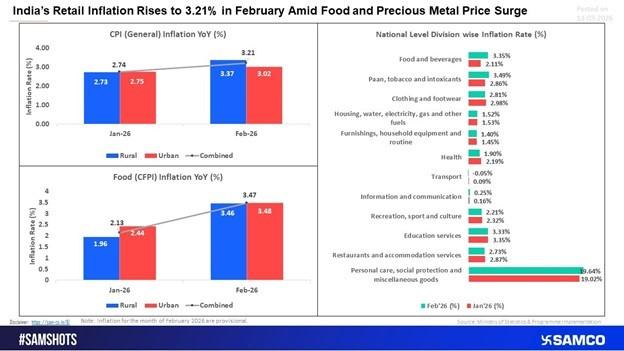
India’s retail inflation, measured by the Consumer Price Index (CPI), increased to 3.21% year-on-year in February 2026, compared to 2.74% in January, marking a 47 basis-point rise on a sequential basis. Despite the uptick, inflation remains comfortably within the Reserve Bank of India (RBI) tolerance band of 2–6%, indicating that price pressures are still broadly under control.
Rural Inflation Outpaces Urban Price Growth
The data shows that inflation pressures were stronger in rural areas than in urban regions.
- Rural inflation: 3.37%
- Urban inflation: 3.02%
This divergence suggests that food price transmission remains stronger in rural markets, where household consumption baskets are more heavily weighted toward essential food items.
Food Inflation Accelerates Sharply
One of the key drivers behind the rise in inflation was the increase in food prices.
Food inflation rose to 3.47% in February, compared to 2.13% in January, reflecting a noticeable acceleration in price pressures. The increase was mainly driven by higher prices of vegetables and key food items such as tomatoes, although some items saw month-on-month corrections.
Food prices remain a crucial component of India’s inflation dynamics due to their significant share in household consumption.
Category-Wise Inflation Trends
At the category level, the inflation trend showed mixed movements across sectors.
Highest Inflation Categories
- Personal care, social protection & miscellaneous goods: 19.6%
- Food & beverages: 3.35%
- Paan, tobacco and intoxicants: 3.49%
Meanwhile, some categories helped offset overall price pressures.
Lower or Negative Inflation Categories
- Transport: -0.05%
- Information & communication: around 0.25%
The decline in transport inflation helped moderate the overall CPI reading.
Inflation Outlook Remains Moderate
Despite the rise in February inflation, overall price pressures remain relatively moderate. Core inflation trends appear stable, indicating balanced demand conditions in the economy.
However, some risks could influence the inflation outlook going forward, including:
- Rising global commodity prices
- Volatility in Crude Oil
- Weather-related fluctuations affecting food supply
What It Means for Policy?
For the Reserve Bank of India, the current inflation level provides policy flexibility, as it remains comfortably within the central bank’s target band.
However, policymakers will likely continue monitoring:
- Food inflation trends
- Energy price movements
- Global commodity market developments
These factors could shape the future trajectory of inflation and interest rate decisions in the coming months.