



Global markets are once again facing a potential macro risk as crude oil prices surge sharply. A near 90% rally in oil over the past year is not just a commodity story—it has historically been a warning signal for equity investors.
Data suggests that when oil prices rise this aggressively, equity markets—especially in the US—tend to struggle in the months that follow.
Oil Surge and Equity Performance: What History Shows
Historical trends indicate a strong inverse relationship between sharp oil rallies and future returns of the S&P 500.
The chart below highlights how sharp spikes in WTI Crude Oil have consistently been followed by weaker equity performance.
📊 Samshot Insight
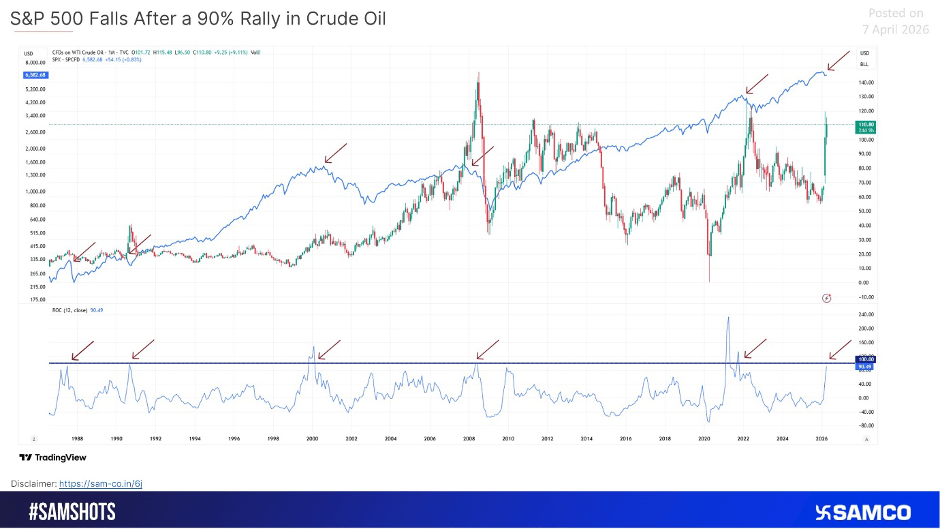
Source: Samco Securities – Oil spikes vs S&P 500 historical performance
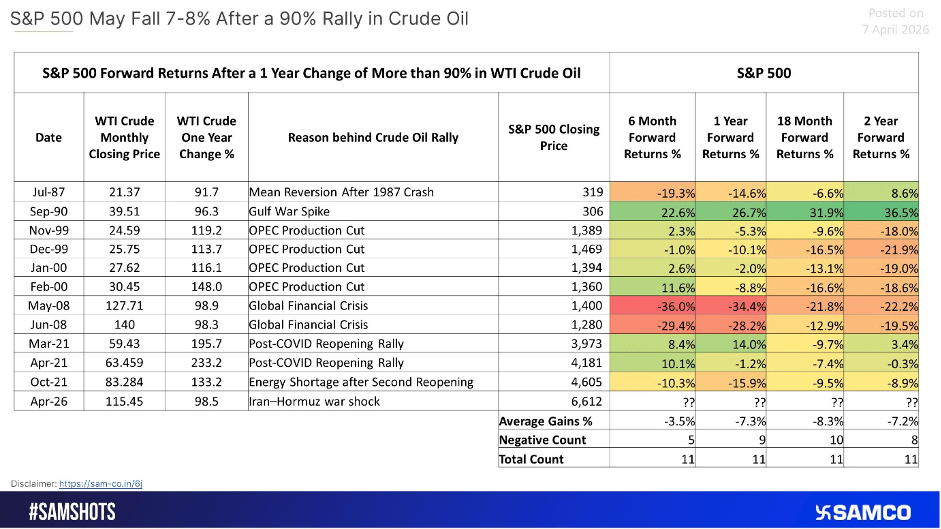
Across 11 similar instances since 1987, markets have consistently delivered weak forward returns after a major spike in crude oil prices.
Average Returns After a 90% Oil Rally:
- 6 Months: -3.5%
- 1 Year: -7.3%
- 18 Months: -8.3%
- 2 Years: -7.2%
How Often Markets Fell:
- Negative returns in 5 out of 11 cases (6 months)
- Negative in 9 out of 11 cases (1 year)
- Negative in 10 out of 11 cases (18 months)
This consistency highlights that sharp oil rallies often precede periods of equity weakness.
Why Rising Oil Prices Hurt Markets
A surge in oil prices acts like a hidden tax on the economy and impacts multiple layers of growth:
- Higher transportation and logistics costs
- Increased manufacturing and input expenses
- Rising inflation expectations
- Pressure on bond yields and interest rates
- Reduced consumer spending power
These factors collectively lead to margin compression and put pressure on stock valuations.
What’s Driving the Current Oil Spike?
The current rally appears to be driven by geopolitical tensions affecting global supply routes. Supply-side disruptions tend to have a deeper and longer-lasting impact compared to demand-driven price increases.
The chart below shows the recent surge in crude oil prices, highlighting the sharp upward momentum triggered by global uncertainties.
📊 Samshot Insight
Source: Samco Securities – Recent crude oil price movement
While the immediate market reaction may not be sharp, history suggests that the real impact often plays out over the next 12 months.
Key Takeaway for Investors
One insight stands out clearly:
When oil prices double, earnings expectations usually don’t.
This mismatch creates valuation pressure, often leading to corrections in equity markets—especially in growth-heavy and global portfolios.
Investors should treat crude oil as a leading macro indicator, not just a commodity trend.
Bottom Line
A near 90% surge in oil prices has historically been followed by a 7–8% decline in the S&P 500 over the next year.
While outcomes may vary, the signal remains consistent:
sharp oil rallies often come with hidden risks for equity investors.